Leaderboard

Popular Content
Showing content with the highest reputation on 03/27/2026 in Posts
-
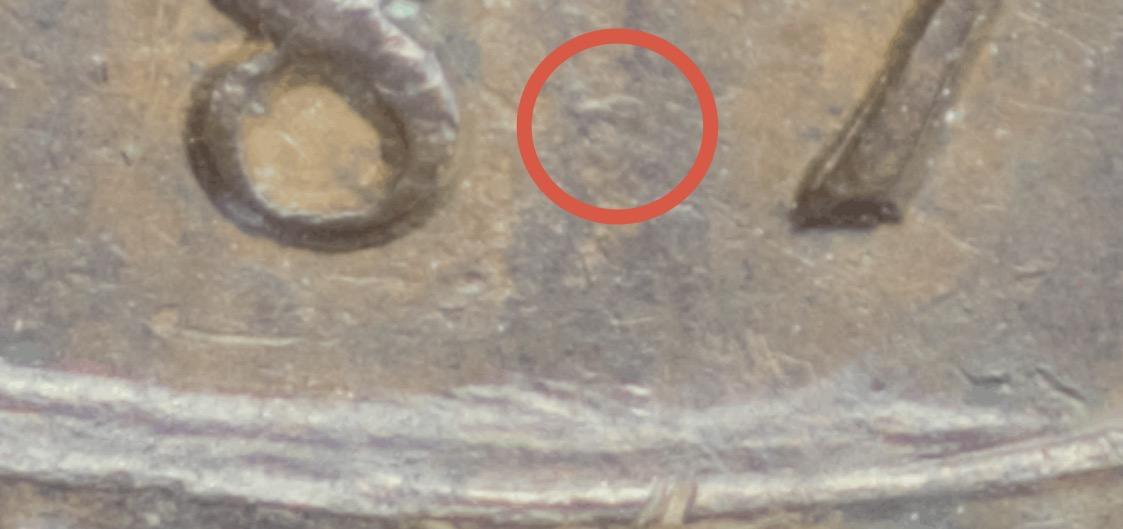
Definitely NOT an H. As you can see from Secret Santa's post above too, the H if present is smaller than the smudge/toning/anomaly you have where the H would be. Many times we all wish the presence of something and convince ourselves from a humble picture that a smudge or blob just might be the magic thing! I myself must have bought over the years half a dozen 1863 pennies with "something" perhaps below the date which just might possibly have been a die number with a fair wind behind. Needless to say of course, none of them were!!2 points
-
I can’t see an H either. I think there may be a blemish in there that the brain may try to interpret as something meaningful, especially if one is looking for it. Like the image of Jesus in a slice of toast or an alien face on Mars.2 points
-
Thank you both for the orders. wlewisiii, I'll sort you out with a PDF of the Irish book over email.2 points
-
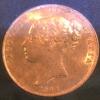
I'm pleased to share with this 1875H coin I have just purchased. (I think the seller missed the H) In your opinion what is the grade please of this coin, my gut feeling is GVF/GVF I'm inexperienced and am a bit lost when it comes to grading. There is rim damage and a few stains, you can also just some some luster around some of the legends. I know the following is only a basic guide but its difficult for me to be sure how the coins grades. 1) VF-20 We start to see all major line in the hair. The thistle and shamrock decorations starts to appear. Clearly readable but lightly worn legends, illustrations show good detail, rims are clean, but the whole coin shows moderate wear on the high points. 2) EF-40 Hair lines are mostly sharp and distinct except above forehead. The rose, thistle and shamrock decorations are visible. Legends are sharp, illustrations are clear with slight but obvious wear on the high points. 3) AU-50 Hair above forehead are visible and dress details are distinct. Sharp legends and illustrations show only a trace of wear on the highest points. There must be some remaining mint luster." Note inside the bottom of the Letter O in One the small flat part which does not appear to be damage. I would be grateful to hear opinions please. Thanks.
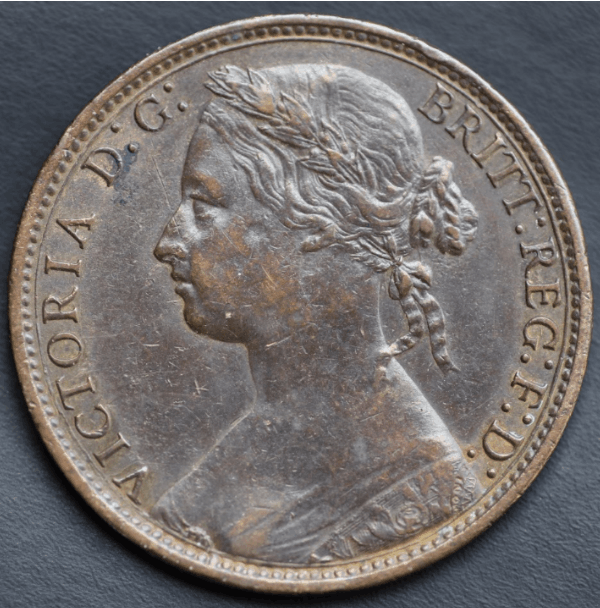
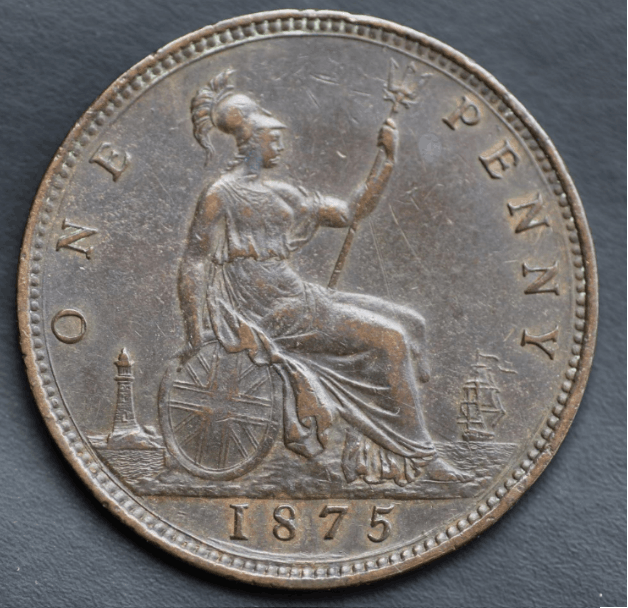 1 point
 -
On a relatively high grade penny like that, the H would show strongly. What you've got there is a ghostly anomaly, and I'd agree - no H1 point
-
I would say it's an F82. The figure 5 is more upright on the 1875H.
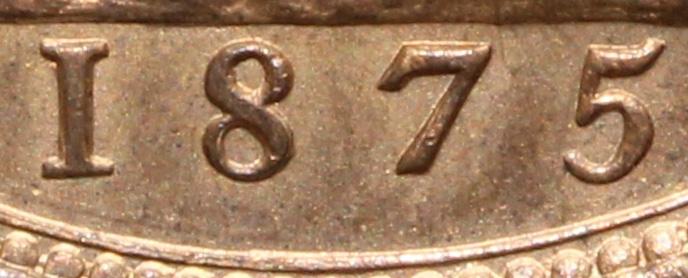
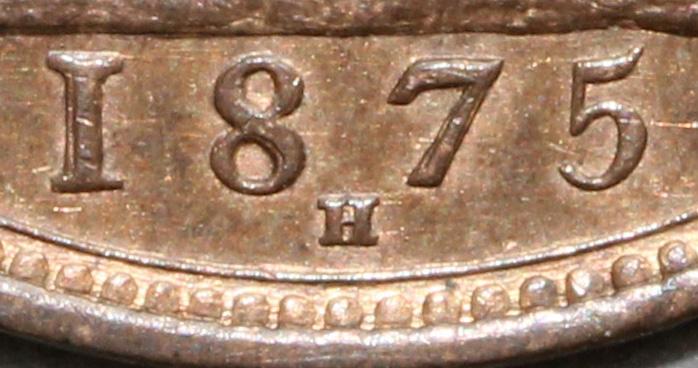 1 point
 -
Good luck, Some members might remember the fiasco of PCGS misattributing an uncirculated 1860 Mule farthing. PCGS would not admit that the slightly separated teeth, a known issue and mentioned in catalogs and guidebooks, were not round beads. They covered themselves by identifying it as a new variety, midway between teeth and beads. It will be interesting to see what their response is. Probably just call it a clerical labeling error.1 point
-
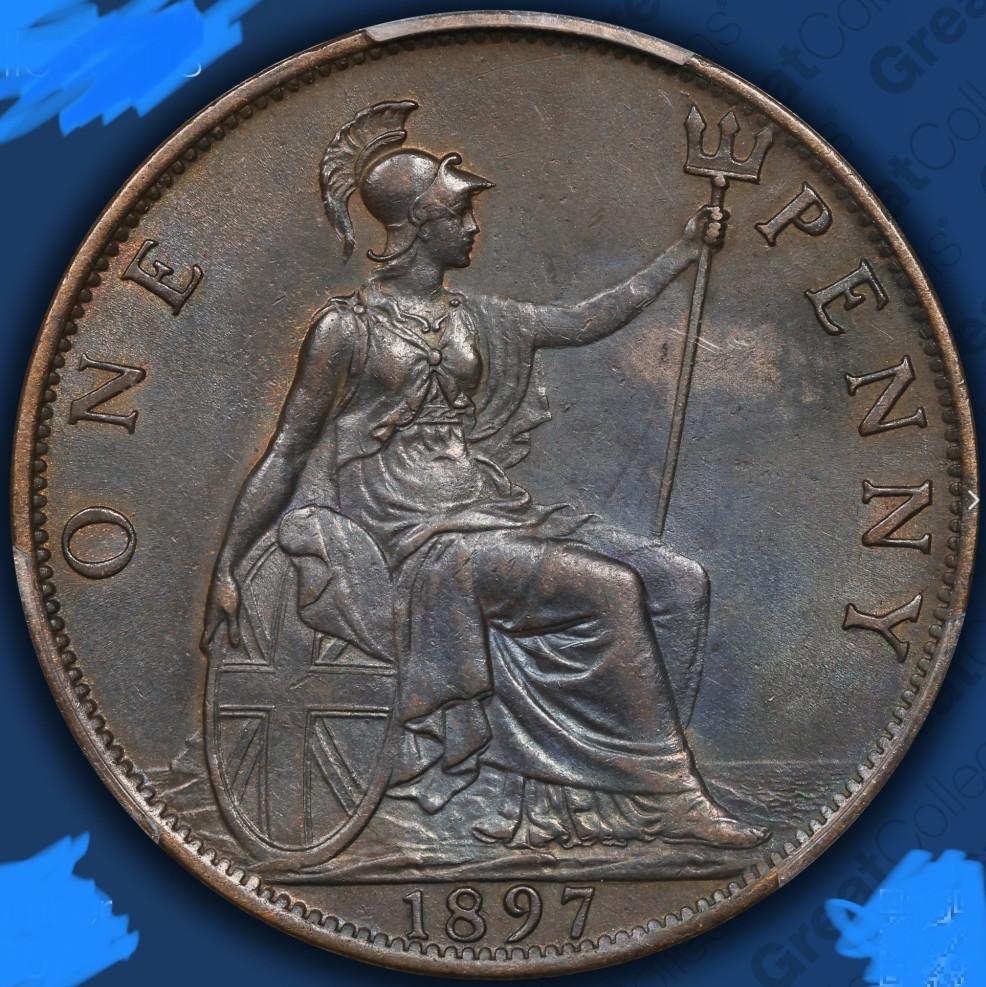
Here is what I plan to send to PCGS I believe this coin to be improperly attributed as High Tide/ High Sea Level https://www.pcgs.com/cert/56163554 Distinctive markers to determine variety correctly: Center of the upright part of P in Penny should point to gap between denticles, not to a tooth. Shield at bottom should basically be touching denticles, whereas there is a gap here in this coin. Tide on right side of coin should reach next fold up in Britannia's dress, closer to where legs cross. For comparison, this one is correctly identified: https://www.pcgs.com/cert/82915544 I can also provide more pictorial proof upon request.
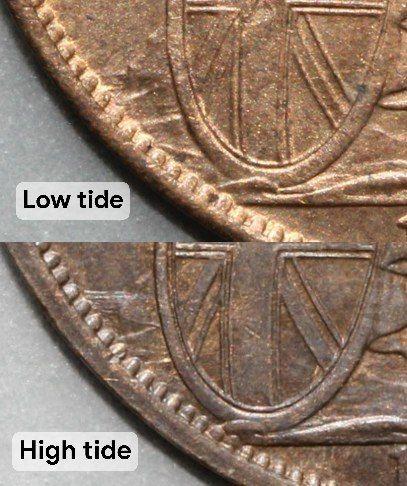 1 point
 -
I contacted Great Collections, who has it up for auction, trying to contact PCGS through their web contact form, but the contact options don't exactly pertain to this, so who knows how this will go.1 point
-
It could be a filled die but I am not convinced of the presence of an ‘H’. Either way, I would want a clear cut example for my collection rather than one that will likely remain uncertain. In terms of grade, don’t confuse the UK grading system with the US Sheldon scale; their AU is more akin to our EF and their EF40 is about our VF. The book you need is https://coinpublications.com/product/the-standard-guide-to-grading-british-coins/ Jerry1 point
-
FWIW I don’t think it’s an H, just an anomaly of toning and surface metal. The big issue is, if you’re going to call that an H, you then have to have an explanation for the Triangular shape that’s hovering between the digits?
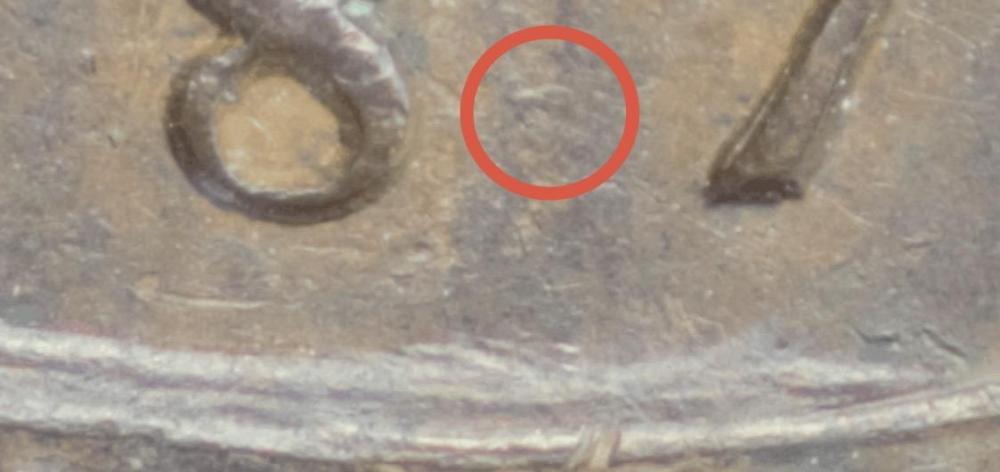 1 point
 -
Images, photos, etc, can be deceptive and not necessarily deliberately. The best determinant is studying the coin in hand.1 point
-
Im going to study the 1875 and 1875 H there must be an identifiable die characteristic unique to the H coins. Lets see.1 point
-
My own opinion for what its worth is there is NO H there 😃.1 point
-
Its one of the most mis attributed types you see , nearly all the so could high tide examples on E.bay are incorrect . The best way to tell is by the stem of the P in Penny which on the High Tide points to the Gap [space] between the teeth, on all the others it points to the Tooth.
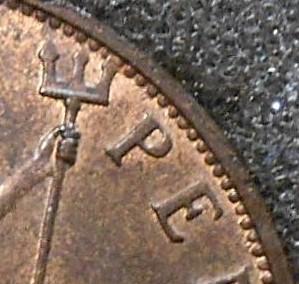
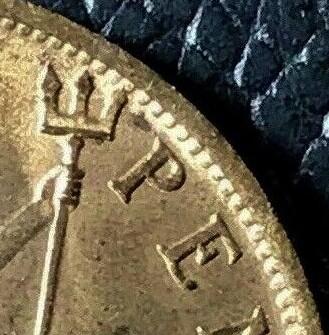 1 point
 -
Agreed; not high tide.1 point
-
I am no expert on these but by comparing with @secret santa's site I would agree, this is not High tide. I see there is a link on the PCGS page to report errors - is that worth a try?1 point
-
I decided to order it today from your link because of this post Now I just need the other one and I'll have two really nice references!1 point
-
Yes, get the Freeman book, esp as the new edition is available once again, although the prior edition is extremely useful, and an industry standard.1 point
-
I found another graded example (PCGS this time), which i believe to be misattributed. Can other please confirm or deny my suspicion? https://www.pcgs.com/cert/56163554
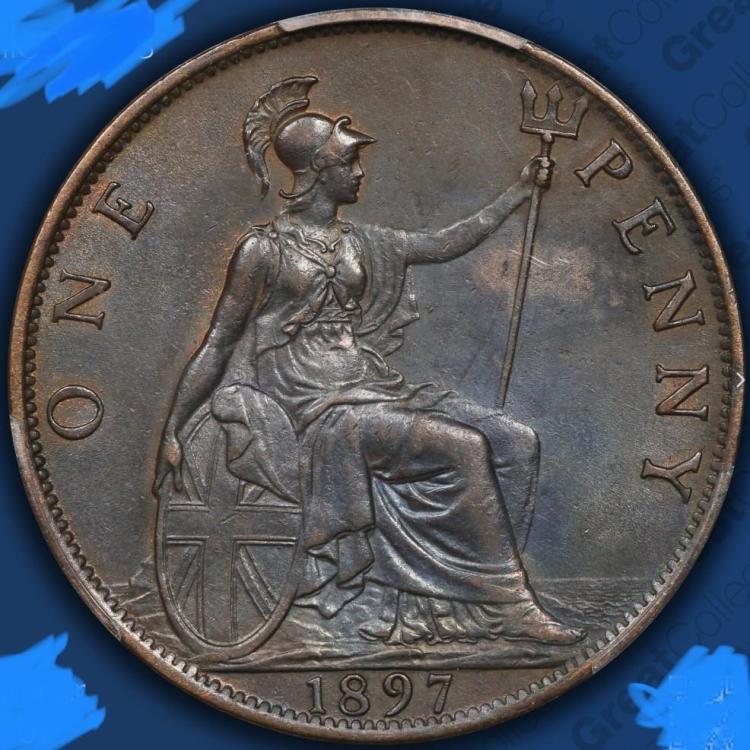 1 point
 -
I messaged the seller to tell them exactly that. No response, and the listing stands.1 point
-
Can also clearly see the 'WRL' on the reverse. Westair Reproductions Ltd, I think. They make replicas for museum gift shops etc and they always have WRL stamped on them.1 point
-
Thanks again ! Il let you know if I win.1 point
-
They’re going to ruin that 100% positive feedback with that 😆1 point
-
Well Done again! If I was you I would buy a national lottery ticket, about the same odds!1 point
-
I know, it's embarrassing that there hasn't been one for so long. Ideally I think I'd like to hand the reigns to someone else to do that and just be the publisher, if you know anyone!1 point
-
It's not really a paperback - it's A4 pages held in a ring binder.1 point
-
Did you order via: https://coinpublications.com/product/the-bronze-coinage-of-great-britain-freeman/ If so, it'll be reasonably fast. I have a few in Germany that I use to fulfil international orders, as postage is much cheaper from here. The UK warehouse has 2 or 3 left at the moment and I just ordered a small re-print yesterday, so with any luck no one will notice the gap.1 point
-
I enjoy having huge silver coins in my pocket so I added a new one to my “pocket coins” today: a 1971 S proof Eisenhower 40% silver one dollar. It looks fun alongside my 1935 Peace Dollar and 1935 Rocking Horse Crown from the UK. My son was “Oooh! Shiny!” and, yeah, proof coins are cool that way. To protect them I do keep them in encapsulated so that they don’t get scruffed and dinged in my pocket like other circulation coins. Fun stuff1 point
-
Just one of the ubiquitous modern replicas... Not even good enough to fool anyone except an idiot. https://www.ebay.co.uk/itm/406789410745?_skw=406789410745&itmmeta=01KMAVAFKDNTTGCHV256D0YB2K&hash=item5eb689cfb9:g:95IAAeSwS5ZpvvKF&itmprp=enc%3AAQALAAAA0GfYFPkwiKCW4ZNSs2u11xBUXE%2BOaPHIv8uZXkMDusPtlLW3mKOT4AlbEkZlhYUSQf3ssm3Ki9cgqJyg%2FRy0CFuTTQ%2B27w6xt%2FDJHPkYlLSOUmbK2SYJqHN89UMFJvkaC%2BbtCI9b%2FdOAqtk14AxXA%2Fr1tEoxf3UHg04Jouny2X02ErsROqmKw3lh8h3eW645zAiFS0kEbugMTlsMpMQf1YE6rgBNnkuzLi%2FDevGJQ%2FH7bOyzmpQR3oK6TuV%2B6Q0mBaRRMZksZwNGHusaKSdlB3M%3D|tkp%3ABk9SR-L5qduiZw1 point
-
I know we have had a lot of talk recently about grading companies and their abilities, and this is an example which I feel demonstrates that the companies in the US are great with US coins but not with UK coins. There is currently an auction on ebay for a slabbed 1860 mule, which caught my attention. The price looked reasonable for a slabbed 1860 mule which was showing signs of lustre, but it was difficult to confirm the variety from the existing images. I enquired about better images of the coin and in the sellers defense he provided them very quickly and courteously. The issue is that it is my opinion that this is a toothed/toothed border farthing which it would appear has been incorrectly slabbed by PCGS (a verification check on the cert number does show this to be in the PCGS database as a mule). It does not bear the signs of a beaded border reverse and the single rock to the left of the lighthouse confirms this fact. I write this post to try and inform potential buyers of my opinion, and I have written to the seller in the hopes that by showing comparisons he will agree with the error and pursue this with PCGS.1 point
-
Gary, I have to say I agree with your comments, and would add that by definition a "mule" is an obverse and reverse that were not intended to be paired, however due to some reason (probably an error) during the period of transition, some coins have been produced with a mismatch of intended obverse and reverse die pairings. If PCGS are defining the beaded designation by some partial beadings on the border then this does not constitute a mule. Whilst the labelling on the slab, would be interpreted by many collectors as detailing an example of the established mule variety, the labelling on the slab does not indicate it as a mule whilst the accompanying letter certainly does. They can call it what they wish, but it should not be clearly described as something it is not.1 point
-
Hi Bob, There is no dispute that these are different dies. 130 beads and 3 rocks identifies a specific die; 136 "things" and a single rock identify another specific; other dies may have more or fewer beads or teeth. The value of any die derives from its rarity. The borders on both coins consist of beads. On the preferred variety, the beads are separated from the border. On the PCGS coin, some beads are separated, many touch the edge, and some are embedded in the edge. But they are not teeth, or denticles, or anything toothlike. The only reason to call them "teeth" is to protect the traditional variety. In U.S. coins, we have many varieties that are similar, with one worth a significant premium over the others. A good example is the 1922 "Plain" Lincoln Cent, where we have varieties that show ghosts of the mintmark (very little collector value), others that show no mintmark whatsoever (good value), and one specific die variety that is the most desirable and valuable by far. In fact, the parallels are important because the 1922 "Plain" Cent was struck from a worn die in which the mintmark filled with dirt. My observation of the traditional "Beaded" variety is that it was struck from lapped dies. The polishing of the die face reduced the size of the beads and separated them from the edges. This also accounts for the loss of the shallowest detail in and around Brtitannia. To me, the traditional Toothed/Beaded designations are inappropriate. If the specific dies have been standardized (i.e. Obverse A, Reverse 1), then that's the way they should be designated to eliminate any confusion. Best wishes, Ron Guth Actually, according to Michael Freeman's designations in "The Bronze Coinage of Great Britain", the attribution is F-498 (Obverse 2, Reverse A)...... Obverse 1 is described as having Round Beads, Obverse 2 and later Obverses as having a Toothed Border.... Reverse A is described as having Round Beads, Reverse B and later Reverses as having a Toothed Border...... "The Bronze Coinage of Great Britain (1986 and 2006 editions)" is considered the authority for Bronze Collectors. Peck for tin, copper and bronze.... Although neither is absolutely complete, their respective descriptions are the accepted standards for attribution and are considered authoritative. In virtually every instance of a new discovery or variety, that discovery only complemented the text and/or added information, and did not change the information already in existence..... Krause merely designates TB/RB and gives no accompanying text to ensure that the proper attributions are made and might be the text that is referred to in the quoted text. Possibly the proper question should be; "Is this coin an F-498 (Obverse 2, Reverse A) as listed in Freeman?", the variety that is universally accepted as a mule.1 point
-
Hi Bob, There is no dispute that these are different dies. 130 beads and 3 rocks identifies a specific die; 136 "things" and a single rock identify another specific; other dies may have more or fewer beads or teeth. The value of any die derives from its rarity. The borders on both coins consist of beads. On the preferred variety, the beads are separated from the border. On the PCGS coin, some beads are separated, many touch the edge, and some are embedded in the edge. But they are not teeth, or denticles, or anything toothlike. The only reason to call them "teeth" is to protect the traditional variety. In U.S. coins, we have many varieties that are similar, with one worth a significant premium over the others. A good example is the 1922 "Plain" Lincoln Cent, where we have varieties that show ghosts of the mintmark (very little collector value), others that show no mintmark whatsoever (good value), and one specific die variety that is the most desirable and valuable by far. In fact, the parallels are important because the 1922 "Plain" Cent was struck from a worn die in which the mintmark filled with dirt. My observation of the traditional "Beaded" variety is that it was struck from lapped dies. The polishing of the die face reduced the size of the beads and separated them from the edges. This also accounts for the loss of the shallowest detail in and around Brtitannia. To me, the traditional Toothed/Beaded designations are inappropriate. If the specific dies have been standardized (i.e. Obverse A, Reverse 1), then that's the way they should be designated to eliminate any confusion. Best wishes, Ron Guth This is in response to the suggestion that the round beads are actually toothed beads that were LAPPED, or struck from worn/polished dies.... (Highlighted and BOLD within the quoted remarks).... It is my understanding that there is NO doubt that the ROYAL MINT used ROUND BORDER BEADS in the initial striking of the bronze coinage on all three denominations (Farthings, Half-Pennies, and Pennies)... This has been documented as such, as well as the fact that there were difficulties with the design and they were therefore redesigned with a TOOTHED BORDER.... There are HIGH GRADE examples of all denomintaions which show this clearly. There are records that document the fact that a ROUND BEADED BORDER was the original design... It has NEVER been suggested (to the best of my knowledge) that a ROUND BEAD BORDER was the result of a defective strike, polished/lapped dies, etc..... It has ALWAYS been acknowledged to be the original design, and then later that year (1860) changed to the TOOTHED BORDER.... The mere suggestion that this is the case sends up red flags and begs the question that "If the ROUND BEADED BORDER is the result of DIE WEAR/POLISHING/DAMAGE, then how did it happen that the ROUND BEADED BORDER was released into circulation first...." ALSO, why has there been NO question of attribution or question of LAPPED dies in relation to the OBVERSE DIES....... Calling a WORN TOOTH a BEAD does NOT make it so........ In the example of the 1922 "PLAIN" cent, it is known that there were NO Philadelphia mint cents struck.... We KNOW that it is an error from a worn/filled die... As such, we can document the various stages as the die deteriorated..... There were also different reverse dies used..... That with the D missing completely and the strong reverse being the most desireable..... I have a PCGS specimen of the missing D with the WEAK reverse, still rare although not as valuable as the STRONG reverse... I also have an ANACS example of the WEAK D, an intermediate stage, and FAR LESS valuable than either of its siblings.... In any case, had there been a 1922 PHILDELPHIA MINT coin struck, the 1922 "PLAIN" would STILL NOT be a PHILADELPHIA MINT COIN.... IT would be MOST ACCURATELY a "1922-D NO D" or "MISSING D".... Calling a WORN TOOTH a ROUND BEAD as a means of making an expedient explanation of a question at hand is counterproductive to discovering the TRUTH , and in this instance also does not instill confidence in PCGS's GUARANTEE.... Using another US coin as an example, the 1866-S dime notoriously has a WEAK mintmark and is quite often not visible on worn specimens..... HOWEVER, calling it an 1866 as another 3rd party grader, NOT PCGS, did in certifying a specimen, does not make it so.... The 1866-S is relatively common, the 1866 Philadelphia mint coin is significantly RARER.... The proper attributions can be made by using die diagnostics, as should be used in this case... In the case of the 1866 Dime, the other 3rd party grader tossed it off as a "CLERICAL ERROR" and refused to offer or provide any guarantees... PCGS has ALWAYS stood behind its certifications; will they continue to do so???? Or will they continue to obfuscate the issue by presenting speculations that do not fit the facts????? Admittedly there are new discoveries being made, but until this coin is examined by experts knowledgeable in THIS series (farthings), we can not have a satisfactory resolution to this attribution..... This raises an issue too... Which experts (and what were their qualifications insofar as GB coinage?) originally examined and certified the coin???? Also, which experts (and what were THEIR qualifications insofar as GB coinage is concerned, especially as this was a re-examination) studied the coin in its second review (the one that prompted PCGS letter standing behind its original attribution????? Calling a duck a swan does not make it one..... A rose is a rose is a rose...... It's up to PCGS now state in open forum exactly what their guarantee will be... For the protection of the OWNER, if he is unable to sell the coin due to this controversy.. And to any potential buyer of this coin, should someone take a chance on the coin and trusting in PCGS stature....... This coin has a significant value, and I;m sure was originally purchased with PCGS's attribution factoring heavily into the transaction....1 point
-
Yes..... It is the same coin... Relisted AFTER the owner followed through and did what was suggested..... He can only rely upon PCGS at this point...... Insofar as I am concerned, he has done ALL that he can do..... PCGS needs to 100% GUARANTEE the coin beyond ANY question or doubt......1 point
-
I really did not want to weigh in anymore on this subject inasmuch as my purchasing and returning the coin speaks for itself..... However, I think some of the focus is being lost, although Bob C. (RLC35) has made an attempt to place this subject back on track.... The question is, as I see it, "Is the coin an Mule (TB/BB) or not... As the Royal Mint used ONLY Round Beaded Border reverse or Toothed Beaded Border reverse, and at NO time ever used a PARTIALLY BEADED BORDER reverse, the question to be answered is which variety this is.... Creating a NEW name of a reverse to address a specific situation does NOT resolve this question. Calling a duck a swan, does not make it so. In the interest of full disclosure, I believe there has been a recent discovery of a Mule (TB/BB) struck with an Obverse 3 die (instead of the documented Obverse 2), but with the same Reverse A... As the question regarding THIS coin involves the REVERSE, the subject is moot. This coin needs to be examined without the slab, by someone who specializes in this subject, and whose expertise is uninmpeachable. (Michael Freeman has been suggested, and as a impartial observer whose book is considered the BIBLE of Bronze coinage, is an excellent choice), If indeed, after the coin is examined, the determination is that the coin IS a mule, as PCGS has certified on two occasions, then the coin MUST be accepted as such by all, with apologies in order to the OWNER/SELLER and to PCGS..... More importantly, to both the current owner and/or any potential buyer; should, after EXPERT examination, the determination be that the coin is NOT the certified variety; WILL PCGS GUARANTEE THE COIN AND PURCHASE IT BACK????? If PCGS stands by its current assessment of the coin (certified as a MULE TB/BB) and an interested party purchases the coin and has it examined by ACKNOWLEDGED & RESPECTED EXPERTS (such as Michael Freeman, the staff of Colin Cooke, the British Museum, the Royal Mint, etc), and their determination is that the coin is NOT the certified variety; WILL PCGS GUARANTEE THE COIN AND PURCHASE IT BACK????? It all boils down to whether PCGS will guarantee 100% that this coin IS a TB/BB mule, or will PCGS attempt to create a NEW variety, "Toothed / PARTIAL Beaded Border", a variety that does not exist and was never struck, to explain something that is most likely merely the result of as worn die...... A decision that would be viewed as a "cop-out" or evading the issue by most collectors, and would not instill confidence in the numismatic community. Another question arises as a result of the dispute regarding this coin. Inasmuch as a severe doubt has been placed upon the accuracy of this certification and has therefore hindered the sale of an EXTREMELY RARE COIN IN EXCEPTIONALLY CHOICE CONDITION: Will PCGS arrange for an EXPERT ( or EXPERTS), knowledgeable in this series, impartial to the controversy, whose determination would be unimpeachable, to examine this coin, outside of the slab, AND to accept his/her/their decision as absolute??? And, should that determination be that the coin is NOT as certified, will PCGS stand by its GUARANTEE and purchase the coin back from the owner at its fair market value??? Or will PCGS stand behind its Grade Designation (not in question or disputed) and claim that the INCORRECT VARIETY designation was a "Clerical Error"??? Another decision that would be viewed as a "cop-out" and would not instill confidence in the numismatic community. At this juncture, I believe the time is right and the neccessity exists for PCGS to state, in public, in UNEQUIVOCAL and UNAMBIGUOUS terms, exactly what its guarantee is regarding this coin, so as to provide, ANY and ALL, past, present, and future owners of this coin the peace of mind that their investment in a RARE coin is secure as to designation......1 point
-
I counted the tooths(beads) on the reverse of the coin (picture) provided by Bronze and Copper, that he had obtained on ebay, and the count came to 136 teeth on the reverse of the coin. This is not consistant with the 130 beads on the normal beaded reverse, of the mule. It also has the teeth closer to the outer rim than the inner circle. The beads on the mule are closer to the inner circle. A couple of other things are... that it has the single rock, more like the toothed type reverse, and the zero (0) of the date touches the inner rim, which it does not on the mule. I would think a differant designation would better clarify this coin, than to be classified as the classic mule of 1860. I would agree with Colin... that this would better identify the classification of this coin. I think it would also help clear any misunderstanding about this coin variety. Bob C.1 point
-
Ron, It is always encouraging to see personal representation especially from a large company like yourselves, and it really is a move to be commended. I can appreciate your comments about the "toothed/beaded" border designation, and the fact that it is not immediately clear, but the two different reverses that the major references class as toothed or beaded do have differences. When looking at a number of these farthings, it does become clearly apparent that a coin is either the toothed or beaded variety, even down to grades as low as fine. Historically in literature this has always been defined by the 3 rocks to the left of the lighthouse instead of the large single rock that appears, although as we all know only too well, coins do come to light that differ from the "norm" and hence become a new variety. The fact that new varieties are identified regularly further compounds the fact that the "3 rocks" factor is not a 100% guarantee that a coin can be classed as a Beaded Border. I have no doubt that there could well be a beaded border reverse out there with a single rock waiting to be discovered. I have provided an image comparing the beaded and toothed borders on several coins at various grades, and I think the difference is readily apparent, not only in the shape of the denticles/beads, which are consistent around the perimeter, but also when considering a section through the coin. Comparison Section The problem is that if I was purchasing a BB/TB mule, I would want to see this feature to determine that my investment was not at risk, unless I was 100% certain that it was a new variety. I also expect that many people would feel the same. However many other investors may not be aware of such distinguishing features and would want to choose the slabbed option, safe in the knowledge that an expert has authenticated the variety. As you say if there is a portion of the toothed border that has deteriorated to show beads then your description may well be accurate, but I would also suggest that it could be misleading to the buyer who may not be getting what they expect. I am not stating that the coin in question does not show a mix of beads and teeth, because without the coin in hand it would be difficult to be certain, and the fact remains it may well be a new variety. However my personal opinion was that it did not match what "historically" has been defined as a BB/TB Mule, and should ideally therefore not be labelled as such to avoid confusion similar to that which has already occurred. If the coin in question has mix of beaded and toothed on the reverse and toothed on the obverse, would it not be better labelled as a beaded & toothed obv/toothed rev mule, I can appreciate its a bit of a mouthful and could probably be better worded, but at least it is an accurate reflection of the coin in the holder. Fixed Link!! Comparison1 point
-
Hi, First a warm welcome to this forum. As a contributer to the 'Darkside' PCGS forum I know you have a genuine interest in 'World Coins'. Your reasoned argument is also welcome. You have obviously spent time on a relatively small $ coin - to preserve your companies reputation. If I ever decide to slab my collection it would be with you. However (you knew there was going to be a BUT) I think you are wrong to designate this coin as a TB, BB mule. Peck, Freeman, Colin Cooke (not Goode) have all described this type - a particular rev. die as very rare < 100 known. You are introducing another rev. die - quite common - that they would have seen many times, and giving it the same description. Beaded border means full beads all round. My toothed border 1860 has most of the same characteristics as the PCGS mule. Including the 5 o'clock beads. If you stay with this stance you will be slabbing a LOT of 1860 TB/BB. So if it is all semantics, why not call this TB / 5 o'clock beaded look border. Without the lighthouse rock and bead count of a beaded border. Just wrong to make people think they have a high value coin, even if us Brits need to re-appraise how we designate border types. Again welcome to the forum - and thanks for posting. Teg1 point
-
Teg, I can appreciate your comments regarding the owner, and maybe their appeal could have been worded a bit less aggressive, but I can also see their concerns. They are going to be selling a coin which they have had double checked by the "experts" and negative comments in relation to the coin could affect the sale price. It is not their fault that there are differing opinions on this coin, and at least they reacted to informed opinions the last time the item was put up for sale and sought confirmation before attempting to resell. At the end of the day the issue will be passed to the new owner, but so will the potential for recourse against the grading company. I thought I needed a better social life scanning every farthing that passes through my hands , but I have to admit, I have not yet started counting border beads That will give me something to do on Sunday afternoon1 point
-
Yes... The son definitely follows in his father's footsteps.... He was a highly respected coin dealer when he was in business1 point
-
Rob, Peck decribed the reverse of the 1860 BB by the distinctive rocks to the left of the lighthouse, as did the late great Colin Cooke. Every Mule I have ever seen has had the three rocks present and by the scarcity of the variety I would not consider it feasible that there is the possibility of 2 different mule varieties one of which has never been seen before. The beaded border style is surrisingly different in that all of the beads are individual and placed on a flat area, whereas the toothed edge may have some teeth that are separated but is not consistent on every tooth. The 0 in 1860 is another area where the variety can be compared, the 1860 Beaded reverse has a gap between the 0 and the linear circle and a marginally smaller 0. You may be correct in that there could be a type of Beaded Border farthing with a single rock, but would you realistically gamble £400 on the possibility when every specialist source/reference book states otherwise. Believe me when I say there is nothing I would have liked more than to say to Gary that the piece appeared correct, and I get no pleasure from saying otherwise, but from a collector to a fellow collector I have to give my honest opinion, and would appreciate people doing the same with me in similar circumstances.1 point
-
I sent him a note, when I saw he had purchased the Mule. Bob C.1 point
-
The rocks to the left of the lighthouse was the factor I used in determining the authenticity of the item, and this is what I explained to the seller. The single rock is clear on the larger images, but I am hesitant about posting someone elses images on a forum. If you ask the seller for the images, I am sure they would send them to you.1 point
-
Josie, I know how you feel, I was really unsure about what to do with this item. Do you ignore it and let people bid on something that is not what it appears to be with the view that it is buyer beware. The problem with that is that it is a lot of money for someone to invest into something when it is not what it seems. I sympathise with the seller because they are stuck with the item and the error is not theirs. I sent a polite e-mail to the seller stating my view and explaining the features that are found on a beaded border reverse and referred them to the coins in Colin Cookes collection and the comparisons on my site. I even offered to put something in writing if they did want to take the issue up with the grading company. I am not interested in trying to bad mouth sellers and I have no problems with this seller who has been courteous and efficient in their response throughout the process, and I have to admit if I was in their position I would probably treat my e-mail with a bit of suspicion and would want to check it out before deciding what to do, but I feel as a member of the numismatic community that I should advise people of my opinion. I also would not put this opinion forward unless I was sure of my comments.1 point
-
That's very naughty. As you say, a modern replica 'aged'. It's not even a proper George V penny altered (e.g. 1935) which people are willing to pay up to £200 for in order to fill a gap.0 points
-
I just took a look at the mule from enlarged pictures. Although the beads/toothes were not as sharp as I would have liked, I do not feel that the farthing for sale is a mule. Mostly based on the lrge rock to the left of the lighthouse (Peck, pag 440/441). A couple of other things are the 0 of 1860 touhes the outher ring. On the mule it does not. Also the beads/toothes appear to be closer to the outer ring, which in fact should be the opposite. Bob C. PS the coin has SOLD!0 points




.jpg.59f7f7c5ad8ff67a70f8db9e7dffd413.thumb.jpg.0826c31400cad2e4de5fe0a6afd6fd8b.jpg)