
Nick
-
Posts
2,063 -
Joined
-
Last visited
-
Days Won
31
Content Type
Profiles
Forums
Events
Downloads
Store
Gallery
Articles
Everything posted by Nick
-
Raynox DCR-250 Macro Attachment
Nick replied to Nonmortuus's topic in British Coin Related Discussions & Enquiries
An improvement I think, you've created more of a perception of depth, but perhaps just lost those hints of lustre. It'll be interesting to see the results with the new lamps. -
I wouldn't have thought that there was even the slightest possibility that the 1918 would get a higher grade than the 1919, but there you go.
-
Raynox DCR-250 Macro Attachment
Nick replied to Nonmortuus's topic in British Coin Related Discussions & Enquiries
I have used axial lighting, but it is pretty difficult to get enough light on the coin whilst blocking ambient light and reflections. It worked ok with highly reflective proofs, but normal coins appeared dull and lifeless. -
Raynox DCR-250 Macro Attachment
Nick replied to Nonmortuus's topic in British Coin Related Discussions & Enquiries
I bought something similar quite a while ago. The lamps are halogen and get seriously hot. IIRC the connections are not the same as GU10. -
Raynox DCR-250 Macro Attachment
Nick replied to Nonmortuus's topic in British Coin Related Discussions & Enquiries
No need for central heating then if you have 500W light bulbs. A standard house light bulb these days is 60W (or a third of that for energy savers). -
Raynox DCR-250 Macro Attachment
Nick replied to Nonmortuus's topic in British Coin Related Discussions & Enquiries
Close-up lenses have a tendency to make the phase detector used by the autofocus system go bananas. -
Raynox DCR-250 Macro Attachment
Nick replied to Nonmortuus's topic in British Coin Related Discussions & Enquiries
Lustre is not easy to capture, as it is effectively the result of light being reflected in slightly different directions from the surface. The camera only "sees" those reflections which fit within its limited field of view. It could be that you need to take your photos in a place that has more ambient light, or you could try moving slightly further away from the coin. -
Let's See Your Toned English Milled Silver!
Nick replied to Paulus's topic in British Coin Related Discussions & Enquiries
Nice. I do like coins with peripheral toning. For coin photos, I use mode-A (aperture priority) with an F-number around 10 or so with a daylight bulb CFT light source. If your photo doesn't quite tally with what you see in hand, you may need to change the white balance to match your light source type (some DSLRs also have a procedure to match the white balance exactly to the light source). -
Sovereign 1917 Genuine ?
Nick replied to Mycoins's topic in British Coin Related Discussions & Enquiries
It doesn't look at all convincing. Best avoided. -
Is there anybody out there?
Nick replied to Rob's topic in Nothing whatsoever to do with coins area!
We're all just Comfortably Numb. -
Thoughts on this halfcrown?
Nick replied to Conor44's topic in British Coin Related Discussions & Enquiries
Weakness in the centre is often seen on this reverse. The top lion in the bottom right shield is usually less distinct than the other two. -
Nice 3d. Those Edwardian threepences aren't easy to find with a well struck obverse.
-
Thoughts on this halfcrown?
Nick replied to Conor44's topic in British Coin Related Discussions & Enquiries
I would say it is pretty close to EF. -
That's a nice crown, especially the reverse. It looks as if it may have started out as a specimen. Either that or a very early strike.
-
DNW - Coins Going Cheaply?
Nick replied to VickySilver's topic in British Coin Related Discussions & Enquiries
DNW estimates are generally a bit on the low side, but they do depend on any reserve required by the vendor. I would say that DNW photographs are pretty good and that the coins are usually slightly better in hand than you would expect from the photos. -
First set of pictures are much more realistic. Coin looks good and better than EF, but someone has had a go at it with something abrasive - hence the hairlines. Having said that, it's very difficult to find crowns without any hairlines.
-
Sovereign mint lustre
Nick replied to Conor44's topic in British Coin Related Discussions & Enquiries
They are 22 carat, so that is 0.9167 (91.67%). -
George V 1911 - 1919 Type Collecting
Nick replied to Paulus's topic in British Coin Related Discussions & Enquiries
Thanks. I'm not sure there are any currency florins out there with perfectly formed lions' faces, even some of the proofs do not. -
George V 1911 - 1919 Type Collecting
Nick replied to Paulus's topic in British Coin Related Discussions & Enquiries
This is the best I have, taking both sides into account.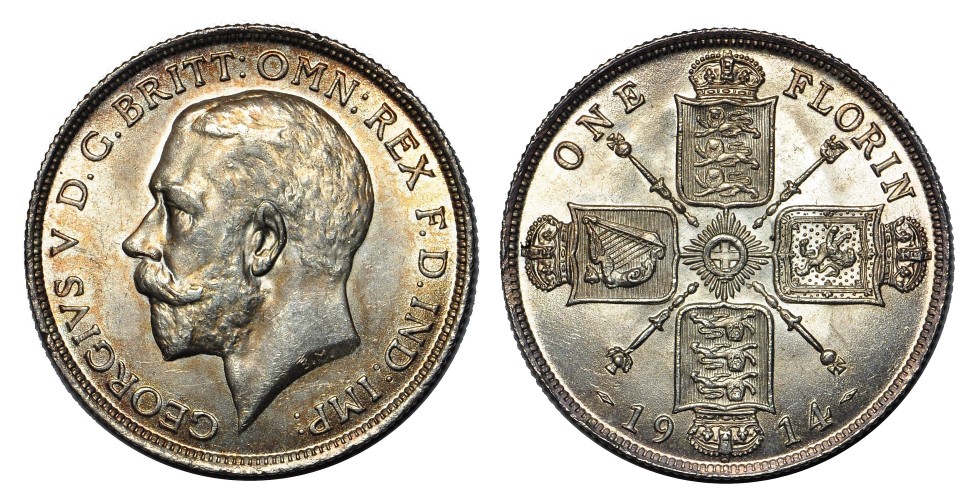
-
...and I also forgot to mention 1876, which is really tricky to find.
-
I left varieties out of my list, but agree with those you mentioned.
-
For sixpences: 1826 (2nd reverse), 1827, 1848, 1854, 1862, 1863, 1869, 1870, 1879 (with die number), 1882, 1893 (Jubilee head).
-
And with the disappearance of CGS, goes with it any notion of any guarantee they offered.
-
I suspect that they all used the same background. The appearance of the background is dependent on the colour and reflectivity of the subject, so the duller the coin - the lighter the background will appear.
-
So sorry to hear of your loss, Peter. My sincere condolences.