

Rob
-
Posts
12,964 -
Joined
-
Last visited
-
Days Won
382
1 Follower

Recent Profile Visitors
55,246 profile views





Rob's Achievements






-
I can only suggest that when a brockage happens, the press is full of unwanted metal which in these cases shattered one of the flans with the remnant causing what is seen. The offending item did not bind to the full flan and fell off. It doesn't look concocted in either case, as the incuse legends are approximately correct for orientation, albeit displaced significantly in the first one.
-
I can understand the logic of considering the lack of stops by the mark of value as a true variety as they provide a finite area for visual confirmation of the coin's face value, making it very difficult to add extra strokes to 'increase' its value. Given the random weight distribution at certain periods in history, this would provide some reassurance as to what it was. Urban myths are not a new thing. Edited to add, I think the right hand pellet is on the left hand side of the vertical light area, but the left hand dot isn't clear on my screen. It is also important to remember that dies were normally recut after the old one had been rubbed down, meaning it could show old detail anywhere on the flan, or not depending on where it was re-engraved on the die stock. The die shaft was not necessarily the same diameter as the coin being struck.
-
Stuart. For your own sanity, stay calm. Jackson - Kent spent 10 years analysing the string numbers on W3 coin harps only to conclude at the end of it that there was no significance. Personally, it makes more sense for the stops to be personal privy marks as an engraver id, as there are a number of types used, but thick string or thin string in varying quantities is never going to fly given die degradation. Stops however, are rarely confused.
-
Not rare, so how many would you like? Value, £2 face but little if any in a premium given the 2 black marks on the reverse and numerous obverse bagmarks. Somebody desperate for an example might pay £3, but not likely.
-
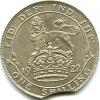
Theories as to what's happened with this penny?
Rob replied to RChris's topic in British Coin Related Discussions & Enquiries
It is the rim metal covering the legend that gave me the response above. It may well have been both processes to clean off any surface marks from cooked material in the mould (if cast), with force applied (?) to produce the inner ring. I'm struggling to reconcile the ring lip with a linear circle, as it would have to impinge on the legend too as seen. Only the person responsible for it knows the truth. -
1945 Penny - Thin flan
Rob replied to Accumulator's topic in British Coin Related Discussions & Enquiries
If you consider what a flan is, there is an underlying crystalline structure based on the metal in question. At the atomic level, the atoms are connected by well defined structural links via shared outer electron pairs. In a perfect piece of metal with no inclusions, this would be consistent across the entire surface. However, at the next level up, the surface is disrupted by metal flow when struck leaving small sub-micron cracks. A crack is a crack and therefore will allow a greater surface area to be exposed to any reactant. One thing I have noticed with seriously corroded coins at the date for example is a 'moat' around the digit where the metal has been more rapidly removed than one might otherwise expect. I acquired and sold one 20 years ago, but can't find the image. This I would explain by the cracks allowing the reactant to penetrate the metal and so lead to increased metal loss at these points. To compare with toning, which is only another form of altered metal surface, not involving metal loss, you regularly see more toning around the relief detail. Again, I would put this down to the stress cracks allowing greater reactivity with the atmosphere. eg. see below. It is posted elsewhere, so apologies, but does demonstrate my theory very well. If metal is going to react, it doesn't matter much whether the fluid is a liquid or a gas, as both will cause some effect if chemically possible, just the rate and effect will vary.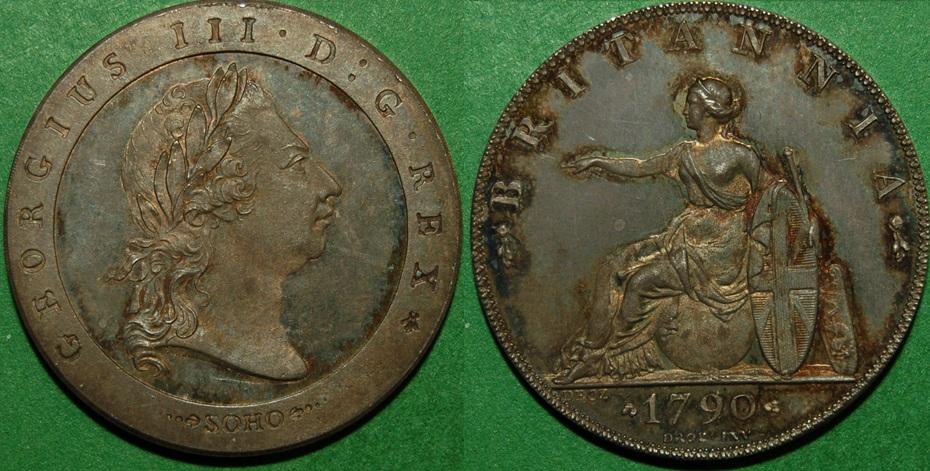
-
Theories as to what's happened with this penny?
Rob replied to RChris's topic in British Coin Related Discussions & Enquiries
The visible lettering is too crude and close to the rim IMO. It looks more like an abused attempt at a cast copy to me. Any attempts at acid cleaning will thin the letters and reduce dimensions on all 3 axes if there is total immersion. The weight of a cast would obviously depend on the amount of metal poured into the mould, so I think not relevant in this instance. -
Because they know no better and want to believe what they see. Unfortunately, knowledge requires some input from the prospective purchaser in the form of reading up the subject before buying. To me and you it is simple, but that's because we are interested in the subject matter. For the uninitiated just randomly looking for things that appeal visually, it's not a great step to hit the buy button. Sad but true. Ebay can't police the content sufficiently to make a difference, so once again, it relies on the moral compass of the seller. There should be a useful statistic in there somewhere for a number for Mr. Average's honesty coefficient, not to mention the gullibility coefficient of the typical buyer.
-
Have to confess that I was only interested in a couple of milled patterns, so wasn't paying much attention other than to note they were expensive. However, I did get both Martlet/CLH 1550 shillings though (lots 13 & 14) at some cost. Both typical Ed.VI dogs in terms of quality, but happy with the pair.
-
Ink printing on a silver coin ? Victorian 1883 3 Pence
Rob replied to Citizen H's topic in Free for all
In the case of written text, I suspect it may have been underneath a piece of blotting paper or at least something as adsorbant as bog-roll. That was the only way I could rationalise my 1773 halfpenny on a spread flan with Basing House plus some indecipherables written in the hand of H Webb. The above could equally be due to someone making a poster. Anything written or pressed onto newsprint with excess ink is likely to pass through quite easily given the paper quality. -
Worse still, looking back, it appears I also posted the Truro and B a year ago too. I claim mitiga...... Actually, I had just started to dig into, photograph and update the collection database which hasn't seen anything new for the past 12 months despite a few dozen acquisitions since then. Must do better.
-
Well spotted Mr G. Maybe my kids weren't so silly to suggest I sign up for the Biobank Alzheimers Accelerator Project after all. TBH, I'm not sure it needs to happen quicker anyway, but hey-ho. I had completely forgotten about that, but claim mitigating circumstances as I had just driven to the other end of the country through the night to look after the grandkids in Plymouth due to a family bereavement on the other side and not bothered going to bed afterwards. Hopefully get some sleep tonight when I can switch off.
-
Sorted then. Well done. Those who don't like keeping reference books/records, please note.
-
Maybe, I don't know. That's why I said perhas someone else has the books to check for references and values. I see few Scottish coins apart from the early pennies, or the much more common milled bits.
-
It looks Scottish, but my books are at home and I'm not, so someone else has to chip in with a reference number/value.