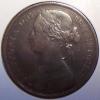
Peckris 2 Posted July 9, 2023 Posted July 9, 2023 On 7/8/2023 at 12:25 PM, 1949threepence said: Finally managed to get a decent grade 1856 OT. Obviously not the absolute apex, but orders of magnitude better than the one I've got. I'd say toned EF/NEF. No issues. This is lot 401 from the recent Baldwin's auction. Was chased all the way for it as well. Baldwins refer to "intermittent lustre", but I can't see any lustre at all. It will appear when you're not looking at it 1 Quote
jelida Posted July 10, 2023 Posted July 10, 2023 Having read the above re 1859 penny ‘9’ font varieties, I purchased this example from KB coins at the MCF yesterday, £210 ….not too unreasonable. https://www.kbcoins.com/store/pennies-1859-victoria-small-date-very-scarce-ef/nef.html This coin, and Richard’s and Mike’s all seem to have the zig-zagging flaw from the lower left of Victoria’s bust to the rim, this might be a consistent feature of the variety. Jerry 2 Quote
secret santa Posted July 10, 2023 Posted July 10, 2023 4 hours ago, jelida said: This coin, and Richard’s and Mike’s all seem to have the zig-zagging flaw from the lower left of Victoria’s bust to the rim, this might be a consistent feature of the variety. Looks like it - over to Ian to confirm ! Quote
alfnail Posted July 11, 2023 Posted July 11, 2023 Richard / Jerry, Yes, I am sure you are correct in that this flaw is a unique identifier of type. I have owned 6 examples over the years and all have had this flaw at front of truncation. The flaw progresses, on later strikes, right through the base of the truncation and then down to a border tooth at the back of Victoria. This die also has another progressive flaw through the VICTORIA legend; the attached pictures refer. I am, therefore, almost certain that the numeral 9 which we have been discussing only appears on a single obverse die. Quote
alfnail Posted July 11, 2023 Posted July 11, 2023 This discussion has prompted me to take digital pictures of the various numeral 9’s on my own 1859’s, and I now show some of these below. The pictures were all taken at 140x magnification by sliding next coin under the microscope without changing settings. These are all decent grade coins so I don’t think that ‘flattening’ through wear will have made much difference to the measurements which I have given. I have only taken measurements of the lengths, as width measurements would have made the pictures too busy, and I think one can see the width variations without needing to have their measurements. We all knew that Gouby B has a visibly different smaller 9, so no great surprise on that one, but I think there are a couple of other interesting things:- The 9 (top right), which has been the subject of this discussion, is indeed narrower (in itself) than the other type of 9’s. So, in addition to being the narrowest date width of all 1859’s (at 9 teeth) it could also be thought of as a ‘narrow date’ type based upon the width of the 9 itself. Note that this 9 also has other distinguishing features e.g. shape of its tail. The surprising one for me is that I now believe that the numeral 9 on Gouby Date Style Ab is slightly different to that on Gouby Aa. In addition to the measurement difference, I think that the area within the top loop also seems more circular on Ab. You will see that I have drawn in a blue arrow to highlight a protrusion bottom right, this can be checked against the picture on MG’s website to verify that this is the exact same die which he references. CP 1859 date varieties (michael-coins.co.uk) P.S. My experience is that Gouby Aa is by far the most common type for 1859, and I have this morning taken measurements of several other Aa coins, all coming in at 1.62mm, albeit with varying amounts of doubled numerals. I can also show these pictures if anyone wishes to see them. 5 Quote
1949threepence Posted July 11, 2023 Posted July 11, 2023 Fantastically well researched Ian. Much appreciated. My specimen has the start of a die flaw between the V and I of VICTORIA, but no extension beyond that. Quote
PWA 1967 Posted July 14, 2023 Posted July 14, 2023 A new one and not a bad grade for type. F39A 1862 8 over 6. 8 Quote
secret santa Posted July 18, 2023 Posted July 18, 2023 Over a year ago I wrote to Spink suggesting some additional varieties to include in the Penny sections of their "Coins of England" annual catalogues. I listed the following types with pictures of the interesting features: 1847 Medusa, 1858 large rose, 1860 ONF, 1862 3 plumes, 1862 VIGTORIA, 1862 B over R, 1863 open 3 and 1909 F169. I felt that they were all worthy of mention with associated values as they exist in collectable numbers, and offered advice from my records on recent prices paid for these types. I thought that Medusa would be a certainty. Today I received a reply saying that they would include only the 1858 large rose and the 1862 VIGTORIA, despite already including 1863 over 1 (a much less obvious type) and 1903 open 3. Rather disappointing. Quote
1949threepence Posted July 18, 2023 Posted July 18, 2023 53 minutes ago, secret santa said: Over a year ago I wrote to Spink suggesting some additional varieties to include in the Penny sections of their "Coins of England" annual catalogues. I listed the following types with pictures of the interesting features: 1847 Medusa, 1858 large rose, 1860 ONF, 1862 3 plumes, 1862 VIGTORIA, 1862 B over R, 1863 open 3 and 1909 F169. I felt that they were all worthy of mention with associated values as they exist in collectable numbers, and offered advice from my records on recent prices paid for these types. I thought that Medusa would be a certainty. Today I received a reply saying that they would include only the 1858 large rose and the 1862 VIGTORIA, despite already including 1863 over 1 (a much less obvious type) and 1903 open 3. Rather disappointing. I'm amazed they've not included the Medusa. 1 Quote
Peckris 2 Posted July 18, 2023 Posted July 18, 2023 To be fair, the ONF is just a broken die, but I'm amazed they didn't include the 1862 B over R - it's a fairly obvious variety. Quote
DaveG38 Posted July 18, 2023 Posted July 18, 2023 2 hours ago, secret santa said: Over a year ago I wrote to Spink suggesting some additional varieties to include in the Penny sections of their "Coins of England" annual catalogues. I listed the following types with pictures of the interesting features: 1847 Medusa, 1858 large rose, 1860 ONF, 1862 3 plumes, 1862 VIGTORIA, 1862 B over R, 1863 open 3 and 1909 F169. I felt that they were all worthy of mention with associated values as they exist in collectable numbers, and offered advice from my records on recent prices paid for these types. I thought that Medusa would be a certainty. Today I received a reply saying that they would include only the 1858 large rose and the 1862 VIGTORIA, despite already including 1863 over 1 (a much less obvious type) and 1903 open 3. Rather disappointing. I'm not surprised. I have tried to get them to include the 1695 DEI GRATIA halfpenny, for which their laughable reply was that they couldn't possibly include every minor variety. So, a major legend change is a 'minor varient', but the tiny differences in the early Victorian pennies are 'major' and worthy of inclusion. Spink are a joke and not worth the effort. 1 Quote
Michael-Roo Posted July 19, 2023 Posted July 19, 2023 (edited) 11 hours ago, DaveG38 said: I'm not surprised. I have tried to get them to include the 1695 DEI GRATIA halfpenny, for which their laughable reply was that they couldn't possibly include every minor variety. So, a major legend change is a 'minor varient', but the tiny differences in the early Victorian pennies are 'major' and worthy of inclusion. Spink are a joke and not worth the effort. 'Minor'? Ridiculous. How many confirmed examples do we now have, seven, eight? They've included the 1694 MVRIA halfpenny for many years even though, until a recent fourth came to light, only three were known. And if we're talking about early milled minor varieties, and whether or not they are deemed worthy of inclusion, just one 'off the top of my head' example of many, I'd suggest they might like to reconsider would be their 1675 farthing, no stop after CAROLVS. Again, been listed for years, and given a value, yet has anyone here ever seen one? I haven't, nor am I aware of anyone who has. Edited July 19, 2023 by Michael-Roo Quote
oldcopper Posted July 19, 2023 Posted July 19, 2023 43 minutes ago, Michael-Roo said: 'Minor'? Ridiculous. How many confirmed examples do we now have, seven, eight? They've included the 1694 MVRIA halfpenny for many years even though, until a recent fourth came to light, only three were known. And if we're talking about minor varieties I'd suggest they reconsider their inclusion of a 1675 farthing, no stop after CAROLVS. Again, been in there for years, and given a value, yet has anyone here ever seen one? I haven't, nor am I aware of anyone who has. I've never seen a clear William III BRIVANNIA halfpenny, although this is still listed in some catalogues. More likely a damaged T in the cases I've seen, with no telltale middle gap. Spink are inconsistent, they don't list copper patterns, although some of these (the Medusa and the DEI GRATIA eg) were seemingly just released as currency. Yet for instance 1826 George IV/Wm IV crowns, and all the 5 and 2 guineas/5 and 2 pounds (except 1823 £2) from George III to Una and the Lion, though patterns, are listed and priced. If I remember rightly (haven't bought a Spink catalogue for some years) several edge/border varieties of the Una and the Lion are listed and priced. The staff are probably too busy to re-write it to any extent. Quote
secret santa Posted July 19, 2023 Posted July 19, 2023 26 minutes ago, oldcopper said: Spink are inconsistent, they don't list copper patterns Yes, that's why they don't want to list Medusa. I've now pointed out to them that it's not really a pattern - there are only circulated specimens in existence, whereas genuine patterns tend to survive in near FDC condition. Quote
PWA 1967 Posted July 19, 2023 Posted July 19, 2023 (edited) One i recently purchased ,not the best grade or condition 😀 F16 5+D ONF and looking at Richards Rare penny site i wasnt aware there was so few known. Edited July 19, 2023 by PWA 1967 Quote
Peckris 2 Posted July 20, 2023 Posted July 20, 2023 On 7/19/2023 at 2:54 PM, PWA 1967 said: One i recently purchased ,not the best grade or condition 😀 F16 5+D ONF and looking at Richards Rare penny site i wasnt aware there was so few known. were you doing the washing up when you posted this? I've never before seen an example of an 1860 PINNY... 1 2 Quote
terrysoldpennies Posted July 20, 2023 Posted July 20, 2023 I picked this 1933 penny up a while back now , but forgot at the time to share it with you . It would be nice if it were the real Mc Coy, but a pretty good modified example I think . 1 Quote
PWA 1967 Posted July 21, 2023 Posted July 21, 2023 (edited) 6 hours ago, Peckris 2 said: were you doing the washing up when you posted this? I've never before seen an example of an 1860 PINNY... What it does show is how its often hard to determin a coin variety / type from a picture ,sellers pictures which were lightened show the detail much better. The E in Penny is complete even though it appears not to be on my picture. Edited July 21, 2023 by PWA 1967 1 Quote
1949threepence Posted August 6, 2023 Posted August 6, 2023 I note the September LCA catalogue is now out on their website. For the accomplished collector, it's a bit run of the mill to be honest. But for those who aren't quite there, some interesting possibilities. There's a hgh grade F14 LCW under foot, but with very prominent die cracks. There's also a distinctly suspect slabbed 1863 touted as a proof, but with poor photography. A F169 is on offer which doesn't appear to be on Richard's rare penny list. Quote
DaveG38 Posted August 6, 2023 Posted August 6, 2023 38 minutes ago, 1949threepence said: I note the September LCA catalogue is now out on their website. For the accomplished collector, it's a bit run of the mill to be honest. But for those who aren't quite there, some interesting possibilities. There's a hgh grade F14 LCW under foot, but with very prominent die cracks. There's also a distinctly suspect slabbed 1863 touted as a proof, but with poor photography. A F169 is on offer which doesn't appear to be on Richard's rare penny list. Run of the mill!! The first lots I found were the 1826 and 1831 proof sets - estimated at £60-120k and £35-70k. If they are run of the mill, then my collection must be regarded as meagre and scarcely worth the trouble of collecting. However, I do take your point regarding the rest. Quote
1949threepence Posted August 6, 2023 Posted August 6, 2023 (edited) 46 minutes ago, DaveG38 said: Run of the mill!! The first lots I found were the 1826 and 1831 proof sets - estimated at £60-120k and £35-70k. If they are run of the mill, then my collection must be regarded as meagre and scarcely worth the trouble of collecting. However, I do take your point regarding the rest. Oh sure - I was only referring to the pennies in the auction, which is why is I posted it on the "More Pennies" thread. I agree there are some spectacular proof sets Edited August 6, 2023 by 1949threepence Quote
DaveG38 Posted August 6, 2023 Posted August 6, 2023 10 minutes ago, 1949threepence said: Oh sure - I was only referring to the pennies in the auction, which is why is I posted it on the "More Pennies" thread. I agree there are some spectacular proof sets Ah, sorry, I didn't see the title of the thread. 1 Quote
oldcopper Posted August 7, 2023 Posted August 7, 2023 (edited) 15 hours ago, DaveG38 said: Ah, sorry, I didn't see the title of the thread. I don't think gold and early proof sets really count for many collectors - they're now mainly collected by investors from what I can see. Which of us is going to fork out the best part of 100k (or the best part of half a million upwards for a good 1839!) for one of the old proof sets? Especially as you could pick up a nice one for 10-25K 20 years ago. Anyone seen the Philip Richardson mainly Soho collection now listed on DNW? There's 200 lots on there. Some nice coins.... I notice one anomaly, to do with the gilt 1797 inscribed edge KP5 penny. DNW refer to the coin as a one off, and the inscription was referred to in Peck as a later adulteration in a footnote. Now, whether it is or not I don't know, but In Baldwins 47 (Gregory II) one of these was the front cover coin, in beautiful and brilliant mint state no less. A stunner. However, a more ropey one turned up in their auction a few years later, scratched and edge knocked, but it was given exactly the same provenance as their supposedly unique earlier mint state one. This is the one in DNW. So either someone bought it in Baldwins 47 (£2,800 hammer), kept it in their pocket for several years, then resold it (£460 hammer!), or more likely there are at least two of these coins in existence, both identically and incusely inscribed. In which case it is more likely that the edge is a contemporary and official addition. Edited August 7, 2023 by oldcopper 1 Quote
Recommended Posts
Join the conversation
You can post now and register later. If you have an account, sign in now to post with your account.