terrysoldpennies
-
Posts
804 -
Joined
-
Last visited
-
Days Won
58
Content Type
Profiles
Forums
Events
Downloads
Store
Gallery
Articles
Everything posted by terrysoldpennies
-
He must have use his metal detector , in a Chinese takeaway.
-
Fantastic sunset just now.

-
NHS Thank you.
terrysoldpennies replied to PWA 1967's topic in Nothing whatsoever to do with coins area!
Right Pete , ill book both of us down for the London Marathon Next year, !!!!!!! Terry -
Cameo or not ? Be wary !
terrysoldpennies replied to secret santa's topic in British Coin Related Discussions & Enquiries
Not necessarily better , just a greater contrast between the two surfaces, and it is after all just a matter of personal taste. -
Cameo or not ? Be wary !
terrysoldpennies replied to secret santa's topic in British Coin Related Discussions & Enquiries
Welcome to the Forum, its a very useful link with the staged comparison pictures. Terry -
Cameo or not ? Be wary !
terrysoldpennies replied to secret santa's topic in British Coin Related Discussions & Enquiries
Unless they continue to use an old proof die, for circulation coins, the first few would look pretty good. Terry -
Cameo or not ? Be wary !
terrysoldpennies replied to secret santa's topic in British Coin Related Discussions & Enquiries
I found this , thought it was interesting. https://www.thespruce.com/cameo-cam-definition-768528 -
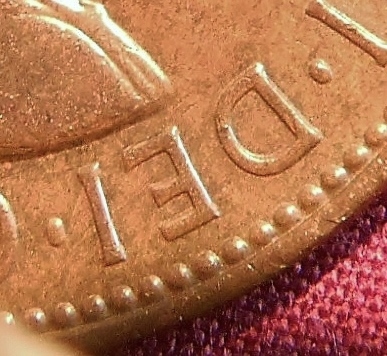
This is the 1967 with the extremely elongated colons. Terry
-
More Pennies
terrysoldpennies replied to Prax's topic in British Coin Related Discussions & Enquiries
This is not an 1882 its an 1862 penny as it has an obverse 6 only used up to 1874 . Terry https://www.ebay.com/itm/RARE-Great-Britain-1882-NO-H-One-Penny-Queen-Victoria-HOLLED-NO-RESERVE/272917120131?hash=item3f8b20c483:g:iVIAAOSw5gFZdPkn -
More Pennies
terrysoldpennies replied to Prax's topic in British Coin Related Discussions & Enquiries
I think this may have been caused by a small piece of metal getting itself pressed with part of the obverse image, then being flipped over to face the other way up on top of the next blank about to be pressed, the two pieces of metal,[ the blank and the smaller piece of metal ] were then pressed together ,this would give the brockage, but only over the area where the smaller piece of metal had been. The two pieces of metal must then have parted company , leaving the blank, now a coin looking like yours. Terry -
More Pennies
terrysoldpennies replied to Prax's topic in British Coin Related Discussions & Enquiries
Yes it is . Terry -
Just seen this on Ebay, He's showing a genuine known 1933, pic https://www.ebay.co.uk/itm/Rare-1933-penny/202093087478?hash=item2f0dafcaf6:g:3IQAAOSw8UZZ8SVx

-
1909 identification markers
terrysoldpennies replied to zookeeperz's topic in Confirmed unlisted Varieties.
One other identifier is the sea to the right of the coin which touches onto the tooth on the E , but on the D it is to a gap between the teeth. -
1909 identification markers
terrysoldpennies replied to zookeeperz's topic in Confirmed unlisted Varieties.
The P in PENNY on the 2+e points to the tooth, but there is a tiny edge knock , all the other 1909s I have the P point just to the right of the tooth. Terry -
1909 identification markers
terrysoldpennies replied to zookeeperz's topic in Confirmed unlisted Varieties.
Hi , below is my 2+e 1909, as you said the 1 in date should be directly over the tooth, but also the right side down stroke of the N in ONE should point to the gap between the teeth. Terry
-
More Pennies
terrysoldpennies replied to Prax's topic in British Coin Related Discussions & Enquiries
It looks to me like its the result of two tiny dents , raising the metal up slightly between them, giving the impression that the two ends of the E are joined. -
Hi Gaz and welcome, Have you any great finds to show us . Terry
-
I can't discern any difference between it and any of the other ribbons , it looks more offset in the picture I know, but as you can see there's a small scratch across the end of the ribbon , and I think it has very slightly damaged it . Terry
-
Normal colons and rotated normal width colons.


-
This is a strange one, colons like this are known and listed for some pennies in 1860 and 1861, but are all to be found on Freeman 4+d [gouby G+d] coins , and all are thought to have been made from a batch of dies made without colons in this position ,and then being etched into the die by hand ,there by making the position of the colons vary from one die to the next , this though is an 1873 , and along with all pennies made between 1863 to 1873 is a Freeman 6+g [Gouby J+g]. Until now all seemed to have had the normal width colons, most coins having colons pointing towards the gap, but with a few having them rotated partly onto the tooth. I notice though that the replacement 1874 F7 obverse has the colons rotated to point towards the tooth, but are still of the normal width. Terry

-
1890 Penny Obverse Legend Difference
terrysoldpennies replied to zookeeperz's topic in Confirmed unlisted Varieties.
What ever happened to the saying ''The customer is always right'' ?. As to date widths , as you say, its often so obvious a difference that can stand out a mile, but there, it takes all types to make a world. Did you see the picture I posted of the different 1861 penny dates, well they certainly can vary dramatically , as the narrowest date one I showed has the 1 almost climbing on top of the 6, and as to how a date type like that cannot be seen as interesting and desirable beats me. Well soldier on Terry -
1890 Penny Obverse Legend Difference
terrysoldpennies replied to zookeeperz's topic in Confirmed unlisted Varieties.
Hi I must say, I welcome your input, and please do continue as we all can learn from each other. I posted the three types of R plus E as I thought it would be of interested to you. I am very interested in date differences , and do collect differing date widths, some of which are extremely rare . I know many collectors don't bother with them, but interest is growing, as can be seen by the sales recently of an 1896 extremely wide date worn penny on London Coins for £200, and the 1904 narrow date selling at Colin Cooks for £70. Good luck in your collecting. Terry -
1890 Penny Obverse Legend Difference
terrysoldpennies replied to zookeeperz's topic in Confirmed unlisted Varieties.
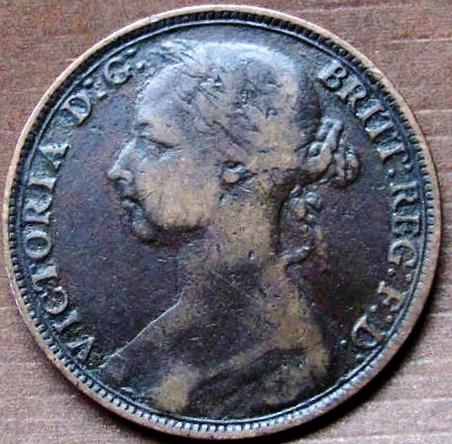
Here's the 1891 unlisted 16 tooth date width, this one has the gap between R and E, I have another with the letters joined. Terry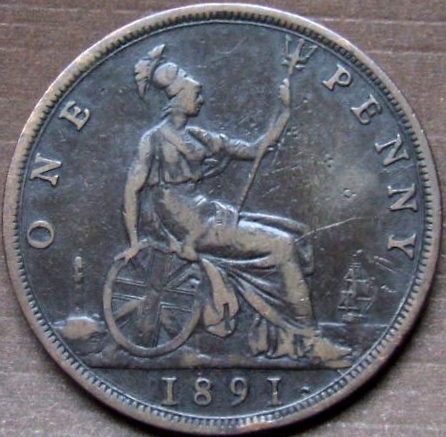
-
1890 Penny Obverse Legend Difference
terrysoldpennies replied to zookeeperz's topic in Confirmed unlisted Varieties.
I've found three types on the 1890 , your two, and one with the E in REG rotated clockwise making the R and E not line up at the bottom, the E is higher up than the R. I have also open and closed REs on 1889s , and on two 1891 Ex. wide date , unlisted 16 tooth pennies. Pictures of the 1891 later