
Accumulator
-
Posts
2,180 -
Joined
-
Last visited
-
Days Won
9
Content Type
Profiles
Forums
Events
Downloads
Store
Gallery
Articles
Everything posted by Accumulator
-
Help with the-saleroom LIVE bidding!
Accumulator replied to Coinery's topic in British Coin Related Discussions & Enquiries
With the volume turned up, it created quite an atmosphere in our little 'van I can tell you! "£32K with me, £32,500 with the room, selling at £32,500, it's with you at £32,500 Sir, £33K on the 'net..." Pheeeweee! £100k for the triple unite. There's some serious money chasing these Gold coins. -
Help with the-saleroom LIVE bidding!
Accumulator replied to Coinery's topic in British Coin Related Discussions & Enquiries
I've used the system several times and, as Rob says, not had a problem. Watch a few lots before your own comes up and you will quickly get the hang of it. The auctioneer always gives time after the last high bid before bringing the hammer down, so you won't miss out on anything if you're quick. Just one important think to watch for: when you log in, you specify whether you want to be able to bid or just watch the auction. It's possible to be watching for a while and forget you haven't actually logged in to bid! Always ensure that you have the live BID button on your screen otherwise your lot will arrive and you won't be able to bid. Good luck! -
It would make sense to collect the scarcer dates/types at the moment and wait for the bullion price to recede before picking up the common ones. They are never going to be in short supply unless there is a government inspired and legally backed impounding and melting of private gold. Prices being what they are at the moment you are only paying a few times bullion for what are quite scarce coins in some instances. A mintage of a couple tens of thousands only costs 3 or 4 times that of one which has a mintage of millions. It isn't until you get to the quantities available of the 1920S and 1819 that collector demand way outstrips supply. Even the Ansell sovereigns are not rare in low grade, though go for silly prices. I am finding this thread very interesting and would like to make some points and add some questions for our undoubted experts! I am not remotely worried about the CGT on coins as I don't expect ever to make over £10,000 profit on a single coin ... if I ever did I would be delighted and I am sure would get away with not declaring it! - a nice problem to have! I have not yet regarded coins as an investment and have been careful to distinguish collecting/the hobby decisions from investment decisions, as all the best advice would recommend I would seriously consider investing in gold and silver coins if and when the price of such precious metals fell back to their pre 2009 prices, as I would confidently expect to make a good (tax-free) return on them in the medium to long term, expecting them to occasionally return to current levels sometime in the next 10 years, and if not, to certainly beat other (taxable) investment options My question is - if you invest in gold and/or silver coins that are priced at/worth say 1.5-2X bullion value (sovereigns are a prime example), how much are they affected by fluctuations in the bullion price? For example, buy a sovereign for £500/$800 now, assuming that is the going rate for that date/rarity/condition, and the bullion price of gold halves to $860, what might be the effect on the value of that coin? Is there an inherent content value built in for coins that have significant precious metal content, but are collectable beyond their metal content? I hope the question makes sense, it is the same question for pre 1947 silver! Possibly unanswerable. Here's some Spink data comparing 2000 and 2005 (before the huge bullion increases of course): 1911M to 1918M : 2000 £75 ... 2005 £85 each 1929M : 2000 VF £500 EF £1750 ... 2005 VF £900 EF £1400 1930M : 2000 VF £95 EF £175 ... 2005 VF £95 EF £120 1931M : 2000 VF £150 EF £300 ... 2005 VF £200 EF £250 As you can see, the BV increased by around 15% in 5 years, but the coin values don't match up at all. Generally the VF prices range from static to much higher, while the EF prices are all lower. I'm sure if I picked a different series, the results would be different again. Despite these catalogue figures, I think it's fair to assume that the BV element of any sovereign's value will always track the gold index and the residual will vary according to the market demand from coin collectors (not bullion investors). There is a HUGE market for pure bullion sovereigns, which are bought by their hundreds and thousands by investors who never even look at their coins. Essentially all but the rarer dates in VF or below are bullion. Just look at the mintage figures and you can see what's out there, squirrelled away in safety deposit boxes and the like. In answer to your question, the further above bullion you buy at, the more the risk switches from a gold price one to a coin market one. You take your choice.
-
Its hard to be sure as your photos aren't very large, but it certainly looks like the one sold by London Coins. Well done! Satin 19
-
I don't suppose the disposal of a valuable coin collection in the latter years would be tax-free, would it? Legal tender British gold coins can be sold tax free. The sale of other coins has been discussed here in the past and is more complicated. If you have a number of disparate coins (i.e. not part of a set), these can be sold individually and CGT is only payable if any one of those sales produces a profit of £10,000 or more but, and this is the big BUT, if the coins form part of a 'collection' HMRC will assess the total of all the sales from that collection in any one year and only give a single allowance of £10,000 for everything. The definition of a 'collection' is subjective. It may be that if you wished to sell, lets say, 6 very valuable crowns, 6 shillings and 6 pennies it would be better to sell a mix of denominations in each tax year to avoid the 'collection' definition. Selling all the crowns in one year, for example may be viewed as the sale of a collection for which only a single £10,000 allowance applies. Selling one crown, one shilling and one penny of different dates may be viewed as a sale of three separate coins for which a total allowance of £30,000 would be applied. Please don't take this as any offer of advice! It's just my understanding of the present tax rules. Many thanks but, just to clarify, is that £10K TOTAL sales price, or £10K PROFIT? ie if you spent £10K on your collection and sold the whole thing for £20K, does this mean the whole £20K is a tax-free sum? Sorry Accumulator!!!! The calculations are all done on the PROFIT. So if you purchased a coin for £10k and sold it for £20k, the profit of £10k is subject to tax (less any allowances). I should say that the CGT allowance is actually £10,600 for the 2012/13 tax year, not the £10,000 figure I used above. Is this a magic loophole by any chance? If we say, for example, on April 6th get really excited about collecting G4 silver, and then by the end of June can't stand the monarch, can we sell the collection off and declare the profit under Capital Gains? Of, course, on April 6th the following year, we're about to have a love affair with Queen Mary (you will note I didn't say Anne)! It's not that simple. If you start buying and selling on a regular basis you will be assessed as a trader and will be taxed on your trading profit. This is a different area of taxation to CGT and is the one that regular eBay traders can be liable for. The revenue don't make it that easy!
-
I don't suppose the disposal of a valuable coin collection in the latter years would be tax-free, would it? Legal tender British gold coins can be sold tax free. The sale of other coins has been discussed here in the past and is more complicated. If you have a number of disparate coins (i.e. not part of a set), these can be sold individually and CGT is only payable if any one of those sales produces a profit of £10,000 or more but, and this is the big BUT, if the coins form part of a 'collection' HMRC will assess the total of all the sales from that collection in any one year and only give a single allowance of £10,000 for everything. The definition of a 'collection' is subjective. It may be that if you wished to sell, lets say, 6 very valuable crowns, 6 shillings and 6 pennies it would be better to sell a mix of denominations in each tax year to avoid the 'collection' definition. Selling all the crowns in one year, for example may be viewed as the sale of a collection for which only a single £10,000 allowance applies. Selling one crown, one shilling and one penny of different dates may be viewed as a sale of three separate coins for which a total allowance of £30,000 would be applied. Please don't take this as any offer of advice! It's just my understanding of the present tax rules. Many thanks but, just to clarify, is that £10K TOTAL sales price, or £10K PROFIT? ie if you spent £10K on your collection and sold the whole thing for £20K, does this mean the whole £20K is a tax-free sum? Sorry Accumulator!!!! The calculations are all done on the PROFIT. So if you purchased a coin for £10k and sold it for £20k, the profit of £10k is subject to tax (less any allowances). I should say that the CGT allowance is actually £10,600 for the 2012/13 tax year, not the £10,000 figure I used above.
-
Yes, but only if they are legal tender British coins. See above for the CGT position.
-
I don't suppose the disposal of a valuable coin collection in the latter years would be tax-free, would it? Legal tender British gold coins can be sold tax free. The sale of other coins has been discussed here in the past and is more complicated. If you have a number of disparate coins (i.e. not part of a set), these can be sold individually and CGT is only payable if any one of those sales produces a profit of £10,000 or more but, and this is the big BUT, if the coins form part of a 'collection' HMRC will assess the total of all the sales from that collection in any one year and only give a single allowance of £10,000 for everything. The definition of a 'collection' is subjective. It may be that if you wished to sell, lets say, 6 very valuable crowns, 6 shillings and 6 pennies it would be better to sell a mix of denominations in each tax year to avoid the 'collection' definition. Selling all the crowns in one year, for example may be viewed as the sale of a collection for which only a single £10,000 allowance applies. Selling one crown, one shilling and one penny of different dates may be viewed as a sale of three separate coins for which a total allowance of £30,000 would be applied. Please don't take this as any offer of advice! It's just my understanding of the present tax rules.
-
Indeed. And £200 for it. This particular coin means nothing to me but, in relation to the discussion on ethics taking place in another thread, the seller's description is a model of honesty and that's to be applauded.
-
Rob and Peckris have covered most aspects of sovereign collecting, except for one specific point. An advantage of sovereigns (over gold bullion or many other assets, such as shares) is that they can be sold free of capital gains tax (CGT). CGT is normally paid on any sales that result in a profit (not sales value) of more than £10,000 in any one tax year. So if you do put some of your hard earned graduate salary into gold sovereigns, and they appreciate substantially in value over the years, they could make a nice tax-free pension pot for you to dip into!
-
Cleaning up the coin market
Accumulator replied to Accumulator's topic in British Coin Related Discussions & Enquiries
I think 2. is a problem area, the way you've presented it. In terms of the consequences (i.e. whether mistake or not) then it ranks only below #4, in other words it could have a catastrophic effect for a buyer. However, in terms of actual intent, you'd have to place it at #1 as it is the only genuine mistake among them. So I'd have to ask - are you listing those in order of criminal intent, or are you listing them in order of their consequences on a buyer? #1 grading is a matter of opinion and is unlikely to ever be any different. Mint state is an absolute if qualified at a certain magnification as is flat with no detail. Everything in between is in the eyes of the beholder. Some people grade stricter than others, but with a degree of leeway, many grading attempts could be deemed accetable. It is as Peck says, up to the buyer to make their own judgment. As long as individuals maintain a consistent standard of grading, then there is less of a black and white case for claiming a coin is overgraded. Hands cannot be held all the time, so somewhere along the line people need to be responsible for their own actions given nobody is compelled to buy. #2 & 3 I agree with Peck. If attempting to sell a coin as genuine that you know is a fake, then that is fraud. However, mistakes have been and will be made. The Circular had a copy groat in it a while back which was withdrawn when pointed out. Yesterday's sale had a copy shilling which Richard noticed. It would be irrational to believe these were attempts to defraud anyone, so the situation for most dealers is that they hope they haven't sold/will not sell a copy by mistake. 'there but for the grace of God go I' is probably the feeling of most dealers unless they make a conscious decision to abandon a particular field to avoid any such event occurring. The case of the slabbed copy in the recent thread is unlikely to have been deliberate case to deceive on the part of NGC, rather a case of being out of their depth and trying to make a buck in a series with which they are not familiar. The person submitting it may also not have realised if sold a coin as genuine, however, submitting multiple copies for slabbing would suggest the person is digging a hole for themselves - but how would you prove it? #4 would be a criminal offence in this country, but I don't believe it is in China. Unless you were to have world-wide control over all industrial production the problem cannot be avoided. The problem therefore is one of fraud committed by people who sell coins knowing they are fakes. You cannot have a totally regulated market when the masses have the ability to set up their own businesses and effectively produce what they want. A thousand years ago when the production of money in this country was delegated to a few individuals at specific locations, you still had nefarious activities taking place whereby the coinage was copied illegally. If it isn't illegal, you can't stop it. The best you can hope for is to have the copies identified (with their own privy marks for identification) and to clamp down hard on individuals who sell copies that aren't clearly so - if necessary by Act of Parliament. This would force ebay's hand in the UK, but wouldn't and couldn't apply worldwide. The danger of regulating in this way would be that it would potentially criminalise a lot of innocent people, whilst at the same time legitimising slabbed fake items because ebay have already given them unquestionable status in the US. It might seem a bit impotent, but I don't think there is much you can do apart from covering your own backside, both as buyer and seller. Rob & Peck, we all seem to basically agree over these four different situations. To conclude then: 1. Knowingly over-grading a genuine coin - It's up to the buyer to examine any coin and do whatever research is necessary to make their own judgment. Caveat emptor then. 2. Mistakenly representing a fake or replica coin as being genuine - Mistakes happen. As long as 'amateur' sellers rectify the error when it is pointed out and 'professional' sellers not only rectify the error but also take appropriate corrective steps, then little more can be done. 3. Intentionally misrepresenting a genuine coin as being of a rarer type - Outside the EU or USA little can be done. Within the UK this is a crime. As such crimes are generally perpetrated via eBay then this is where pressure should be applied. 4. Intentionally faking or replicating a coin (the Chinese copies) - Same as 3. above. Based on the above, I can't believe that, say, the BNTA aren't making representations to eBay over it's handling of potentially illegal acts perpetrated by users and writing to TPGs to agree a process by which incorrectly slabbed coins are properly reported and dealt with. Many years ago I was involved (Chairman) with a very different trade organisation and we successfully took appropriate steps to protect our member's customers in a comparable way. There's a baton out there that needs to be taken up by a properly organised representative group within British numismatics. -
An offer to good to refuse
Accumulator replied to Gary D's topic in Nothing whatsoever to do with coins area!
1. YOUR FULL NAME.......................................David Cameron 2. YOUR AGE....................................................40 ish 3. YOUR OCCUPATION...................................Wanker 4. YOUR ADDRESS..........................................10 Downing street, London 5. YOUR PRIVATE TELEPHONE NUMBER.......Can't say These 2 would go hand in hand eh, both trying to rip everyone off, Cameron is doing a better job though Steady on old chap! Anyway, no need to worry unduly as Boris will be taking over the reigns soon (Intentional spelling mistake to leave Dave confused) -
1877 Victoria penny possible reverse-j freeman small date 0.66mm between 77 . narrow lighthouse and narrow neck. Wide date penny's have much smaller lighthouse and neck. http://www.londoncoins.co.uk/webcatalogue/137/L1730r.jpg What lighthouse?? Neck, what neck? DEFINITELY Reverse J - the commonest one for 1877 As for his link, ERROR 403 Forbidden Second time he's tried to flog this piece of junk. As you say Peckris, definitely reverse J (I think he meant to say "possibly reverse H"!).
-
Baldwins Auction 77
Accumulator replied to azda's topic in British Coin Related Discussions & Enquiries
I did my usual. Was busy with work so left a proxy bid on one coin, only to be outbid. Now kicking myself and wishing I'd gone higher. I might have saved 200 quid but will probably have to wait a couple of years to find another! -
Cleaning up the coin market
Accumulator replied to Accumulator's topic in British Coin Related Discussions & Enquiries
I think 2. is a problem area, the way you've presented it. In terms of the consequences (i.e. whether mistake or not) then it ranks only below #4, in other words it could have a catastrophic effect for a buyer. However, in terms of actual intent, you'd have to place it at #1 as it is the only genuine mistake among them. So I'd have to ask - are you listing those in order of criminal intent, or are you listing them in order of their consequences on a buyer? My aim was to bring the conversation out of another thread and kick it off in its own right by just giving my initial thoughts. I take your point about the consequences being the same, whether an error is intentional or unintentional. However, I think we have to accept there will always be genuine mistakes made by amateurs (in what, after all, is only a hobby) and these cannot generally be legislated against. It will always be a case of caveat emptor for the buyer and this is probably right. My main focus is on the professional faker or those offering a professional grading service, who very definitely should know better. In my opinion, the fakers should be banned and the TPGs should be accountable for their errors in the same way that every other professional is. I presume they must have professional indemnity insurance cover? If I bought a slabbed coin that later proved fake or misattributed (and the seller refused a refund) I might well consider making a claim against the TPG, despite any disclaimers they may try to hide behind. If organisations like eBay and Hertiage are going to demand slabbed coins then the TPGs will have to stand behind their product. Just an opinion! -
Cleaning up the coin market
Accumulator replied to Accumulator's topic in British Coin Related Discussions & Enquiries
"..this was done years ago"? Clearly not, or we wouldn't be discussing all the problems now. Perhaps the BNTA should be protecting and enhancing the reputation of their members by being more pro-active in tackling some of the above listed abuses? -
To kick this off as a seperate subject, here are a few thoughts from me. There seem to be a number of different issues that threaten the reputation of the coin market. My order, from the least significant to the worst offence, would be: 1. Knowingly over-grading a genuine coin. 2. Mistakenly representing a fake or replica coin as being genuine 3. Intentionally misrepresenting a genuine coin as being of a rarer type 4. Intentionally faking or replicating a coin (the Chinese copies) A lot of discussion has taken place about item 1. (dipping and re-selling coins etc.) but I personally believe it is ultimately up to any buyer to make their own judgement of a coin’s condition. Whilst bad practice, I don’t generally regard this as fraudulent and therefore not something we should directly tackle as a priority, beyond the general berating of offenders that already happens. Item 2. only arises through genuine mistakes. If the mistake is being made my a dealer or a private seller then I think that individual should be notified in writing and expected to remove the item from sale or re-list it with the appropriate notification. If the mistake is made by a TPG then they should be notified in writing, asked to remedy their error (note against the relevant UIN on their website etc.), investigate the lapse internally and ensure, as far as possible, that the same error could not occur again. Items 3. And 4. are possibly criminal offences and are unlikely to be perpetrated by any dealer or auction house operating in the UK. The main outlet for such coins is almost certainly eBay. At the very least we should seek to have eBay de-list and ban offending sellers. Easy to say, I know! Anyway, these are just a few of my thoughts to kick off the discussion.
-
I'm planning to go on Saturday as it's not too far from me. Too busy with work on Friday, even if I thought the £50 fee was worthwhile. Anyone else going to be there?
-
Not me! Just thinking if he had gone to the right of the Lighthouse, it would have been rarer still 2 bids now - all the way up to £1.75! Not bad for an "apsolutely mint state" bun halfpenny Not sure I'd want to get on the wrong side of the guy hiding behind that coin in the photo! And check out his feedback response: "NOT MY FAULT THE ITEM WAS STOLEN!!" (honest, officer!)
-
Baldwins Auction 77
Accumulator replied to azda's topic in British Coin Related Discussions & Enquiries
I won't be at either auction in person, just following on Sixbid. There's no extra premium for the Sixbid service. Just remember to register in advance if you want to bid, rather than only follow the auction. -
Baldwins Auction 77
Accumulator replied to azda's topic in British Coin Related Discussions & Enquiries
Some lovely coins, as there are also in the St. James Auction (in conjunction with Baldwins) on 1st October. Serious collectors of early milled silver and gold will be giving their wallets a real hammering for sure! -
Fake in an NGC Slab!
Accumulator replied to Coinery's topic in British Coin Related Discussions & Enquiries
It is a shame for sure, as I for one would've taken a chance on an NGC slab blind before seeing this! It would've been more palatable if it was a really good quality fake but, honestly, I've handled 2 examples of this cast copy, it's obvious in the extreme! Sadly for PCGS and others, it has coloured my judgement of them too! I found an NGC Elizabeth Hammered a while back that even had the wrong denomination on it. Not a three-farthing/threehalfpence confusion, but sixpence/groat (and it wasn't a roseless sixpence either). The only saving grace now is that I might, as Rob suggests, find a glaring (or subtle) error to my advantage, and that's what I am looking for now in NGC (maybe I'll find that rare roseless coin slabbed as a penny or something ). I look forward to acquiring, and hearing about other's one-upmanships in this respect! Really obvious mistakes should definitely be picked up by the TPG. Failures like this suggest that they are being lazy (i.e. just accepting the submitter's description) and have poor quality control (not ensuring multiple checks of the principal grader's opinion). In my opinion mistakes should be reported back to the TPG and should be taken very seriously (a full examination of the audit trail for that particular coin being investigated and lessons learnt). Without this forensic examination the whole process could become worthless. Personally, while I'm not a particular fan of the TPG process, I would definitely not want it to lose all credibility. The damage, should that happen, would ultimately affect all collectors be serious threat to the credibility of our hobby. I have reported mis-attribution before (to CGS) and not had a serious response beyond 'we will look into it'. Perhaps we should consider writing as a community when one of us discovers a mistake, explaining our serious concern that such obvious errors are a threat to the efficacy of the whole TPG system and that we expect the error to be investigated fully, the results made public (or at least communicated to us), and the necessary remedial action taken. Perhaps this sounds OTT, but I think the whole issue needs addressing urgently. I do believe that this affects us all. -
Welcome to the forum Cristatus. Lots of farthing enthusiasm and chat here, so you won't be alone. My own interest lies with pennies, mainly from 1860 though I have a few earlier examples.
-
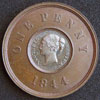
Nice! :-) But a silly question - how do you differentiate between bronze and copper? weight? colour? David Not a silly question at all, and I guess the only 100% test would be a metallurgical analysis. Bronze is around 95% -97% copper, so the relative densities are almost identical, hence weight doesn't really help. I bought my coin from Mark Rasmussen who owned, and has handled, many other similar proofs. He assured me that the coloration of this coin, compared to the otherwise identical bronze proofs, was very evident. The same difference that exists between the 'yellow/brown olive' toned examples of pre 1860 copper pennies and the subsequent bronze coinage which doesn't exhibit the same toning. In hand it is very evident.
-
Mmm worth £1600 so I'll sell it for a grand. Bargain. 99p would be closer to the mark for a 6 + G in this condition. I note he has tilted the camera so that the clincher between Obverses 2 and 6 - the gap between the top of the head and the linear circle - can't be seen clearly! Yes, funny that! Luckily he hasn't managed to hide different protrusion of leaves at the front of the wreath.