
Rob
-
Posts
12,800 -
Joined
-
Last visited
-
Days Won
347
Content Type
Profiles
Forums
Events
Downloads
Store
Gallery
Articles
Everything posted by Rob
-
It's somewhere else on the forum, but to save looking...

-
It's always nice if you can get it, but only one in a few hundred at best have multi-hued toning. The Edward the Confessor Pointed Helmet from Dorchester in Hulett part 1 was the best offering of late, with the pictures in the catalogue not doing the coin justice. A superb coin that JH was over the moon with when it arrived. Best I can do is my Cnut Crewkerne, but that is just predominantly pink to red.
-
The higher the grades, the more likely it is to be dealers. The lower grade bulk goes on eBay. Lotting is a difficult one. You obviously can't combine lots from different vendors, so a single person's submission will really depend on the overall value of the consignment. You don't want lots with an estimate of a fiver, otherwise you would be all day making not a lot of money. That can easily lead to diverse lots. I still don't see how any one person can cherry pick at lower prices in a free and fair auction. If somebody wants a lot then they will continue bidding, and if a collector, they can pay more than a dealer because the latter needs to make a margin. Virtually every collector I have known has pushed the boat out on a bulk lot to get a particular coin of interest. Whether it is a bulk lot or a complete collection you are buying, in my experience the initial outlay is nearly always covered with interest when the unwanteds are sold, so on balance worth pursuing.
-
For every dealer there are literally hundreds of collectors, so surely the prices realised are a reflection of collectors' unwillingness to pay 'a fair price' at auction. Time and time again, you encounter people whose sole reference point for prices is eBay, and in consequence are always working on the expectation of picking up something for 99p. No auction excludes people because they aren't a dealer, so with a level playing field in terms of access to bidding, it boils down to the collector's willingness to pay. The auctioneer is never going to knock things down for less rather than more, as his commission is usually a percentage of hammer.
-
By that do you mean too high or too low and ultimately what constitutes the real value given none of the references are definitive?
-
Or stored in less than desirable conditions.
-
Looking at the contact marks it has circulated, so the proof surfaces have been lost.
-
They can pay for their own honeymoon. A month trekking in the Himalayas in the autumn is a bit too much. Anyway, I have number two to sort out soon.
-
I was in Devon this weekend. My eldest got married, so a farmhouse and barns was hired for a few days for the ceremony and celebrations. Just short of a hundred guests including a couple dozen from as far away as New Zealand and a good time was had by all. Seriously hot though. I can report that the M5 was freer than expected today.
-
Use the Maundy sets for reference. They are 925 silver and the portrait agrees with the 1970 issue. Although there is a slight difference in colour between Ag and Cu-Ni, it isn't mind blowing, so any pre 1970 proofs will do if they have frosting.
-
It's cleanly struck and a full found coin, which is in its favour, but with the caveat that the surfaces are a bit wanting. The resolution isn't good enough to say whether it is deposits or corrosion and the portrait is a bit flat. You should be able to get one with a decent portrait for not a lot of money. I doubt you would have to go very far into three figures for a well struck full coin. Even on ebay you see decent examples on a buy it now for less, mainly due to the fact they are not the most popular denomination. It's the perennial problem of halves of anything being unpopular with collectors.
-
Makes use of their spare space. Rents in London are expensive, so any income from unused footage will help.
-
1853 proof halfpenny
Rob replied to oldcopper's topic in British Coin Related Discussions & Enquiries
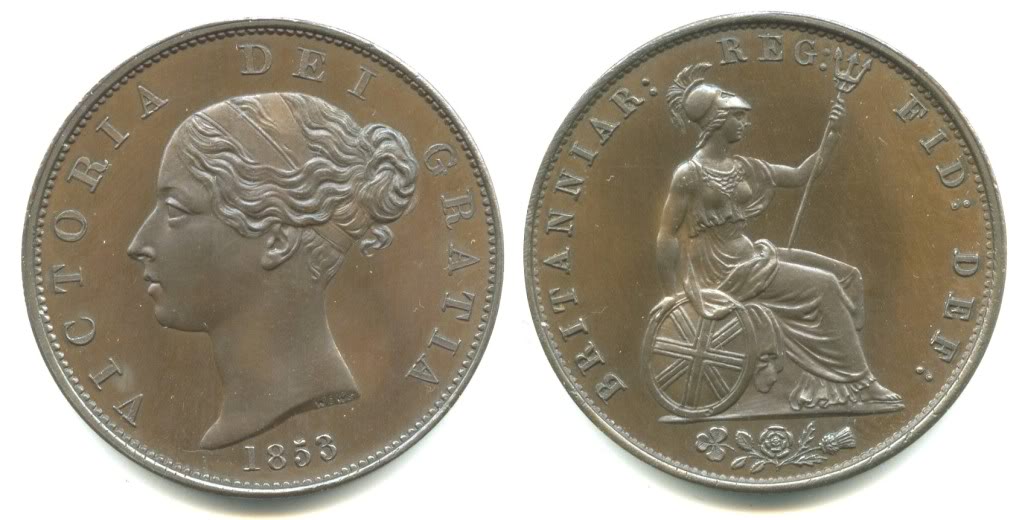
I certainly wouldn't want that as a proof, and I'm not convinced either. I have Norweb's 1853 proof copper halfpenny which has the stops all well struck up - see attached. A quick perusal of a few 1853 proof halfpennies listed show the dies don't match the bronzed proofs either. The SNC for Jan 2014 had an article by Peter Duff discussing the bronzed pieces.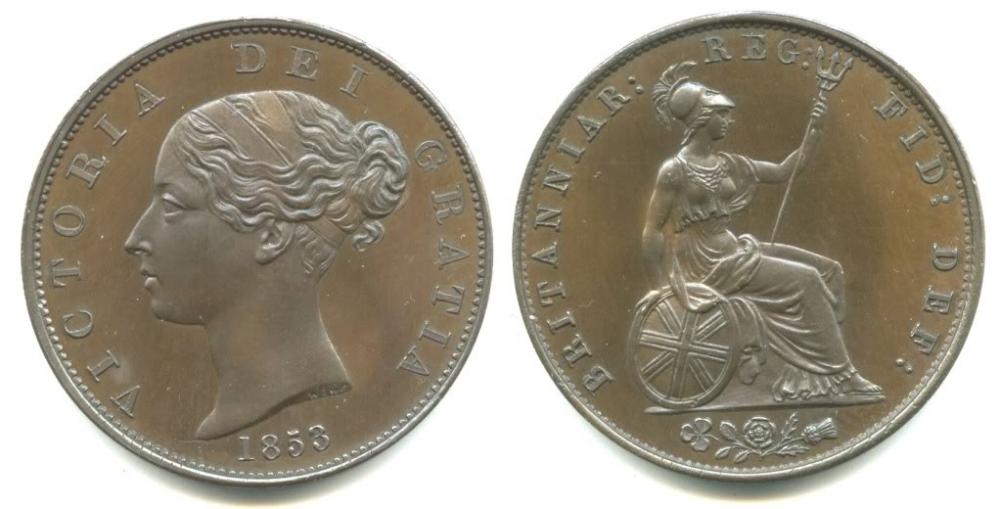
-
1853 proof halfpenny
Rob replied to oldcopper's topic in British Coin Related Discussions & Enquiries
If you copy and paste a link to it, then you don't have to worry about images. Go to the item and copy the address bar, then paste it into a reply on this thread. -
That'll be $56 for the coin and $300 for the label, then.
-
1848/6 Shilling - PCGS61
Rob replied to VickySilver's topic in British Coin Related Discussions & Enquiries
Looks like a broken die where the indent on the foot has been lost. -
It's too good for a PO1 designation. If it was a PO1, it for some reason becomes very collectable. There are people who strive for ever greater depths, and I don't mean divers.
-
Or for all the crap, a good dose of the Sex Pistols. Something to Pogo to and capable of distributing the dross far and wide
-
PCGS DCAM64 1953 crown EBAY
Rob replied to craigy's topic in British Coin Related Discussions & Enquiries
This might just be possible under an FOI request, as could a list of recipients. There aren't any security and minimal commercial confidentiality reasons to deny producing such a list - unless of course, there isn't one. They might not wish to reveal the identity of foreign governments using the mint's services. I was brought up on the understanding as Peck says, i.e. that the non-set years were called VIP proofs because their restricted numbers dictated a very restricted number of recipients. These people may or may not have been VIPs (whatever that actually means), but clearly were not given to all and sundry. Suitable candidates for receiving proofs would be certain cabinet politicians such as those directly responsible for the coinage; the designers, though clearly they wouldn't need subsequent examples to the first set received; the Royal collection; foreign dignitaries or anyone of similar stature you could think of. The list is not very long. A politician or former politician with an interest in coins might be able to shed some light on this. -
PCGS DCAM64 1953 crown EBAY
Rob replied to craigy's topic in British Coin Related Discussions & Enquiries
As I said. The TPGs have introduced another designation to get the financial juices flowing. I can see that a Cameo attribution can reasonably be claimed for a frosted bust, but to subdivide this without making some objective measurement is just a marketing ploy to expand the number chasers' remit. Given the TPGs don't address this issue in any scientific way, it would help if people stopped being obsessed with something to which there is no correct answer. The RM don't recognise the term 'VIP'. This whole issue is being driven by people who want to capitalise big time on the better frosted examples of common sets. Rhetorical question possibly, but why aren't there many people claiming the same 'VIP' attribution for all denominations? I can probably find half a dozen frosted bust 1953 proof halfpennies for example, all of which are now unquestionably VIPs and worth a million quid in consequence. When these common year examples are selling for the same price as the non-set years, which might only have one or two known and only rarely into double figures, then we can safely say the market has lost the plot and someone will shortly be burnt. It's a circus. -
PCGS DCAM64 1953 crown EBAY
Rob replied to craigy's topic in British Coin Related Discussions & Enquiries
Don't like maybes. So much speculation. It shouldn't be beyond the capabilities of anyone who thinks they have a heavily frosted 1977 proof to test the silver content against the regular one. Nobody can use the excuse that the regulars are hard to come by, and there is no shortage of microscopes fitted with EDX. BM, RM, the local uni,... I'm not sure why people are so exercised over this naming, other than the smell of filthy lucre. Heaven forbid you get one that looks like a 'VIP' but isn't accorded the title. The world will end. -
Try North (vol.1) for a reasonably comprehensive list of moneyers for each reign at a particular mint. As for individual numbers of type by a certain moneyer you will have to refer to specialist volumes or articles regarding said mint.
-
Coin Weight for Identification please
Rob replied to Paddy's topic in British Coin Related Discussions & Enquiries
That's what I assumed. There wouldn't be any reason for Briot to cut a James I legend. The next bit doesn't make sense? Needing a drink I can relate to. -
Coin Weight for Identification please
Rob replied to Paddy's topic in British Coin Related Discussions & Enquiries
OK, so using an old angel design die from James? I assume that side has no B? -
Coin Weight for Identification please
Rob replied to Paddy's topic in British Coin Related Discussions & Enquiries
I was referring to the less than clear lozenge after the S in the first post, which could be a knackered B. The image isn't clear enough on my screen to say what it is. I said not 1612-1619 because they made 11s weights for the contemporary angels, so anything made between these years would reflect the upturn in valuation. There is one in a thread on here somewhere. However, I would question a B signed weight being contemporary with the 1612 revaluation as Briot was engraver at the mint in Paris from 1605 to 1625 and he only appeared in this country during the reign of Charles I. I concur it is probable that they were made for 1/4 angels from Elizabeth's reign or earlier. Presumably, although 1/4 angels were not produced in the 17th century, there were sufficient numbers held by the public to warrant a weight being produced.