Leaderboard


Popular Content
Showing content with the highest reputation on 01/14/2026 in all areas
-
I admire all your work and dedication to this subject. I would love to make a more positive contribution, but unfortunately I have little detailed knowledge on these matters, and do not find them interesting enough to invest the time to learn more about the topic. Please don't be put off - I am sure others must be much more interested than me!1 point
-
This topic has now accumulated more than 200 views, but got no further comments. Since it is more than 2 weeks since I put my questions to Diaconis, with no reply, I figure it is time say where I stand. The position put by Diaconis is the one put in 2004 in a book issued by the Museum of Scotland “Weights and Measures in Scotland: A European Perspective” Up until 2004 the question had always been: 1) when did England get its weight system? In 2004 the Scottish book confused the situation by changed the question to: 2) when did that system get the name “Troy”? I judge the correct answer to (1) is the one suggested in the official account by Skinner of 1967. In a nutshell, we got the Troy system in 793 AD. This is the sequence of events. In 789 AD Charlemagne announced the creation of a new pan European penny (of 1.7g). Offa refused to to join up with his plan - with what was in effect an early medieval Euro. A hard Brexit broke out. By 790 AD Channel ports on both sides were reported closed. That hard Brexit terminated with what was in effect a new tariff agreement, with a charge of 1/16th by weight on bullion. In Mercian England an imported Troy pennyweight of silver (24 Troy grains) bought foreign merchants a sterling penny (weight 22.5 grains). Notice that in 1344 Powerful Italian Bankers tried the same sort of thing again. This time to push England onto an Italian (Florin) weight standard, using the standard we today call avoirdupois or “Imperial”. That attempt failed by 1351, as far as the coinage goes. However avoirdupois became widely used for other goods in the 14th century, which is the real reason why the name “Troy” arose. It was to distinguish the very old English standard from the newly imported standard of the Italian bankers (often called “Lombards” but in fact being chiefly Florentines) Notice this third matter. The Scottish book went to the press in 2004, so was developed alongside a third failed attempt to push Britain into a continental currency – now the modern Euro. Tying up a loose end, the Scottish book correctly points out that the English Troy system closely resembles a weight system used for silver in the city of Bruges. The resemblance was already well known before 2004. But the only argument given for Bruges having got the standard first is the spurious one, concerning the origin of the word “Troy”. Surely the tail is wagging the dog here? Little Bruges got its standards from mighty England. That sums up my own conclusions. Questions or criticisms are of course welcome. Robert Tye1 point
-
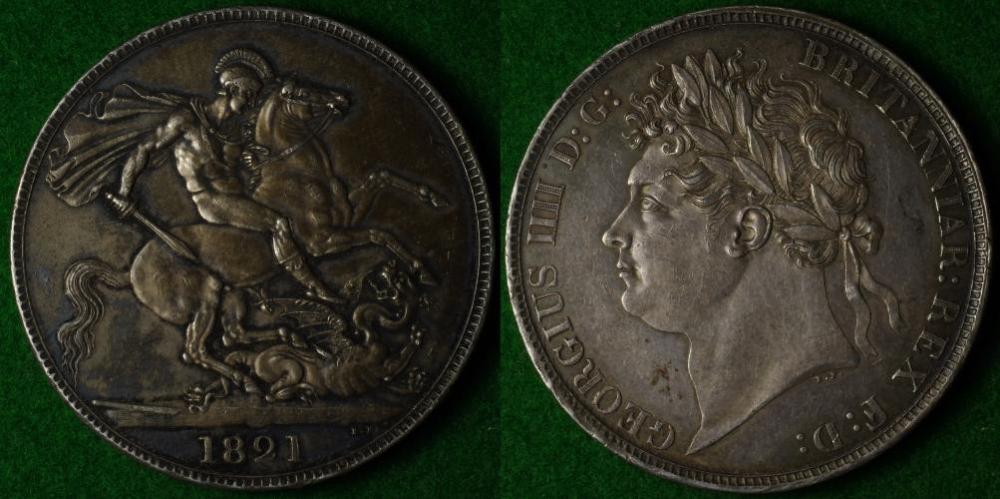
I picked this up for about £200 over 20 years ago: I wouldn't rate it as a thousand pound coin but should be well over what I paid!
 1 point
 -
Consider getting a specimen crown rather than the RE proof as it is much cheaper. The specimen is nice, has reflective fields (but no frosting), and comes in the same red box as the proof. My specimen (top) cost me £50 in 2020 and my RE proof (bottom) cost £500 15 years ago.
-Copy.jpg.2c588ce105ce4add953990bc7684bba5.jpg)
-Copy.jpg.99ed70fff3cb1123b6b0487666b46107.jpg)
-Copy.JPG.3a8d4752925046782defcbed3e7a9426.JPG)
-Copy.JPG.63b62e71f732190c680b7a61215b9d19.JPG) 1 point
1 point -
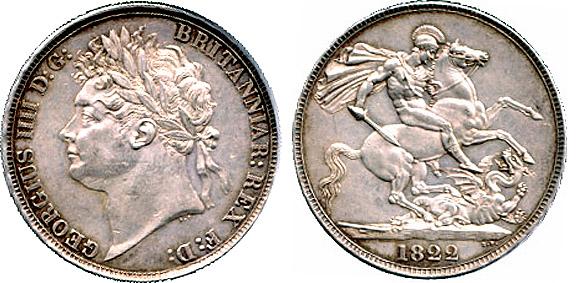
I hadn't realised GIV Crowns had got so high! This is my best, picked up about 15 years ago as part of an old family collection:
 1 point