Peckris Posted July 5, 2018 Posted July 5, 2018 9 minutes ago, DrLarry said: could you please advise me what microscope camera you are using. Are you a petrologist? I'm not - I'm looking at alfnail's big enlargement picture he posted, and I quoted. Quote
Rob Posted July 5, 2018 Posted July 5, 2018 3 minutes ago, DrLarry said: one other intriguing thing is that I have a 58 where the 5 appears to be over a 3 with a small bulge in the lower loop of the 8 is it all all possible that the 8 is over a 9 and they reused the proof die for 1839 Penny ? On the face of it, this might have some merit because 1839 proof sets were being produced long after 1839, so 1839 penny obverse dies were certainly available. Quote
Rob Posted July 5, 2018 Posted July 5, 2018 That looks like a small flaw rather than an underlying character. Quote
Rob Posted July 5, 2018 Posted July 5, 2018 There is circumstantial evidence for the 1839 proofs being issued up to the early 1880s because ESC 3249 (1738) is a 3rd young head sixpence with an 1839 reverse. The third young head was introduced in 1880. However, the mint equipment was upgraded in 1882 when the old Boulton & Watt presses were replaced. It's only conjecture, but there may have been a few sets of 1839 proofs issued prior to the refurbishment when the old dies may have become redundant - not being compatible with the new equipment? If so, the number made could possibly equal the number of these anomalous sixpences extant. ESC rates them as R5 (5-10 known), which is feasible. In terms of the penny, it is therefore likely that 1839 dies were always available. The halfpenny proof die was replaced on at least 2 occasions, with both 39 over 41 & 39 over 43 known. 1 Quote
Peckris Posted July 5, 2018 Posted July 5, 2018 1 hour ago, DrLarry said: yes maybe but interestingly this one does not have a W.W on the trunk That looks like a simple 'doubling' caused by recutting the date - my 1858 is exactly like that (though possibly without the protuberance on the 1) Quote
alfnail Posted July 5, 2018 Posted July 5, 2018 5 hours ago, DrLarry said: could you please advise me what microscope camera you are using. Are you a petrologist? The digital microscope I use was bought around 4 years ago, so I expect there may be some better ones out there for similar price, but I haven't checked recently. You can see on the following link:- https://www.dino-lite.eu/index.php/en/component/k2/item/2566-am4815ztl P.S. You need a good stand as well to focus in accurately. Quote
Diaconis Posted July 5, 2018 Posted July 5, 2018 2 hours ago, alfnail said: The digital microscope I use was bought around 4 years ago, so I expect there may be some better ones out there for similar price, but I haven't checked recently. You can see on the following link:- https://www.dino-lite.eu/index.php/en/component/k2/item/2566-am4815ztl P.S. You need a good stand as well to focus in accurately. Video may be of interest, hope so. I had a Firefly, now expired, was comparable with a Dino-Lite. Looking to purchase a new one. Might try one of these. 1 Quote
Diaconis Posted July 5, 2018 Posted July 5, 2018 16 minutes ago, DrLarry said: thanks for that it has many of the features I would like in the processing application You're welcome DrLarry, somehow I knew that YOU would like it 1 Quote
jelida Posted July 5, 2018 Posted July 5, 2018 19 minutes ago, DrLarry said: 1861 E over B PENNY has anyone ever come across an 1861 PBNNY E over B I have one which has a die break connecting the upper and lower part of the E with additional metal in the centre. The die break follows the arc of a B curving around . I always think of die breaks as following the line of least resistance which sometimes seem to indicate they follow flaws where a letter may have been mistakenly set and or removed. I assume that you would have to grind down to remove such an errors and if you do not grind down sufficiently cleanly the fracture can occur along that boundary. Am I correct? my confusion arises from the HALP varieties some say they are over P's some clearly are die flows connecting where the P is removed. I doubt you could grind out the full depth of a misplaced repair on a die without creating a massive and obvious bulge in the field of a struck coin. Far easier to fill the die locally, polish the die surface (field on the coin) and re-punch the necessary repair. And I do agree re the HALP halfpenny, all those I have seen look very much like a flaw, especially when compared to the 1860 E over P penny which is clearly an erroneous repair with a clear clean loop of the P. Some nice discussions over the last couple of days, Penny-wise. Jerry Quote
PWA 1967 Posted July 5, 2018 Posted July 5, 2018 (edited) 13 hours ago, DrLarry said: well done that will be a really great contribution I have about 80 1853's which I have been studying as part of my collection on copper pennies. Let me know if you need any help there are some strange things going on with some of the legends Why you have such a large group Larry can i ask you out of the eighty you have how many are PT please ? Sorry if its not something you know off the top of your head but the PT is much scarcer and would guess at three out of eighty Edited July 5, 2018 by PWA 1967 Quote
PWA 1967 Posted July 6, 2018 Posted July 6, 2018 4 minutes ago, DrLarry said: Mine are mostly cheap ones I was intrigued by something in the legend I'll count tomorrow sometimes I don't notice these variations at times I just like them they are pretty shiny things lol Thank you. There is also a 1853 with the large 5 which is a DOT between the I & A in GRATIA ,you may not be bothered but a variety that you also may have in such a large group. Quote
Peckris Posted July 6, 2018 Posted July 6, 2018 21 minutes ago, DrLarry said: Jerry could you explain for me the process of "filling the die locally" do you mean physically insert a piece of metal the hope it stays in place? This little journey with this E over B? in the 61 LCW reverse is proving to be quite interesting. I will prepare the pictures and let you take a look I have gone through about 20 and there are indicators and I would value your or anyone else's input who may have some 61's Thanks That would be impossible considering the enormous force with which the die hits the blank. The only way IMO is to repunch the erroneous letter, which would certainly leave some trace of the underlying letter. That is obviously not the case with the ONF penny for example, where it's a case of die fill through gradual process, not a stray piece of metal. Where a piece of metal does stick to the die - a brockage for example - it survives only for a single subsequent strike, which is why brockages are unique. Quote
Rob Posted July 6, 2018 Posted July 6, 2018 (edited) They must have been able to fill the die somehow. It clearly isn't a case of just dropping in a piece of metal the right size and hoping it stays. It would have to be a piece of soft metal that is physically hammered into the recesses and then the die put through the hardening process again. The attached is my 1675 over 3 over 2 halfpenny, which has a continuous flat surface in the exergue and so the 2 was clearly not ground out before the 3 was entered. The 3 only marginally impacts on the 2 (the top curve of the 3), with the remainder cut into good metal. The 5 is made by adding a reversed z-type 1 to the curve. A raised trace of the bottom of the 2 base is still visible on the coin as is the general 2 profile, which gives 2 options. First is the 2 was removed on the coin with the die still retaining the original 2 detail - which is a non-starter. The second is that it was filled and recut, which I believe is the solution. This was also the method used by Taylor to make the 1807 proof halfpenny die, also shown somewhere on this forum. In that case though, the total number struck was small unlike the currency Charles II shown here. Edited July 6, 2018 by Rob Quote
jelida Posted July 6, 2018 Posted July 6, 2018 44 minutes ago, DrLarry said: Jerry could you explain for me the process of "filling the die locally" do you mean physically insert a piece of metal the hope it stays in place? This little journey with this E over B? in the 61 LCW reverse is proving to be quite interesting. I will prepare the pictures and let you take a look I have gone through about 20 and there are indicators and I would value your or anyone else's input who may have some 61's Thanks I understand this can be done but do not know for sure how, and I can’t remember where I came across it. Die letters do fill in use presumably with metal particles. I understood that the die recess could be filled with powdered metal/alloy of a fractionally lower melting point than the die metal, then the whole heated to the melting point of the fill followed by working/punching/polishing then annealing of the repaired die ready for use. But without a reference I cannot confirm this. Certainly a die is far too hard and thick to tap up from behind to replace any metal ground away from its surface. Jerry Quote
jelida Posted July 6, 2018 Posted July 6, 2018 Just now, DrLarry said: I suppose copper powder in the recess would melt at a lower temperature than the bronze but localised proximity might bond the copper to the bronze even to allow a small extension of the life of the die. I am not 100% sure of the melting points of the two or if in the furnace without some catalyst it would be possible it certainly seems to make some sense to me and I have often wondered how they do correct things as there often seem to be errors that appear (at least with scars) to have been altered especially on the early 60's pennies and half pennies. But it must be a hell of a difficult job. The die is made of iron/steel, and the infill would have to be adherent and hard. I have no idea what would be suitable. Jerry Quote
Rob Posted July 6, 2018 Posted July 6, 2018 It's a lot cheaper to fill a die and recut one character than it is to start from scratch. This applies whether it was a change of privy mark following the pyx, or a change in the calendar year. The mint was not a publicly funded institution with everyone salaried, rather the running costs came out of the sum given to the master of the mint who employed all those under him. Consequently, the cheapest remedy gave him the best return on his activities. 1 Quote
Rob Posted July 6, 2018 Posted July 6, 2018 3 minutes ago, jelida said: The die is made of iron/steel, and the infill would have to be adherent and hard. I have no idea what would be suitable. Jerry I would suggest a softened piece of the same metal used for the die. The presence of the bottom line on the 2 base above tells us that it isn't a perfectly flat fill. Maybe they used a 2 punch to hammer in the filler. The fact that die blockage is fairly persistent and progressive tells us that filling a character has a good chance of lasting long term. Quote
PWA 1967 Posted July 8, 2018 Posted July 8, 2018 3 hours ago, DrLarry said: is the large 5 variety reasonably common ? Yes Larry its a common year and not hard to find one of each ,you will notice the small one described as italic and the larger one having a curl at the top. The scarcest is the PT ....Did you find anymore Quote
scott Posted July 9, 2018 Posted July 9, 2018 1861 halfpennies have plenty of broken letters as well Quote
PWA 1967 Posted July 9, 2018 Posted July 9, 2018 32 minutes ago, DrLarry said: no It turned out I only had 48 a little short of my 80 prediction my apt to thinking I have more than I have when I see a sheet full of them soon it will be time to sell off a load and be a little more selective, I just love these old copper pennies as much as I love the bronzes yet it is hard to imagine carrying them around in the pocket shocking really any survived at all not battered and dented and scratched to pieces. Well one out of forty eight shows how much scarcer they are Plenty varieties on the Coppers to look for. Pete. 1 Quote
alfnail Posted July 9, 2018 Posted July 9, 2018 One small spreadsheet, but a lot of work:- I mentioned a few days ago that I had taken pictures of all ebay listings of Victorian ‘Young Head’ copper pennies over a 5 year period, this was from September 18th 2008 to September 17th 2013. I did this with the aim of trying to compile some useful statistics when time permitted. Attached is my initial spreadsheet for 1853 Pennies, this may help clarify the rarity of the Plain Trident (PT) pennies compared to OT currently available in the market place………and I suspect fairly close to the original mintage percentages. I also attach images, at identical resolution, of the three different font types for numeral 5 (which I know of) used on the 1853 penny. Pete’s earlier comment about the ‘large 5’ was referencing Gouby Style A, sometimes also called Italic 5. This date type is very rare when found paired with the Plain Trident reverse, with a count of only 9 in the above spreadsheet. On the obverse of this variety I believe there may always be a small dot between the I and A of GRATIA, although I cannot be 100% sure on all 9 of these coins because of the image quality. I will follow on with images of my own piece, which I was lucky enough to find in 2014, where this dot can clearly be seen. I also think that this exact same obverse is paired with the much more common Ornamental Trident variety, presumably on coins struck around the time that the Plain Trident was first introduced…….so the I.A in GRATIA can also be found on OT. In this spreadsheet I also decided to include stats for the Peck 1503 variety, sometimes known as the Closer DEF colon, i.e. NOT midway between the F of DEF and Britannia’s toes (as is usually seen). Bramah references this as his type 15 saying “last colon is 1mm from the F, and 2 1/4mm from Britannia's foot; he also goes on to say:- Coming to the trident divisions, the O.T. class of 1853 is common while those with P.T. must be accounted almost rare. The sub-division No. 15 of the O.T. class of this year is also rare. I often wonder, with current knowledge and a blank sheet of paper, how one would now categorise the features that are seen on the 1839 to 1860/59 penny series. There are certainly a number of interesting things seen with regard to colon dots, but where does one draw the line? For example, if one just looks at the 1853 penny, the colon dots after DEF are not just seen ‘closer’ to F, and normally aligned midway to the toes, but also in a number of other ‘in between’ positions…………and the individual dots can be seen a) almost touching, quite distant from one another, and c) distinctly slanted in both directions. Indeed, Bramah again recognises this on his Page 108 by saying:- Another prolific source of minor variation is provided by the colons on the rev. Probably every die creates a colon variant and the only really satisfactory way of describing the position identifiably is by measurement and by the rather delicate indication afforded by projecting the line of each colon and so cutting the inscription opposite. Anyway, I do not wish to hog this site so I will cut off now and invite anyone interested in this area to ask questions or clarification on the spreadsheet numbers. 3 Quote
alfnail Posted July 9, 2018 Posted July 9, 2018 The spreadsheet was supposed to appear before the pictures!! Anyway, here is the promised 1853 PT Italic 5 2 Quote
PWA 1967 Posted July 9, 2018 Posted July 9, 2018 (edited) Ian....... I have confused myself here yet again The Italic 5 is that known as the Large one then and the curl small , i am aware of the differences but just want to confirm please ? Also that the 1853 PT is about one in fortyish that is similar to Larrys findings ? Pete. Edited July 9, 2018 by PWA 1967 Quote
alfnail Posted July 9, 2018 Posted July 9, 2018 Hi Pete, No worries! Those boxes with the three types of 5 fonts are all exactly same dimensions. I could measure numeral sizes but didn't bother because they all look around the same height and width to me, so no real startling differences to report...…...unlike say an 1857 numeral 7 or an 1859 numeral 9 where font sizes can be distinctly different. I guess the italic 5 looks a bit wider than the others, but then if you were to rotate it to stand upright you could say it would become narrower. I prefer to call this an italic 5 rather than a 'large one'. i.e. following the lead given by Gouby on his website:- http://www.michael-coins.co.uk/1853_penny.htm Hope that helps, 1 Quote
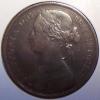
1949threepence Posted July 10, 2018 Posted July 10, 2018 Evening chaps - can someone kindly confirm for me that this is reverse N. I have an opportunity to buy a F114, and I want to be absolutely sure that this is a F115 before I splash out. I'm 99% certain it's the much commoner reverse N, but there is just that niggling doubt, as it was bought in more unsophisticated days simply as 1882H, and no type. I find the two reverses difficult to tell apart as the differences are (or appear to me to be) quite subtle. Thanks in advance. Quote
Recommended Posts
Join the conversation
You can post now and register later. If you have an account, sign in now to post with your account.