Zo Arms Posted September 16 Posted September 16 Evening all. I'm still alive. Silly question time. Picked this up on eBay the other day. 1875. The wide spacing of the colon, in relation to the G of REG, would suggest obverse 13. Thoughts on whether the T's of BRITT are sufficiently touching, to make it a 13#, sought. Desperate coin I know. Been delivered but working away from home at mo, so sellers photos. Quote
Zo Arms Posted September 16 Posted September 16 And a screenshot of Bernie's 13#, to show the relationship between the I and the T's. Quote
Martinminerva Posted September 17 Posted September 17 Think it's a penny, Bob - bust of Victoria too big and too near linear circle at top to be a halfpenny. D'oh !! Quote
Zo Arms Posted September 17 Posted September 17 1 hour ago, Martinminerva said: Think it's a penny, Bob - bust of Victoria too big and too near linear circle at top to be a halfpenny. D'oh !! Of course it is. Listed as a half penny but I was to busy looking at the finer detail to notice the elephant. I'm back home tonight but yes. Definitely a penny. Thanks. Quote
DrLarry Posted 6 hours ago Posted 6 hours ago (edited) In the past few months I have been working on the identification of an unusual anomaly in the 1865 half penny. I bring it to your attention out of respect to the principle of the group to improve our knowledge. In four examples collected since 2024 the colons are I assume then the die differs from any I have seen since I've been collecting. The colons are not rounded but square/diamond shaped. The closest similar colons exist on the Canadian bronze coins. I'm sure someone else must have noticed this but I can find no other references to this. I have it in coins which are EF to fine and in each case the arrangement of the colons is I think the same. I will post pictures if anyone is interested. Edited 5 hours ago by DrLarry Quote
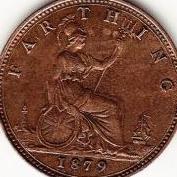
absence of uniformity Posted 3 hours ago Posted 3 hours ago (edited) 3 hours ago, DrLarry said: In the past few months I have been working on the identification of an unusual anomaly in the 1865 half penny. I bring it to your attention out of respect to the principle of the group to improve our knowledge. In four examples collected since 2024 the colons are I assume then the die differs from any I have seen since I've been collecting. The colons are not rounded but square/diamond shaped. The closest similar colons exist on the Canadian bronze coins. I'm sure someone else must have noticed this but I can find no other references to this. I have it in coins which are EF to fine and in each case the arrangement of the colons is I think the same. I will post pictures if anyone is interested. Attached image is a 1861 HP. Edited 3 hours ago by absence of uniformity Quote
absence of uniformity Posted 2 hours ago Posted 2 hours ago I noticed on this halfpenny the features detailed in the attached image. I know its not B/R but I was still interested to identify the possible cause/reason. Quote
DrLarry Posted 2 hours ago Posted 2 hours ago 15 minutes ago, absence of uniformity said: Attached image is a 1861 HP. Have you posted this in order to make a comment if so you seem to have not made one Quote
absence of uniformity Posted 2 hours ago Posted 2 hours ago 4 minutes ago, DrLarry said: Have you posted this in order to make a comment if so you seem to have not made one Im making you aware I have seen the same feature on a 1861 Halfpenny. Quote
DrLarry Posted 2 hours ago Posted 2 hours ago Oh yes on occasions I have seen it but nothing resembles this . I have a least 1000 1861 half pennies i always look to see if anomalies are accidental. A strike to a round edge flatens tht normal colon. But in the 65 the square is consistent. Quote
DrLarry Posted 2 hours ago Posted 2 hours ago Each of these is a different half penny 1865 the col9ns are completely different to the normal 1865 obverse and those found associated with the two types of 1865/3. Quote
Peckris 2 Posted 2 hours ago Posted 2 hours ago As the square colons are both consistent and global, they're clearly not accidental. In the absence of any knowledge from forum members, Michael Gouby would be your next port of call. Quote
DrLarry Posted 1 hour ago Posted 1 hour ago 18 minutes ago, Peckris 2 said: As the square colons are both consistent and global, they're clearly not accidental. In the absence of any knowledge from forum members, Michael Gouby would be your next port of call. Certainly they are deliberate i was surprised to find the pattern and position consistent in even the fine i have. I will contact Michael I just thought I would ask forum members if they had or had not seen this obverse type first. Quote
Coinery Posted 1 hour ago Posted 1 hour ago 47 minutes ago, DrLarry said: A strike to a round edge flatens tht normal colon. But in the 65 the square is consistent. I don’t quite follow you? Doesn’t Richard also have a halfpenny site, have you taken a look on there? Quote
DrLarry Posted 53 minutes ago Posted 53 minutes ago 38 minutes ago, Coinery said: I don’t quite follow you? Doesn’t Richard also have a halfpenny site, have you taken a look on there? Colons on every British half penny are struck round with a round punch. All four examples have square colons the square/diamond punch is placed consistently. The colons are unique to these 4 examples. The only other examples of a square colon set is the 1864 Canadian half cent. Quote
Coinery Posted 46 minutes ago Posted 46 minutes ago Interesting…as Peckris suggests, then! I found Richard’s halfpenny site, I can’t see that it specifically mentions square/diamond colons? I would’ve expected to find it there if it was a known thing! https://halfpennyvarieties.wordpress.com/home-page-recreated/ Quote
DrLarry Posted 45 minutes ago Posted 45 minutes ago (edited) 55 minutes ago, Coinery said: I don’t quite follow you? Doesn’t Richard also have a halfpenny site, have you taken a look on there? Yes of course this obverse was used in half pennies up to 1870s but it has never had square colons Edited 41 minutes ago by DrLarry 1 Quote
DrLarry Posted 42 minutes ago Posted 42 minutes ago 2 minutes ago, Coinery said: Interesting…as Peckris suggests, then! I found Richard’s halfpenny site, I can’t see that it specifically mentions square/diamond colons? I would’ve expected to find it there if it was a known thing! https://halfpennyvarieties.wordpress.com/home-page-recreated/ It's very easy to fall into a habit of glancing at something knowing what to expect only to realise it's a very different beast. Quote
DrLarry Posted 31 minutes ago Posted 31 minutes ago The only variant on the point rotation of each of the corners occurs on one where the side points to the middle of the two leaves after DG on three others the corner points directly into the two leaves. But this could be a repair but that then would suggest the same punch was used sometime after the initial " error " which seems very unlikely. The rotation of the others are consistent. Quote
Recommended Posts
Join the conversation
You can post now and register later. If you have an account, sign in now to post with your account.