
terrysoldpennies
-
Posts
832 -
Joined
-
Last visited
-
Days Won
59
Content Type
Profiles
Forums
Events
Downloads
Store
Gallery
Articles
Everything posted by terrysoldpennies
-
Hopefully you've all had a good Christmas, and as its now over I have a new type for the New Year . I'm sure most of you know that there are two types of 1905 penny listed, the F160 with the E in PENNY pointing to the gap between the teeth [ early type] , and the F161 with the rotated E pointing to the tooth [late type]. Well I noticed some time ago that some of the F160s have a small zero in the date, this by its self seemed of little importance , but I later realised that all of the pennies with the large zero , both F160s and F161s all have the straight bottoms to the Es in PENNY, whereas the small zero type, on all the examples I have managed to find , have the wavy bottomed Es. The straight and wavy Es were both in use from 1899 through to 1905, but only the straight type from then on. The small zero was used from 1901 to 1905, and after this the large zero from 1905 to 1908. This means that it is a transitional type reverse die used between the 1904 F159 and the 1905 F160. It also suggests that the differing bottoms to the Es, was a Font change, rather than a warn die creation. As if it was caused by wear, then you would expect to find at least some of the F160s and the F161s with the large zeros to have the wavy Es . Terry Top :- New type F160 Middle :- F160 Bottom :- F161


-
1860 penny ; variety?
terrysoldpennies replied to Lost_shilling's topic in British Coin Related Discussions & Enquiries
Its a Freeman 2+D [Gouby D+D ] Terry -
I'm slipping how did I manage to miss that one. Terry
-
More Pennies
terrysoldpennies replied to Prax's topic in British Coin Related Discussions & Enquiries
I could not believe it when it came up on E.bay. a buy it now £4, postage included, but I certainly sweated buckets when I thought it had gone missing. Terry -
More Pennies
terrysoldpennies replied to Prax's topic in British Coin Related Discussions & Enquiries
Thanks everyone I've been lucky . terry -
More Pennies
terrysoldpennies replied to Prax's topic in British Coin Related Discussions & Enquiries
I received this in the post today , its taken a month to arrive [ incorrectly addressed ] .and so I thought it to be lost , so I'm thrilled to at last have it safe in my hands. its one I did not have. Terry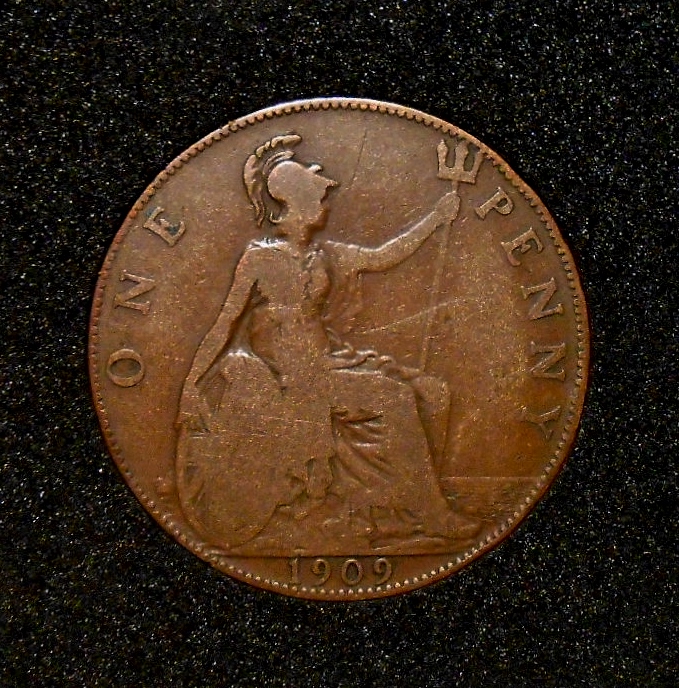
-
1963 penny with wavy exergue
terrysoldpennies replied to terrysoldpennies's topic in Confirmed unlisted Varieties.
I wonder if the distortion of the digits were caused by the same problem in the manufacturing process as that which caused the wavy exergue. Terry
-
1963 penny with wavy exergue
terrysoldpennies replied to terrysoldpennies's topic in Confirmed unlisted Varieties.
I was just taking another look at my 1963 wavy exergue , and have noticed something overlooked at the time , because we were all to distracted looking hard at the wavy exergue. The 9 has a squared off chisel like end to its tail, and also that the circular part of the 9 is squared off at the bottom. A second pic in different light shown below . has anyone else got another one with this feature on it. Terry
-
Penny Acquisition of the week
terrysoldpennies replied to Paulus's topic in British Coin Related Discussions & Enquiries
The thing is that the 1951 has on over inflated reputation, and you cant blame the dealers from cashing in on it. Being one of the older generation I can tell you that people had more on there mind , and little money then to indulge in coin collecting. The boom really came in the 1960s when the introduction of decimal coinage was announced . Terry -
Penny Acquisition of the week
terrysoldpennies replied to Paulus's topic in British Coin Related Discussions & Enquiries
As soon as the location of the 1951s was know people started hording them in mint condition , unlike the 1949 . The 1912h is another one that was horded , where as the 1912 most were melted down in the 1960s. Terry -
1860 Bronzed Proof Penny
terrysoldpennies replied to cathrine's topic in British Coin Related Discussions & Enquiries
Underneath the D in D G there's a Mark , and its present on both coins , I think they are the same penny . Terry -
More Pennies
terrysoldpennies replied to Prax's topic in British Coin Related Discussions & Enquiries
its a 2+d maybe they think its a 2*+d , Its not Terry -
Its a better find than you think, there are four types of 1913 penny , Freeman 174 known as F174 Q.common] / F175 V.scarce / F176 V.rare / and F177 the most common type. Yours is a F175, and not a bad find for the price, though its a shame its been cleaned at some time. Terry
-
New reverse type G on an 1861 F20 penny
terrysoldpennies replied to terrysoldpennies's topic in Confirmed unlisted Varieties.
Hi Mr T , both have 138 teeth on the Rev. and 143 on the Obv. so no difference there , But as Mike suggested they may have been made by different mints , one James Watt and the other the Royal Mint , this may have been an identifier, so as to know which mint manufactured which, later to use the H and KN on coins. Terry -
clogs, die faults, et al.
terrysoldpennies replied to bhx7's topic in British Coin Related Discussions & Enquiries
I think they are just spikes, This is the one I have always understood to be the crows foot , found on an 1918 kn Terry
-
More Pennies
terrysoldpennies replied to Prax's topic in British Coin Related Discussions & Enquiries
The picture of the 1954 in the Empire coins catalogue still shows the bruise across the trident , as with all the other pictures here , I think they must all be the same coin Terry -
More Pennies
terrysoldpennies replied to Prax's topic in British Coin Related Discussions & Enquiries
Note also the bruise on the trident . Another significant point about the 1954 is that the Obverse has 118 teeth and 118 reverse . The 1960s pennies have 119 Obv. 118 Rev. Terry -
clogs, die faults, et al.
terrysoldpennies replied to bhx7's topic in British Coin Related Discussions & Enquiries
This is a novel one that looks like a Ducks head . its on a 1926 3+b Terry
-
Freeman Obv 3 Gouby E Rev D Terry
-
New reverse type G on an 1861 F20 penny
terrysoldpennies replied to terrysoldpennies's topic in Confirmed unlisted Varieties.
I think you may have something there with different mints, and maybe their quality control varied, but it is strange that all of the Rev Ds seem not to vary from P to tooth and E to gap in PENNY . With this also being a well used die in 1860-61 you might have expected to see differences. Maybe they were made elsewhere Terry -
New reverse type G on an 1861 F20 penny
terrysoldpennies replied to terrysoldpennies's topic in Confirmed unlisted Varieties.
Its strange the all the rotated letter Ps and Es are all in the word PENNY , with no variation to the E in ONE which as far as I can tell always points to the gap. Also that they are mostly on 1861s with the close 1 in the date. I wonder whether this was some kind of test series of rev Gs before settling on the P to gap type right through to 1874 Terry -
New reverse type G on an 1861 F20 penny
terrysoldpennies replied to terrysoldpennies's topic in Confirmed unlisted Varieties.
I should add that on all the rev Gs I have look at this left rotation of the P to face the tooth only appears on the 1861s , and not on any other year right through to 1874, but some in 1861 and 1862 have a slight rotation to the right, and a right rotation of the first N in PENNY. As with this 6+g 1861 below. Terry
-
The reverse dies of GVI pennies - a reappraisal
terrysoldpennies replied to davidrj's topic in Confirmed unlisted Varieties.
Both look to be the same date spacings. common type , but the left looks like the single Exergue , though as you say not easy to tell from pictures Terry p s All the new different date types were bought from America , I wonder if some sort of special issue of pennies were despatch to or made by the Americans during the War -
The reverse dies of GVI pennies - a reappraisal
terrysoldpennies replied to davidrj's topic in Confirmed unlisted Varieties.
Right Bob . I have confused things. Pic of all 4 ,second down is the common type, the bottom coin in the pic of 2 . and the third down is the top one in pic of 2 Sorry for the confusion Terry -
The reverse dies of GVI pennies - a reappraisal
terrysoldpennies replied to davidrj's topic in Confirmed unlisted Varieties.
That was a poor picture. The common one is on the bottom with the 4 too the right side of the gap Terry