

Rob
-
Posts
12,934 -
Joined
-
Last visited
-
Days Won
371
Content Type
Profiles
Forums
Events
Downloads
Store
Gallery
Articles
Everything posted by Rob
-
Why has the Queen's portrait on banknotes not been aged?
Rob replied to 1949threepence's topic in Free for all
It could be that HM simply can't be a**ed to get worked up about it, unlike Victoria who was renowned for being picky about her portrait, particularly in her later years. The Jubilee head portrait took 5 or 6 years to gain grudging approval. Just look at all the slightly different pattern halfcrowns struck in 1884 for example. We also know the JH was unpopular, resulting in the veiled head bust being introduced in 1893. There was also the fact that the young head punches were nearing the end of their lives, so it all pointed to change. -
Why has the Queen's portrait on banknotes not been aged?
Rob replied to 1949threepence's topic in Free for all
The young head portrait was used up to 1895 on farthings in this country, and on colonial issues to the day she died. -
That's what you do. Have a look. Look for as many reasons as possible as to why you wouldn't buy it. Compare it to the other items you have previously researched to ascertain where it stands in the pecking order gradewise. If it is in the top few and aesthetically ok then rule 1 applies unless there is one outstanding example out of a few known and the rest are crap. Hobson's Choice, you apply rule 1. If I haven't researched the available options, then more often than not I will move on, even if it seemed ok. Sometimes you regret not buying at the time, but more often not. If I know there are a few decent examples available then I avoid simply ticking the box as I know I will upgrade later if the right thing comes along. Things that only become available once every generation tend to fall under rule 1, as do coins with an impressive provenance.
-
Big Bang has a lot to answer for. I'm absolutely certain that Sheldon had nothing to do with the scale as he certainly wouldn't cope with 11 different categories of a statement of fact, namely, uncirculated. It's one of these sort of/very/extremely unique scenarios.
-
Import Tax, Customs & Excise, VAT on Coins
Rob replied to Coinery's topic in British Coin Related Discussions & Enquiries
You have postage charges from everywhere apart from a coin fair, so I wouldn't worry too much about shipping. The overall cost is only really important when you are buying to sell on. If for the collection, then you will underpay for some and overpay for others. Then it is a question of desirability over price. -
Import Tax, Customs & Excise, VAT on Coins
Rob replied to Coinery's topic in British Coin Related Discussions & Enquiries
Anything coming from the US these days is costing $20 and up. Having said that, tracked and insured to either Europe or the US is a tenner and more from this country depending on value. As for pricing, for the past few years I have tended to use the $ hammer price as the proxy for the price in pounds, delivered. Keeps it simple, because a few pounds either way is neither going to break the bank, nor have a major impact on whether to buy or not. -
Is that the legal equivalent of being sent to Coventry? Or is that Llantrisant?
-
Import Tax, Customs & Excise, VAT on Coins
Rob replied to Coinery's topic in British Coin Related Discussions & Enquiries
Usually the regulation 5% whoever it comes with. Any taxed at 20% I have usually put down to a mistake by the individual concerned as opposed to a company wide lack of knowledge. They all appear to know the rules. -
Let's See Your Toned English Milled Silver!
Rob replied to Paulus's topic in British Coin Related Discussions & Enquiries
First, one of a number of patterns struck in conjunction with Victoria's Golden Jubilee in 1887. A sixpence by Spink / Thomas, ESC 1783. Second, a 1697 E over Y sixpence.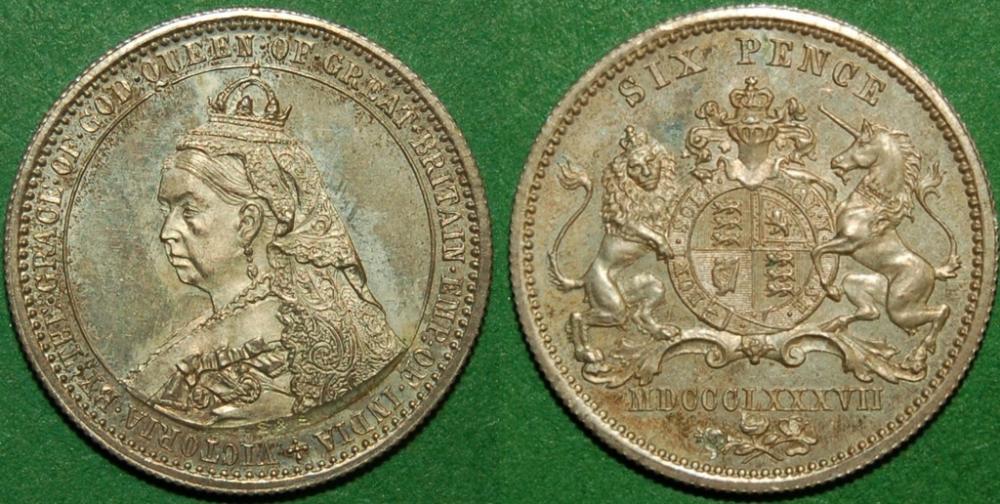

-
Let's See Your Toned English Milled Silver!
Rob replied to Paulus's topic in British Coin Related Discussions & Enquiries
1807 proof halfpenny. I suspect this may have originally formed part of a set in gold, silver and copper, with possibly also a bronzed and aluminium example. The rims have been filed on this coin, and are similarly filed on the gold piece. Maybe 10 years ago, I saw a copper proof with filed rims. All this suggests they were done as a one-off on request from one of Taylor's customers. The filed rims aren't restricted to the 1807 either as my Wiener pattern shilling in copper (ESC 1383) also has the rims filed and again is the only example I am aware of. The question is who asked for them? Murdoch?
-
Victoria Penny 1844 Double date
Rob replied to interNumi's topic in British Coin Related Discussions & Enquiries
Just a repunched date to extend the life of the die I assume. The first I of VICTORIA might have had similar treatment. -
Could do. Scrapping is environmentally friendly as it saves digging up Africa or Chile un-necessarily.
-
2p. As existing circulating currency, they are accepted at many outlets including banks, newsagents, supermarkets and any high street business. The can also be used in charity boxes. They are not suitable for on-line payments, because computers are not fitted with a coin payment mechanism.
-
Let's See Your Toned English Milled Silver!
Rob replied to Paulus's topic in British Coin Related Discussions & Enquiries
Shilling -
Let's See Your Toned English Milled Silver!
Rob replied to Paulus's topic in British Coin Related Discussions & Enquiries
As all my previous contributions were lost due to changes at photobucket, here's a handful of previously listed examples that seemed popular for those who haven't seen them yet.


-
Not sure why a ship is for X, nor why a xenophobe is for z. Surely these would be better listed under E for educational standards? No?
-
I suspect you might not be the only one thinking that. I predict A, E, I & O will be relatively rare in circulation, but at least it means a healthy supply of obverse unifaces for the error collector. Just noticed that this is my 10000th post
-
Surely at 52 coins for £54 it is hardly a case of being ripped off as the illustrated coin plus the 1949 3d, the unc 1920 halfpenny and the three unc farthings have to be worth the £50 you paid. Rhetorical question, but are you not happy at having effectively received 46 coins for free? eBay has always been like that. Many buyers get a bargain, many buyers pay too much, many sellers get ripped off, but most people are happy with what they receive. People have always lied, shilled, photoshopped, 'lost' things, shipped different items to those illustrated etc.The real problem is that buyers' expectations have been massaged down in terms of what they expect to receive and by extension to pay. If one person pays a quid, then all expect to pay a quid. It goes without saying that many expect the item received to be worth more than they paid, considerably so in some cases. The wife had someone the other day from Belarus. P&P to the UK was £3, but for some reason, he seemed to think that international shipping benefited from free postage. So he bought something for three quid expecting it to be delivered for free! The postage was more than 4 quid. Idiot.
-
VIP Proof Royal Mint reply
Rob replied to craigy's topic in British Coin Related Discussions & Enquiries
No, it was the Cu-Ni only. They were item MS5788 in the Dec.2003 Circular. Sorry, can't upload them as there seems to be a formatting conflict which is beyond me. -
VIP Proof Royal Mint reply
Rob replied to craigy's topic in British Coin Related Discussions & Enquiries
Yes it came from a 1958 set in the Circular in 2003. I had the shillings too and should have taken the florin. Colin Adams had bought the set to get the halfcrown he needed, so the others were going spare. The florin was sold through Spink's March 2005 sale. -
VIP Proof Royal Mint reply
Rob replied to craigy's topic in British Coin Related Discussions & Enquiries
And even 'VIP' years aren't necessarily frosted. e.g. http://www.londoncoins.co.uk/?page=Pastresults&auc=156&searchlot=2361&searchtype=2 compared to the 'silver' of the same year, which bear in mind was done on a scanner, so in reality heavily frosted
-
No need for a wish list. There's one here. https://www.amazon.co.uk/Ancient-British-Coins-Elizabeth-Cottam/dp/095668890X or here https://www.ebay.co.uk/itm/Ancient-British-Coins-Chris-Rudd-Free-UK-P-P-/152446965452
-
At least there is one reassuring piece of info in the email. He notes, 'now on wards' - presumably those of Dhoraji lunatic asylum.
-
res.sir, herewith i know you that i have 12th to 18th century gold and silver coins to sell on 80,00,000/- pounds advance cash deposit in my account term. IF YOU ARE NOT REALLY SURE ABOUT THIS OFFER , I CAN SEND YOU MY ID PROOFS. when your amount is deposit in my account then i proceed to send you coins parcel. OFFER NO.1 if you want only silver coins i give you 10,000/- silver and gold coins on this advance cash (80,00,000/- pounds) value. 2000 coins silver in one month of payment done by the party. 2nd lot of 8000 coins dispatch after six month OFFER NO.2 herewith i know you that i want to sell 50,000 ancient {mix metal coins} coins on this value (advance cash 80,00,000/- pounds) now on wards. offer for one month only sir please give me support i have long journy to start with you as business carrier. i have lots of ancient, antique coins to sell. i want to sell all the ancient gold silver and mix metal coins to you. 1st. lot ancient coins :- 2000 coins 2nd. lot gold and silver coins :- 8000 coins rest of coins give you at six month gape. but on one condition please pay fast advance cash of 80,00,000/- pounds first and i send your 1st lot nad after one month i deliver second lot account holder name:- chintan bharatbhai tank (mob.no. 00918469466030) my address near new haveli, jamnavad road, "LAXMI KLYAN", DHORAJI,RAJKOT,GUJRAT, INDIA. bank account details ,bank name:- state bank of india. ,bank routing no.:-360002082 bank account no. :- 31220416951 , bank IFSC CODE:- sbin 0060072 branch code :- 60072 thanking you, yours truly, chintan bharatbhai tank near new haveli, jamnavad road, "LAXMI KLYAN", DHORAJI 360 410 DIST. :- RAJKOT STATE :- GUJRAT COUNTRY:- INDIA Looks like the golden cart has gone. Not me guv.
-
You also see ponding inside the loops of characters due to surface tension.