TomGoodheart
-
Posts
4,272 -
Joined
-
Last visited
-
Days Won
51
Content Type
Profiles
Forums
Events
Downloads
Store
Gallery
Articles
Everything posted by TomGoodheart
-
LOL It was only after I'd written it and posted that bagerap's post showed up. I'm either real slow or need to refresh the page more often!
-
Oooh! Real James Bond stuff! Snap open the Calcium, drop it in water and stand well back!
-
LOL Depends on whether you consider barter items to be 'coins' Debbie. All sort of things were used as money via barter. I have some Hudson's Bay trade beads. Made in Venice they were exchanged at the rate of three beads for a beaver pelt. A rifle would cost its height in pelts. Seashells (cowries and 'tusk' shells (wampum)), quartz stones with a hole in the middle and blocks of tea, were all used as currency at some point. And although even nowadays coins are afaik all metal, things like trade tokens, ticket checks, gambling checks (chips) have been made out of al sorts of materials such as plastic, mother of pearl, wood or paper.
-
Interesting idea. Though personally if I was spending that sort of money I'd rather put it towards freeing the Ashdown Forest Five.
-
It's Iraqui. The portrait is Faisal II and it's a 10 Fils coin, first issued 1943. http://www.chiefacoins.com/Database/Countries/Faisal_II.htm I got most of that from a book my daughter bought me in the local The Works bookshop for a few quid. A fun read. Maybe see if your local library has a copy? Doh! Too slow on the typing again!!
-
The bottom line is that storage is down to personal preference. But what's important is that you avoid the coins rubbing against each other and causing further wear and damage, and that they are protected from extremes of damp or chemical fumes. I used to store my coins in flips. Basically they are card (some are plastic) with clear windows and you pop the coin on the window and fold over the other half. The coin is sandwiched between the windows and so protected from sticky fingers. And if you drop it, the card takes the damage. It's an inexpensive way to start. Certainly compared to the money a coin cabinet would cost! Just be careful if you use the non-adhesive ones and close them with staples, to fully remove the staple before you try to get the coin out. I've met a few coins with staple scratches across them. Not attractive!
-
Essentially when a coin is freshly struck it has a certain surface appearance, commonly known as lustre. Over time some coins will change colour as the air oxidises the metal. Often this can be quite attractive and in some cases this 'toning' is combined with the original lustre. Some coins were chemically treated at the mint to darken them. All of these different states are characteristic of the age of a coin and a sign that it has not been tampered with. Polishing simply removes all traces of the above by removing the surface layer of the coin. The technical term for this is 'ruining' and a ruined coin will have no collectable value whatsoever, I'm afraid.
-
Doh! Yeah, I meant that!
-
Really, until you know what you're doing it's safest to buy from a dealer. Here for example is a lot of Roman coins available for £33 from a reputable dealer that's a friend of Chris P (who runs this forum and site): Not in fantastic condition, but genuine and not a bad price for seven different Emperors from 600-700 years ago I think! Just click on the pic for the link.
-
Yup. I believe your coin is from the Provisional Government of China (ie Japanese puppet government 中华民 ) Year 28. Which if I'm correct is 1939. http://en.numista.com/numisdoc/calendar-japanese-34.html
-
Hi Johnny, and welcome! To try to answer your questions in order; By album, I presume you mean to put coins in? Well, most here tend to use trays of some sort. I have a cabinet, which is a wooden case with drawers drilled with holes to put your coins in, but it weren't cheap! Albums are OK, providing you buy proper ones designed for the purpose since in the old days some plastics used would discolour your coins. But they can get heavy and the pages sag. Trays are a bit more expensive (Chris who runs this site has some if you click on the predecimal.com link under the logo at the top of the page and go to 'Accessories'. Or the generally cheapest option is little paper envelopes. A dealer called Colin Cookesells them. They are made from acid free paper (so won't damage your coins). The only draw back is you can't see the coin! Some people do use the plastic envelopes but these aren't best for long term storage, or for your better coins. Again due to possible damage from the plastic. eBay is best when you know what you're doing. There are bargains, but also overpriced junk! It's more fun to look in antique shops, car boot sales or if you have a nearby coin dealer, in person at a shop. eBay is good to search though to see what people are paying for stuff, but grading (the assessment of how much wear a coin has) can be ridiculously bad. And since better grade means more expensive .. it's important to know a bit about that before trusting ebay sellers! The bulk Roman coins on eaby will never be brillliant condition, but as an exercise in cleaning and identifying, that's not a bad way to do it. However other dealers with websites do sell lots (as in auction lots, ie: a small number together) of Roman coins for ID ing. I think again Chris has a bit he's written about Roman coins here on the predecimal.com site. Probably in time you'll find a range of coins (either of particular value or historic period) you particularly like. Just remember, nobody here minds answering questions (though threads inevitably go off topic a bit!) even to a 'here's an ebay listing number, do you think this is a fair price'. Unless of course it's something someone else wants too. LOL
-
2011 Edinburgh Pound Coin
TomGoodheart replied to alloy's topic in British Coin Related Discussions & Enquiries
No! It's my experience that sometimes it takes longer for coins to filter through to some areas of the UK than others. The Darwin £2 is hardly scarce, given the numbers on ebay (and certainly not rare!) It might take a bit longer to find a nice example in your change but eventually one will turn up. Same with these. Personally I've not seen any 2011 £1 coins yet (unlike 2012 copper)! But I'm sure that when they do appear I will be able to find an acceptable example without actually buying one! -
Rather more interesting than a Euro from someone that's visited France! A little bit of history in change.
-
Two Hammered Charles I Shillings
TomGoodheart replied to HAXall's topic in British Coin Related Discussions & Enquiries
I felt that the marks on both sides were somewhat proud of the coin, suggesting an overmark. Together with the fact that I can imagine something under the mms of the other coin I tend to agree with you Rob. But as to why, that's a different question!
-
Two Hammered Charles I Shillings
TomGoodheart replied to HAXall's topic in British Coin Related Discussions & Enquiries
The rarest is probably the Negro's Head which was only struck between November 1626 to April 1627 in small quantities. Next rarest is the Heart mark (Jun 1630- Jun 31). But because the coins were individually made a number of dies were re-used (or their use extended) by later adding a different mint mark, and some of these 'overmarks' are also rare. And a few coins seem to have been made with the wrong, or an unusual, mark not normally found for that particular variety. For example this is not a terribly rare coin, issued during the Harp mark. But somehow two examples survive with the Portcullis mark; so a regular coin made very rare if you can find another with this mark! And it's made even more complicated (or challenging, depending on your point of view) by the fact that there are some coins that are easy enough to find in poor to Fine condition, but to get a better than average example is both time consuming and probably expensive. In other words it's not just the mint mark that determines scarcity, but condition and irregular features not normally found with that issue.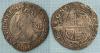
-
Two Hammered Charles I Shillings
TomGoodheart replied to HAXall's topic in British Coin Related Discussions & Enquiries
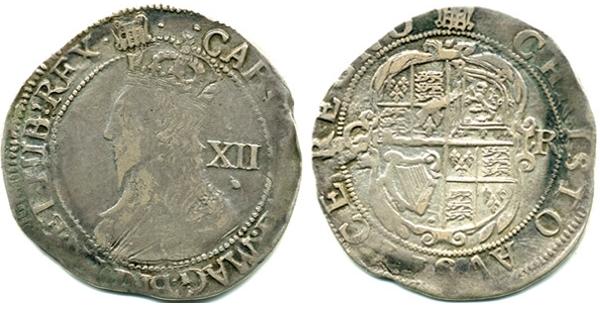
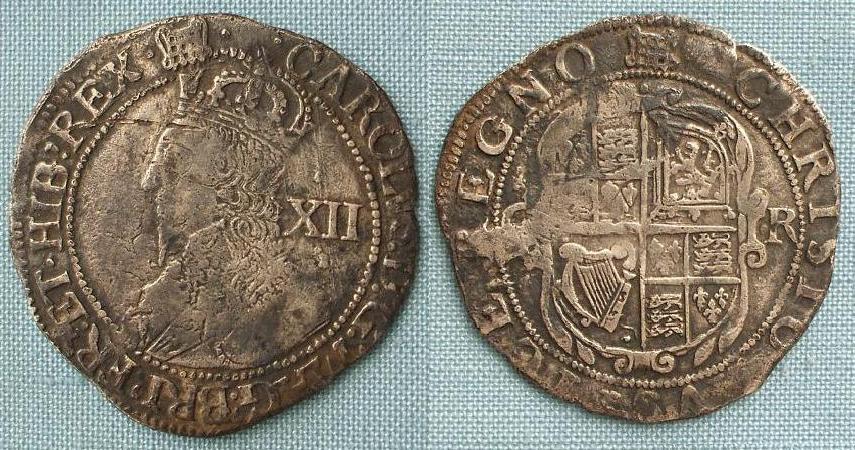
Hi HAXall. Well .... I'm afraid they aren't in brilliant condition! The left hand one (Spink 2800, Sharp G2/2 with the Sun mint mark (Nov 1645 - Feb 1647)) has been badly treated! Possibly it's been driven over, or someone has bashed it about. Without the dents I would grade it Fine (quite a lot of wear, but with design and legends distinguishable). The second (Spink 2799, Sharp G1/2) with the triangle in circle mark (Jul 1641 - May 1643) is about the same (Fine) though some details are clearer. I'd say you paid an acceptable price for the second, the first has to be marked down because of the dents. £12-£15 is about normal for ebay, though of course sometimes people get lucky and they go for more. Interesting pieces of history, but perhaps worth paying a wee bit more for nicer examples if you're planning on collecting the series! . -
Nah. I just remember odd things and have a knack with Googling!
-
Indeed. "The Penny Red The Penny Red was Great Britain's longest running stamp, from February 1841 to the end of November 1879. It was used for the standard letter postage rate of 1d and approximately 21 billion were issued. The 1d Red was a development of the Penny Black with the colour being changed from black to red so that the new black Maltese Cross cancellation could be clearly seen. This change was made following Rowland Hill's "rainbow trials" and "obliterating trials" to find the most sensible stamp and cancel combination to prevent people removing evidence of cancellation so the stamps could be re-used. Basically, his initial choice of very durable black ink for a stamp was a mistake! Until 1854 the 1d red was imperforate. In 1855 the watermark was changed from a small crown to a large crown. The first die was used to produce 204 plates, plus 6 reserve plates. A new die II was also introduced in 1855. This was used to produce 225 plates. Plates 71-225 have the plate number engraved on the stamp and these "penny plates" include the famous Plate 77 which you are unlikely to see outside of an exhibition as it is the rarest penny red and a good example could certainly fetch hundreds of thousands of pounds! The British Library has one on permanent display in the GB selection of the Tapling Collection. this stamp is mint. They also have a used on from the Fletcher collection too. The paper of the 1d red also changed from blued, to cream or toned to white (and a combination of the above!) between 1854 and 1858. A very great permutation of paper and ink shades were used to produce these stamps. The design was modified with letters in all four corners being introduced on 1st April 1864 and the plate number being engraved on each stamp. The reason that letters in all four corners was introduced was to significantly reduce the opportunity for people to reconstruct an unused stamp from the uncancelled parts of 2 used stamps. All 1d reds were printed using the line-engraved method by Perkins, Bacon & Petch (from 1852 Perkins, Bacon & Co) who finally lost their contract of 38 years in 1879 largely due to the fact that their stamps were printed in non-fugitive ink making their stamps more susceptible to being cleaned and re-used. On the 23rd December 1878 The Inland revenue gave 6 months' notice of the cancellation of the contract to print the 1d red. On the 8th May 1879 the Inland Revenue recorded that an agreement had been made for Perkins Bacon to continue to supply the 1d until 31st December 1879. In fact, the last plate was 225 which was put to press on the 27th October 1879 and was used for about 4 weeks, the print run ending at the end of November. This is confirmed by a letter from Mr Robertson of the Inland Revenue who comments on 3rd December 1879 "the printing of the Penny Postage label by your firm having come to a close." I suspect that all concerned would have been amazed to find that their "labels" are still enthusiastically collected and studied by people all over the world 150 years later! Incidentally, the Penny Red was originally called the Red Penny as well by collectors but that earlier term has now fallen away. " People collect stamps by plate number. Why not coins by die? Same difference to me!
-
A typo I think. He meant to write junc (He can't spell either!)
-
-
Fake in an NGC Slab!
TomGoodheart replied to Coinery's topic in British Coin Related Discussions & Enquiries
Out of interest, is anyone registered on the BNTA site and knows what the 'Forgeries' section is about? I can't be bothered to register just to see what there is, but wonder if anyone can post stuff there? http://www.bnta.net/forgeries-login -
It looks like it's been squashed. What diameter is it please Ray?
-
Is that Dolphin Coins trading under a different name? I didn't know that. I used to enjoy flicking through The Sovereign, which had some gorgeous coins for sale if only I could have afforded them! Yes, they became 'South East International Trading' a few years back and the outside of the shop looks more like a pawnbrokers. Bullion silver tat seems to be their mainstay now, in fact I don't know if they even stock coins any more ..
-
Anyone else think this looks like a (rather poor, probably pewter-like white metal) cast? 150912385037
-
330800821400 Ah .. makes me long for the old days. Once upon a time I picked up a few coins from Dolphin Coins. And looking back on the stock they had in their 'Double Sovereign' list there are some very nice coins, I wish I'd bought. But now .. well, you just have to look at the grading. That is never extremely fine condition. And as for the other tat they are selling, well, it makes me sad. Oh, well. Times change ..