All Activity
- Past hour
-
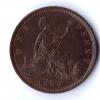 You’ve put in some good work there, but sadly the original sellers image is not sharp enough to be confident either way. Can you get it on approval? Most professional sellers would do that. Otherwise it’s a balance of lower likelihood of very significant gain against a higher likelihood of moderate loss. Might be worth trying to get a clearer photo from the vendor. Good luck! Jerry
 -
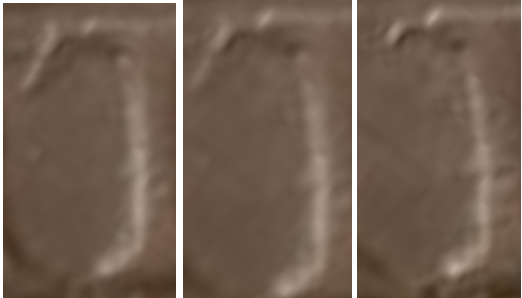
 One last detail, at the very tip of the red arrow there is a possible faint outline that could represent the right serif of the T. The tip of the yellow arrow marks where the I serif should stop and there also appears to be a faint line.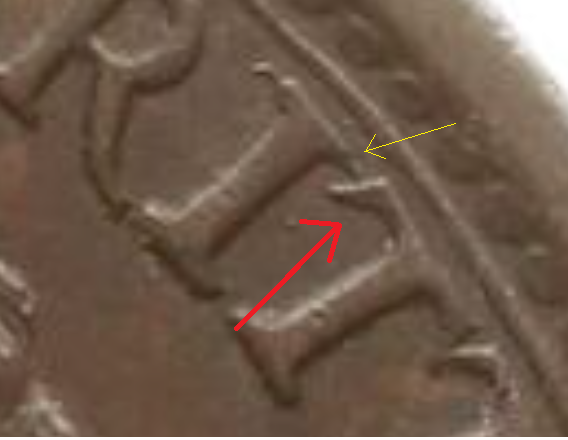
-
The imagination is running wild now I know; if a mint worker went to repunch the T using a T punch and suddenly realised at the last moment the punch wash infact over the I and the punch was struck partially could this little visible flaw be the result of that? I know all too well using a metal punch when marking base metal objects with my makers mark if the force is not right and the punch is not perfectly square to the object half of the imprinted mark is often missing.
-
Its quite expensive, the coin is for sale so I dont have it in hand and the images are all thats availible. The penny is from the 1870s, not a rare pairing. For the price of over 100 there is no luster and the coin is not anything special in my opinion. Concerning location of the serif I made a layered image Jerry to show the serif is actually quite close in terms of location. If I had the coin to hand I could look closely and take macro images. Thanks for the input so far.
- Today
-
Thank you for the response it's frustrating this type of enquiry ofcourse I have a hopeful imagination but also have learnt things are more often than not what they seem.
-
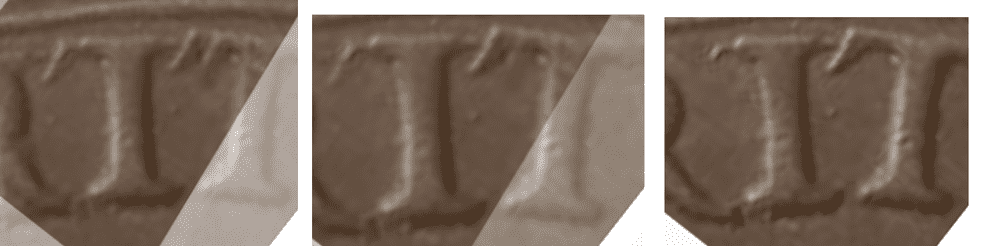
In the attached image I have rotated the image and layered the T over the I from left to right I have faded out the top layer with T becoming more transparent from left to right.
-
I think it may be worth a punt if not too expensive if you don’t have it in hand. The issue could certainly be clarified by microscope close-ups. It’s worthy of note that you see virtually no letter repair errors after the first three or four years of bronze penny production so the date might be relevant too. A die flaw can certainly flow through a letter but an overstrike is not impossible. Jerry
-
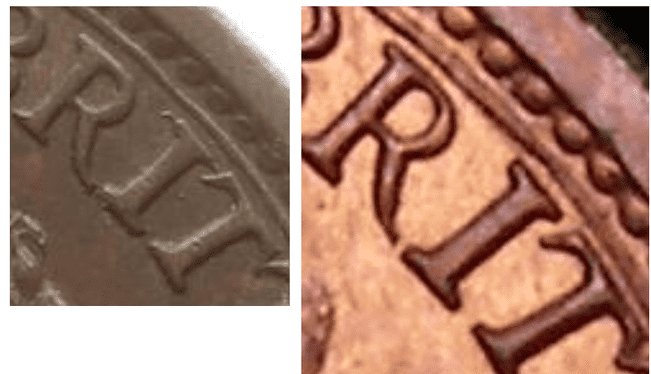
Here I attached an image of coin with what I think is the same pairing note the top right serif of the letter I does not extend far also shown in image is the coin in question for comparison. None of the coins I have looked at for the same pairing show the top right serif of the letter I extending and almost touching the T.
-
I don’t think it’s T over I either, the ‘serif’ starts far too close to the vertical and there is nothing visible to the right . But it is interesting, even if just a die flaw. I do have an 1860 BRTTT and the overstrike repair error is very much clearer. But do you have a USB microscope for clearer close-ups? A close look at the edge of the flaw/overstrike could be illuminating. Jerry
-
 I’ve definitely seen less convincing overdates and legend errors…I personally think that is a very intriguing coin. I’ll leave it to the penny gurus but, for me, I could easily be convinced there’s a T involved.
 -
The coin is a Penny, and for the year there is no listed I/T listed from what I can see.
-
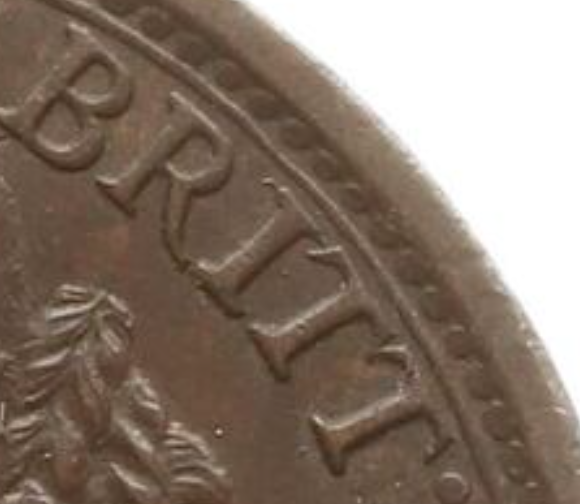
Please dont feel I'm relying on the opinions shared here to make a decision to buy, I'm not. I'm simply asking what others think; I dont think it is I over T but the truth is I dont know ! What do you think? In the image attached there appears to be a what looks like a crossbar extending left of the I. I would appreciate hearing what you think. The only reason I'm not sure the tip of the crossbar shows a similar angle of the serif of the T also the crossbar possibly appears to extend to the right of the I. Thanks
- Yesterday
-
Halfpenny Obverse 5 die flaw
Rob replied to absence of uniformity's topic in British Coin Related Discussions & Enquiries
It also isn't very logical. The wife sold something weighing 1.13kg on ebay, which AI determined should be passable as a Royal Mail large letter (max weight 1kg). Maybe the taxman will round down my bill to £1 on the grounds that subsequent zeros mean nothing. Hope springs eternal. -
Its a shame I didnt copy the initial interaction because I called it out, AI was claiming the die flaw to the forehead was not uniqe to Obv 5, then I said The flaw is unique to 5 and AI bactracked and said yes you are correct I made a mistake lol. I realise I am feeding into to algorithm I'm pretty anti AI but over the last few weeks I have tested it on a few different subjects and mostly the information is incorrect in real world facts. It will hash together what it thinks you want to hear. Rather than stating I dont know.
-

Whitman Blue book shelf type coin albums
copper123 replied to coinkat's topic in British Coin Related Discussions & Enquiries
In the mid to late seventies whitman folders retailed around 25p to 50p range its now virtually impossible to get them for less than a £5 note. On their own they have been a great investment -
 paveltul joined the community
 -
I put the question to AI, why only a few hundred 5+G are estimated to remain and pressed AI for the reason. the text above is what was regurgitated. Use it at your peril, very often the information is incorrect. Hence me asking how likely that information is accurate.
-

Whitman Blue book shelf type coin albums
Paddy replied to coinkat's topic in British Coin Related Discussions & Enquiries
@coinkat's OP mentioned "blue book" so I assumed the blue folders were what we were talking about. I have encountered the posher Bookshelf albums that @Bronze & Copper Collector refers to, but I don't recall the colour of those? They were an improvement in storing coins, but seem to have been much less popular - possibly much more expensive? The blue folders were a great way for a young collector to get started, particularly when many of the coins could still be picked up in circulation. -

Halfpenny Obverse 5 die flaw
Zo Arms replied to absence of uniformity's topic in British Coin Related Discussions & Enquiries
An interesting read. Where did that come from, please. -
 I'm not sure, but I believe Coinkat is referring to the Bookshelf Albums that had precut openings that were covered by plastic slides so both obverse and reverse could be viewed. Some responses are referring to the ubiquitous BLUE Whitman FOLDERS, 3 cardboard pages with cutout openings for the coins. It was not uncommon to see coins taped in to hold them, or in the case of worn coins, to use an additional piece of paper to tighten the opening.
 -

Whitman Blue book shelf type coin albums
Coys55 replied to coinkat's topic in British Coin Related Discussions & Enquiries
I had them in the 60's and filled them with pennies and halfpennies collected from bank bags, but everything older than about George VI fell out every time I opened the things. They were basically useless. I never considered using sticking tape though! As King Kenny said, I would have bought them from WH Smith in Basildon town centre when it used to sell useful stuff. The rebranded TG Jones, which no longer sells anything anyone wants or can't buy cheaper elsewhere, is about to close, taking the town centre's Post Office with it. End of an era... -
 Redstart joined the community
 -
How accurate is the following likely to be ? The exact reason so few 1861 5+G halfpennies were struck comes down to a strict "mismatch timeline" in the Royal Mint's production logs. To understand why this specific pairing is an anomaly, you have to look at the overlap—or lack thereof—between the active lifespans of Obverse 5 and Reverse G in 1861. The Royal Mint did not deliberately manufacture a single "5+G" layout. Instead, they were rapidly testing minor design variations to see which steel dies could withstand the brutal physical pressure required to stamp hard bronze. Obverse 5 was an extremely brief experimental design featuring 15 leaves in Queen Victoria's wreath. It was phased out almost immediately in early 1861 in favor of the much more durable, standardized Obverse 6 (which features 16 leaves). Reverse G was an intermediate, short-lived design choice where the mint engraver, Leonard Charles Wyon, experimented with completely omitting his "LCW" initials from the base of the rock. Because the Mint was facing a massive backlog to replace millions of old copper coins, press operators on the factory floor did not stop production to wait for matching dies when a fracture occurred. They paired whatever functional dies were sitting in the spare inventory racks. [1] The 5+G pairing was a complete accident. It happened during a tiny micro-window of time when an obsolete, left-over Obverse 5 die was pulled from a bin and matched with a newly prepared, short-lived Reverse G die. The definitive reason the numbers are so low is catastrophic die failure. When these two specific pieces of steel met on the factory line, one or both of them cracked or shattered almost immediately under the pressure of the coining press. [] Rather than a sustained minting run, the 5+G is essentially a record of a production run that lasted mere minutes before the machinery was halted to replace the broken components. The technical crisis regarding "die shattering" is well-documented in Royal Mint archives from the Great Bronze Recoinage of 1860. [] Mint Master records from the time note that switching from soft, pure copper to the harder, durable French bronze alloy (95% copper, 4% tin, 1% zinc) caused an unprecedented spike in broken equipment. [] The steel dies of the era frequently developed catastrophic stress fractures. This confirms why the Mint was constantly tweaking the thickness, borders, and leaf counts (like the move from Obverse 5 to Obverse 6) to find a design that wouldn't shatter the steel. [1] During the Victorian era, coining presses were entirely mechanical. Operating logs indicate that when a die fractured, the priority was minimizing down-time to meet massive production quotas. [] Because the obverse and reverse dies are entirely separate pieces of steel fitted into a mechanical press, operators regularly substituted any working spare die that would physically fit the machine to keep it running. The absolute lack of a uniform "5+G production log" coupled with the tiny handful of surviving physical examples proves that this pairing was an unintended transition—an emergency factory-floor substitution rather than an intentional batch design
-
Interesting information thank you. Other than tonnes of coins being lost at sea what other possible explantion could explain very little remaining examples left today?
-
Whitman Blue book shelf type coin albums
Paddy replied to coinkat's topic in British Coin Related Discussions & Enquiries
They were certainly popular in the UK and still turn up at auctions here occasionally. I have seen all the way from farthings to Half Crowns, with the earliest catering for coins back to 1860 I believe. I can't say they were a great way to store coins, frequently losing their grip, and I have seen many coins sticky taped into place! I don't believe they ever went decimal, so I guess they ceased in the early 1970s. - Last week
-
 I certainly had a set of Whitman albums for my pennies back in the 1970's. They were very handy and I only stopped using them when I bought a proper coin cabinet. I think you could buy them in W H Smiths ( a famous stationers in the UK).