Colin G.
-
Posts
2,173 -
Joined
-
Last visited
-
Days Won
7
Content Type
Profiles
Forums
Events
Downloads
Store
Gallery
Articles
Everything posted by Colin G.
-
1919KN Penny
Colin G. replied to argentumandcoins's topic in British Coin Related Discussions & Enquiries
That is one thing where they have got it right, you have to prove it got to him, he will have to prove it got back to you I believe. That's why agree about the refund but do not issue it until the ocin is returned. Make sure you also start a dispute to get your fees back. -
I think you are correct, that as the variety market grows, collectors end up having more than one coin bearing the same date, which inevitably has an effect on the number of coins out there. As more varieties are identified it also creates a new market for finding higher grade examples of that variety. If you look at the bunhead farthings on my site, there are 32 dates to collect, but 155 varieties detailed. I know some collectors will debate whether some varieties are in fact varieties, but even if you take away the smaller varieties, there must be 100 different types
-
1937 Threepence
Colin G. replied to adammearkat's topic in British Coin Related Discussions & Enquiries
Definitely George VI, if you google "Edward VIII Threepence" and click on images you will see the rare one, which is a different design -
1919KN Penny
Colin G. replied to argentumandcoins's topic in British Coin Related Discussions & Enquiries
Exactly the response I expected I reckon I must be getting to know you. Good luck!! -
1919KN Penny
Colin G. replied to argentumandcoins's topic in British Coin Related Discussions & Enquiries
Dave if he has paid via paypal the emphasis will be on you to prove the case. If you want to stand your ground make sure you have no funds in your paypal account, and no link to your bank account from Paypal, because they will remove the funds and then not return it until the dispute is resolved. You will also probably lose your paypal account. I know it may seem unfair, but it is usually easier to offer a refund once the coin is returned, and just re-sell, you will get your fees back if you dispute through Ebay and Paypal -
Anyone got a Spink 2011?
Colin G. replied to Colin G.'s topic in British Coin Related Discussions & Enquiries
Colin G, Prices from the 2011 Spink are: F - 20 VF - 80 EF - 275 UNC - Not Quoted. Cheers Dave!! -
If anyone has got a 2011 Spink, would they be willing to let me know what the prices are for an 1825 D/U farthing? Ta
-
1919KN Penny
Colin G. replied to argentumandcoins's topic in British Coin Related Discussions & Enquiries
Definitely looks like it has been machined/tampered with at the edge, you might have expected this on a fake Mule to try and cover the join, but does not make sense on this one, unless it's just some kid tampering with a coin, I know I have shot, drilled, grinded a few in my youth -
Help with Silver Groat identification
Colin G. replied to crashetta's topic in British Coin Related Discussions & Enquiries
Tim, Sorry for the delay the images ended up in my spam folder!! http://www.aboutfarthings.co.uk/images/forum/crash1.JPG http://www.aboutfarthings.co.uk/images/forum/crash2.JPG I have altered the Obverse to try and make it a bit clearer -
Test Token?
Colin G. replied to Bronze & Copper Collector's topic in British Coin Related Discussions & Enquiries
Nice of them to come back, and another bit of information now stored by the rest of us -
Very sensible. Going down the individual die collecting route would be unwieldy. A back of the fag packet calculation using the 1863 & 1864 etched tonnage figures on pennies gives approximately 134 tons of pennies struck up to the end of 1863. Assuming average weight of 145 grains as per Peck and say 100,000 coins per die pair would imply about 144 die pairs used in the first 4 years of the bronze currency. Depending on teething problems with the new currency, that number could and almost certainly would increase. It's fair to say you could be a while. So what you are saying Rob, is the entity we refer to as a DIE which may or not have flaws etc, is in fact a machine tool cloned from a MASTER, the MASTER being where design changes occur. Which explains the differences in date widths if numbers were added later to the working DIE So question, how were working DIEs produced from MASTERs? What was the life of a MASTER compared to a DIE? And why do we frequently have more than one MASTER in use concurrently? Very confusing in that we are all appear to be using the term DIE for two different entities David I seem to remember there being a video on youtube from the USA showing how a plaster sculpture of a coin design which was about 500mm across was reduced down to form a "hub" as the American's call them (which is in relief. From this the working dies were struck. I believe the process commonly has another two steps in between to form master dies, from which working dies are struck. This exmplains why a master die may have features that span across several working dies, whilst some features are only present on an individual working die. Ahh found the video I was after, it is the modern process, but I think the principles were the same just the machinery might have changed a little
-
How much literature do members have and use?
Colin G. replied to Rob's topic in British Coin Related Discussions & Enquiries
Rob, Fascinating question, I keep adding to my collection, and whilst it is getting there I have a few cooments to make..... Excessive cost? - Some titles are expensive in my opinion for what they are, but others are worth every penny. However I would be willing to spend a fair amount on a book if it covered the right topics Are people unaware of what is available? - I think this is an issue, and it is only as you start to focus your collecting that you start to become more aware of what is out there. Do people refuse to buy books as this eats into their coin purchases fund? - If it is a choice between the two and a set amount of funds, I usually end up getting the coin Do people find it easier to use books or web pages? - For commonly used references it is the book every time. If it is literature that I look at from time to time or for a specific issue, then I am willing to browse. I also think a major factor is whether you "collect" coins or "study" coins. To research coins properly, you need to have a very thorough library and be able to build upon thoughts of previous numismatists before you. It is essential to have a library for these purposes. There are several mint reports I would like to have a look at, but I doubt whether I would keep referring to them, so I do hesitate when looking to buy these, it will inevitably be a case of me purchasing one and then seeing what I think!! -
Help with Silver Groat identification
Colin G. replied to crashetta's topic in British Coin Related Discussions & Enquiries
Tim, Send the images through to my e-mail address on my website and I will host the pictures for you -
Test Token?
Colin G. replied to Bronze & Copper Collector's topic in British Coin Related Discussions & Enquiries
SNAP -
unc tokens x207
Colin G. replied to headsortails's topic in British Coin Related Discussions & Enquiries
Hi, The first thing to establish is whether they are genuine (how were they found, where were they found and might be worth getting one checked by someone with token expertise to authenticate them). If they are genuine they appear to be a very collectable token, these larger tokens tended to be susceptible to edge damage. http://cgi.ebay.co.uk/Staffs-NETHERTON-Withymoor-19th-c-1d-token-1813-GRIFFIN-/150510266940 However bear in mind a find of that quantity will inevitably flood the market and will lower the prices, because what may have been a scarce token has now become less scarce -
As Azda has said I use Acess for my collection, because it suits my needs, and is a programme I used wuite a bit a work. Agree wholheartedly about the change from 2003, mine is on 2002 version It has been set up around farthings and my methods of numbering etc, but could be easily adapted. One thing to watch out for is the image files, they can soon tip access over the edge, so I store them as linked files, but get them to display in the forms. If you want a blank copy I can try and sort it out. It is not the finished article yet, like a lot of my DIY projects
-
I agree, I know they may not be seen to be doing much for their money, but you do get a bigger audience than at a coin auction, but you just have to make sure you sell the right pieces on ebay and the right pieces at auction....that is the challenging bit
-
The only issue I have with it is why there isn't a '0' on the end of the sentences. And if we did it every time, we might clear these kinds of people away permanently, leaving the country a whole lot nicer place to live. Completely agree, and a 6ft square concrete box should be a lot cheaper than the expensive prisons we are running at the moment
-
1819 over 8 Half Crown
Colin G. replied to Benny who's topic in British Coin Related Discussions & Enquiries
Halcrowns are not my thing, so can't really comment, but CGS attribute a value to a coin when it is slabbed, so you should get an idea from the value they have given the coin. -
I didn't realise that my winkie was showing
-
Another new one to find, wait a minute mine's like that a well, now to find a normal one. Wait all of mine are the H errors arrrrr is going to take forever to get them all in the normal H. ah, good! I've just gone through exactly the same thought process... Sorry i should have added the smiley!!!
-
A new one for me!!!
-
Rob, I use a facility named "bulk rename utility" to mass rename files, and looking at it, at also allows you to rename paths. Might be an easier way but unsure how your paths are stored, so you may end up with some files stored separately from the others. Google the program, and it is free, it is a great program, I have been using it for a couple of years now!!
-
to all victorian sixpence collectors
Colin G. replied to chris's topic in British Coin Related Discussions & Enquiries
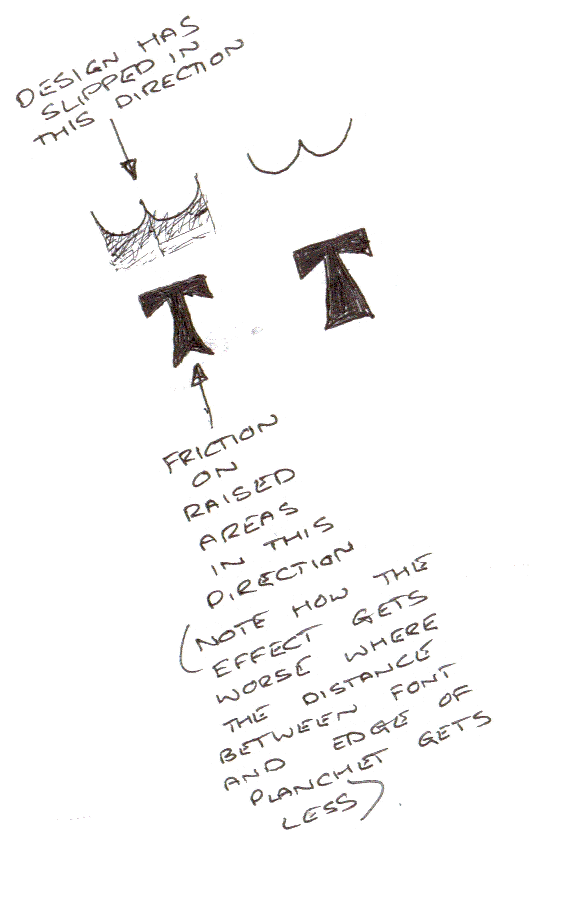
That would be true on a coin struck entirely without collar, but in this case it has only been unrestrained on the side where the design has been partially struck which has caused a slip in the design in one direction which has in my opinion caused excessive metal flow in that direction. See my stunning artwork This is my opinion of why the lettering has taken thse shape it has, and it is also worth noting that the effect gets worse where the distance between lettering and edge of the planchet gets less. As for the portrait not a clue, could it be the same effect? Has the design slipped making it look unusual?
-
to all victorian sixpence collectors
Colin G. replied to chris's topic in British Coin Related Discussions & Enquiries
Look closely on the 1820 halfcrown here, and you will see similar fishtailing to the lettering on the brockage side, again presumably because there is no collar in place, not as bad as the sixpence, but you can see the same effect