

ozjohn
-
Posts
1,246 -
Joined
-
Last visited
-
Days Won
61
Content Type
Profiles
Forums
Events
Downloads
Store
Gallery
Articles
Everything posted by ozjohn
-
This coin was only issued as a proof. 15000 sets in total were issued some in leather presentation cases and others in cardboard presentation boxes.
-
https://www.ebay.co.uk/itm/Great-Britain-Half-Crown-1927-KM-835-Silver-Proof-ChVF/382510982516?hash=item590f6e6574:g:E8sAAOSwW9FbPV1c You can only speculate about this coin but it's a fair chance that the original owner fell on bad times during the Great Depression and was forced to spend it.
-
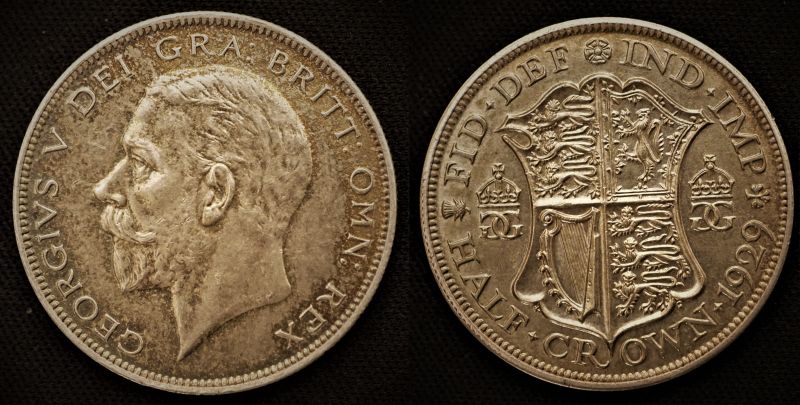
The toning of 1929 halfcrown looks much better in hand. In fact it seems to enhance the design. It's funny that this does not always translate into photos of coins. I am still having issues photographing coins I think light is the critical thing and getting consistency with the lighting can be difficult. Two features of this coin stand out. Firstly the markings on the king's eyebrow are present and secondly the check design on the thistle between the HALF and FID is fully struck up. I have noticed that these features are often missing from otherwise UNC coins graded MS by NGS etc.
-
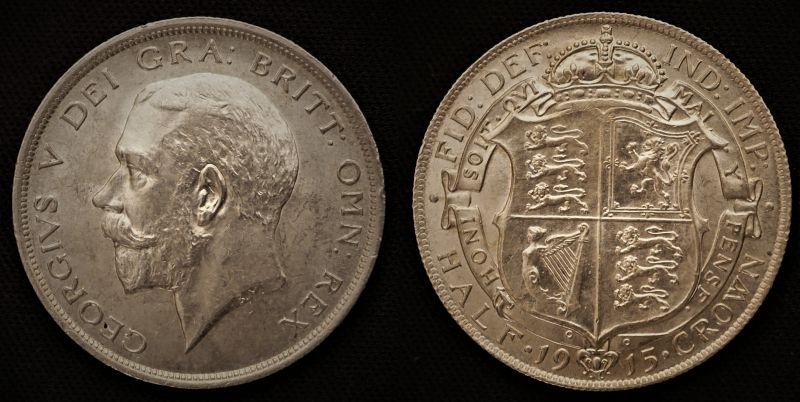
Received 2 coins from AMRcoins both very nice coins at a good price. Perhaps not rare coins but hard to get in really high grades especially the 1915 halfcrown with the king's ear fully struck. Thanks AMRcoins.
-
Thanks for the replies. I was also impressed with the quality of his stock and the consistency of the grading. Perhaps some of the TPG 'ers could learn a bit by visiting this dealer' s site!
-
Found this dealer online. From their website they seem they have some pretty good coins. http://www.amrcoins.com/coins-for-sale/type/milled-silver/ Has anyone had any dealings with this company?
-
Probably a creation by the RAM. Perhaps Fiji should have stuck with the RM to Mint their coins!
-
Quite nice coins but horrible tones.
ozjohn replied to Gaz T's topic in British Coin Related Discussions & Enquiries
Finally cleaned coin using Sodium bicarbonate and Al foil method. A definite improvement I think. An aside to remove the coin from the slab I used a small hacksaw to cut across the slab between the coin and the label then another cut along one side of the slab as far from the coin as possible to avoid any damage.
-
Let's See Your Toned English Milled Silver!
ozjohn replied to Paulus's topic in British Coin Related Discussions & Enquiries
My 1902 Halfcrowns. They are not encapsulated coins. They were scanned in a plastic capsule as I think it produces a better scan by stopping the coin making contact with the glass table of the scanner.

-
https://www.ebay.co.uk/itm/Great-Britain-1907-1-2-Crown-NGC-AU-55-Sharp-Lustrous-Original-Toning/372314063537?hash=item56afa5c2b1:g:8ewAAOSweIla~dXv Dunno how this rates for AU55. F15 to VF20 is about it for me.
-
Gotten is "old" English as many so called Ameriicisms are. They have simply fallen out use in the UK but retained in the US. Examples the fall, creek turnpike. Even the spelling of honor US, honour UK is an older spellling. Note Honor Oak in London
-
Quite nice coins but horrible tones.
ozjohn replied to Gaz T's topic in British Coin Related Discussions & Enquiries
Still thinking about it as there is no hurry. I had a look at the coin in natural light on an angle and all the stripes on the obverse disappeared from view and the coin regained its MS look. This must have been how it was photographed for its Ebay listing. Still interested how much it would cost to have a coin such as this slabbed by PGGS/NGS. -
Looks a little sus with weakness in the middle of the shield. What's the obverse like does the reverse weakness correspond with the obverse?
-
Quite nice coins but horrible tones.
ozjohn replied to Gaz T's topic in British Coin Related Discussions & Enquiries
Just scanned the coin for my record. Looks better than the photo I took.
-
Quite nice coins but horrible tones.
ozjohn replied to Gaz T's topic in British Coin Related Discussions & Enquiries
Giving it serious thought. I hope the results are as dramatic as the 1922 halfcrown I removed from its slab and gave it the bicarb/Al foil treatment see this strand.. Can anyone tell me how much it costs to have a coin graded by NCG etc. as I have never had a coin slabbed? -
Quite nice coins but horrible tones.
ozjohn replied to Gaz T's topic in British Coin Related Discussions & Enquiries
Similar issue for MS 62 1907 florin.Close examination of the coin shows that the marks are only uneven toning and the underlying coin is good. Has to be said the listing did not show the uneven toning. Do I break it out of the slab as with my 1922 halfcrown and dip in my bicarb/Al foil solution or leave as is and rely on the NGC appraisal? I think the reverse of the coin gives some clues regarding its true grade.
-
Sorry, I think you are right. Thinking back the 1920 - 1922 were not too bad with regards to the alloy color but the strike quality was poor perhaps due to the hardness of the alloy even with the recut effigy. The poor copper color was as you say 1924 -25 and by 1927 they got the alloy right.
-
Hi Sword, Thanks. I had another look under a X10 glass and it seems to be clear of any green color. Perhaps because I cleaned the whole surface both sides with metho which seems t remove it. No sign of pitting where the green was. The space around the R & E of REX is a black color suggesting silver sulfide. Hi Peckris, Received 1915 penny in good condition today. Nice coin for a good price thanks.
-
Hi Sword, I received this coin the other day from Pennycrown a 1931 florin a common date I did not have. Anyway in light of our discussions I carefully examined the coin and noticed a slight greening around the V in George V which looks like the start of verdigris forming on the coin. It doesn't seem to have damaged the coin and I will try some metho on it to remove it. As I said I have not see this before but there is always a first time and I will keep an eye open in future. I tried to remove it with metho and it completely went with out any apparent damage to the coin..


-
It would have been nice to see the larger coins halfcrown etc with the Gillick effigy of Betty Windsor fully struck in silver. A set like the 1970 last of the LSD would have been a good vehicle for such an issue. As for maundy money I suppose they are struck in silver but do not carry the reverse designs and any case a bit small in size to appreciate the designl. Maybe even a reissue of the 1960 crown would be an idea as well. Frosting them would be a bonus. Like I say the RAM issued in their masterpieces in silver a re-issue of the new decimal coins as a 50th anniversary edition including the 2 & 1 cent originally bronze coins struck in silver which are close in size to the maundy coins.
-
Sword, thanks for the images. The 50% Ag coin certainly looks like verdigris. As I said in all honesty I have never seen it before and I have been collecting coins on and off since the mid 1960s. I agree completely with you regarding sterling coins the chance of verdigris is very unlikely. I notice one of your coins has been graded by CGS. I thought they were supposed to reject coins subject to corrosion or did the verdigris form after slabbing? Just a question do the green spots pit the coin as what happens with copper and bronze coins or is it restricted to the surface of the coin?
-
A poor choice of metals to replace sterling silver perhaps. They did not hit on the right alloy until about 1927.I think I remember that the early 50% silver coins were "treated"to migrate Ag to the surface to improve their appearance. This can be seen when they wear and take on a distinct "coppery"look. Even with the increased copper in these coins I have never seen green verdigris form on these coins even when they have been lying forgotten in a draw for years. In Australia, where these coins were stored we experience much higher humidity than the UK which is conducive to the formation of verdigris. No verdigris was found on these coins.
-
I suspect the RM is competent to make sure their silver alloys are correctly prepared for coin making. They have been doing it for a long time.
-
A couple of typos: Should read: Any BLACK deposits on sterling silver coins even if they were Cu based ……………….. I also contacted Sterling and Currency …………. No a Sorry if there is any confusion caused.
-
Mostly Cu. However to separate the Cu from the Ag you would need something to break the bonding of the component elements that are sharing their valency electrons. For example oxygen blown thru the molten alloy that would turn the component metals into their oxides which could then be separated. The original assertion was that a coin with some black marks on it was affected by verdigris. The first thing is verdigris is green not black. Green Cu compounds indicate that they are cuprous (valency 2) not Cupric (valency 3) which are black. Verdigris is associated with cuprous Cu compounds as it is green. Any deposits on sterling silver coins evenif they were Cu based would not be verdigris Ag oxides and sulfides are black and these are what you normally find on tarnished (toned) silver coins. I think my chemistry is ok but it has been a long time since I have had anything to do with it. I also contacted a Sterling and Currency in Fremantle a coin dealer who has been in the business for several years on this question for a practical opinion. In their opinion they had never seen verdigris on sterling silver coins. I also found a reference that Cu could leach from very old silver coins but here they were talking about coins several hundreds of years old and I do not think 1917 qualifies for that age.