
Peckris
-
Posts
9,800 -
Joined
-
Last visited
-
Days Won
53
Content Type
Profiles
Forums
Events
Downloads
Store
Gallery
Articles
Everything posted by Peckris
-
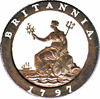
Is that clashing or ghosting? I have a 1799 halfpenny with similar effect: There appears to be a mirror image of the olive branch below Britannia's outstretched arm, but I believe it's ghosting from the obverse.

-
This to me is the best design for a Crown,the differences within the three years,gives you enough to collect without being a daunting task. Forget the obsessive hunting down of minute varieties - you're spot on with the first half of your sentence. Type collectors will have to pay out for ANY decent example of this lovely Crown, but like the 1804 dollar, the rare varieties aren't truly reflected in the values (probably because it was never a circulating denomination). I think collectors just love it for what it is.
-
1876 missing H Penny?
Peckris replied to Danz's topic in British Coin Related Discussions & Enquiries
The giveaway is the height of the numerals in the exergue - they would clearly be lower if there was no H on that die design variant. As to why the H goes before the numerals, it could be that being a lot smaller and lower in relief, that portion of the die was more prone to being clogged up. -
Taken to it's literal conclusion, the problem with that scenario is that the minimum currency available ~ and hence miminum price ~ would be £5, as there would be paper notes available, but no coins. True. But the way things are going, I could visualise a situation where the lower denominations gradually disappear. The penny is worth less than the 1/2p when it was demonetised, and who really finds much use for the 2p or even 5p now? The 10p probably has less buying power than 1p did in 1971. You see where this is going - small change will become too expensive to manufacture, and people will start to think in 10p or 20p units as the minimum. So revise my prediction to see the 10p or 20p as the smallest denomination in a generation. The cheque is to disappear, most people use plastic or online for much of their transactions, and it's not far-fetched to imagine that before too long, someone will come up with a working alternative to the Mondex experiment. Remember - pre-Euro, the Italians gave sweets as change rather than the worthless smallest lire denominations. And that was a long time ago, I remember it in the 70s! It must surely cost more than 1p to produce a (copper covered steel) penny already? I think you're right. it can't be long until the smallest practical unit of currency becomes the 10p and eventually, a £1. The complications could arise in on line trading, where decimal points might easily remain viable in the absence of specific legislation. Judging by the volume of 1 & 2p's from the late 80's and early 90's still with lustre on them (obviously sitting around unused for long stretches of time), I think we might getaway without minting any, and leave the rest in circulation to gradually die out ? Don't know. Intersting question though. Or as someone said on QI recently, "When are they going to mint a 99p coin to help all those shopkeepers and manufacturers?"
-
Cleaning Coins...really that bad...?
Peckris replied to Colin88's topic in British Coin Related Discussions & Enquiries
Not exactly. When anyone buys a house - even if they never have before - there are experts out there who you pay a lot of money to, to ensure that you don't lose a considerably larger sum. There are expert dealers for coin newbies to consult, but there isn't the infrastructure to direct one to the other, nor a legal requirement to go through certain hoops before buying a coin. You have to KNOW from experience that a toned coin is desirable, and that its cleaned sibling is a no-no. It's counter-intuitive in a way, so we as experienced collectors should take the responsibility on ourselves in our pronouncements so that there is a sort of 'knowledge base' that newbies can turn to. E.g. this forum. -
It occurs when the dies are struck together without a blank in between. You'd have thought it would be catastrophic but it seems that they survive pretty well, leaving just an impression of one on the other. Clashed dies are extremely numerous on pre-Jubilee Victorian coins, especially the smaller denominations. Well, if you think about it, there are no raised surfaces involved so only the perfectly flat (field) sections meet each other. The apparent 'clash' is simply the faint impression of the perimeter of the recessed area on an equivalent flat field area on the other die. Where two recessed areas meet, nothing happens.
-
Australian Holey Dollar breaks world record
Peckris replied to paulfrasercollectibles's topic in Free for all
Link missing? -
Cleaning Coins...really that bad...?
Peckris replied to Colin88's topic in British Coin Related Discussions & Enquiries
Yeah, but if inexperienced buyers are being conned into believing that cleaning coins is ok, because the devious seller thinks it makes the coin more attractive to such buyers, then that's hardly a good thing, is it? Newbies don't know enough to make a considered judgement about it, and it will be their loss when later told that their coin is not as desirable or valuable as they'd thought. -
This raises an interesting point. Since CGS only give a single grade, how do they cope with grading coins that are distinctly different grades on obverse and reverse? There are series notorious for this, the pre-1920 halfcrowns coming immediately to mind. If someone submitted a 1913 halfcrown that was GVF/EF (a very commonly encountered grade for that series), how can a single grade do this justice? For example, VF followed by a high number would not convey that the coin's reverse was EF. I had a good look at my 1931 wreath crown this morning. The reverse is indisputably EF and there is no flattening of the ribs of the lilies, or on the thistles. However, the obverse shows more flattening to the ear than would be comfortable for EF, though there are many "EF details" ( ) otherwise. I'd be mortified to see CGS grade this as VF(nn).
-
Damn! I was hoping to be incognito for longer..
-
Taken to it's literal conclusion, the problem with that scenario is that the minimum currency available ~ and hence miminum price ~ would be £5, as there would be paper notes available, but no coins. True. But the way things are going, I could visualise a situation where the lower denominations gradually disappear. The penny is worth less than the 1/2p when it was demonetised, and who really finds much use for the 2p or even 5p now? The 10p probably has less buying power than 1p did in 1971. You see where this is going - small change will become too expensive to manufacture, and people will start to think in 10p or 20p units as the minimum. So revise my prediction to see the 10p or 20p as the smallest denomination in a generation. The cheque is to disappear, most people use plastic or online for much of their transactions, and it's not far-fetched to imagine that before too long, someone will come up with a working alternative to the Mondex experiment. Remember - pre-Euro, the Italians gave sweets as change rather than the worthless smallest lire denominations. And that was a long time ago, I remember it in the 70s!
-
edward v111 trial coin?
Peckris replied to del's topic in British Coin Related Discussions & Enquiries
It could be a trial for a coronation medallion (it looks right for that). Either that, or it could be a trial for a Commonwealth coin. Certainly not a British coin, given he is wearing a crown. -
I was only talking about the coinage - I estimate banknotes will be around for a good while yet. Though I doubt that the £5 coin will replace the paper fiver, given the comparative costs of production. (Having said that, the coins would outlast several generations of paper fivers, so maybe there's not all that much in it?) I agree absolutely about coin clubs.
-
I'm going to assume my point about the slabbing of 60s coin is unanswerable, as Bill hasn't taken the trouble to reply to either of two posts on the subject.
-
Oh I don't know - if you want me that bad Dave, I'll put myself on eBay with "VF Details" Go topless Peck in you auction picture, you might start a bidding war. Yes - to put a shirt ON
-
And killing a dragon the size of a Labrador Yes, it's a beaut of a crown. As for proofs, those crowns weren't issued for circulation I believe, so in a way they're ALL proofs. Kind of.
-
Oh I don't know - if you want me that bad Dave, I'll put myself on eBay with "VF Details"
-
Not only that, numismatics is one of the world's oldest hobbies I believe? Even royalty has got in on the act at various times. Very true - but it is really wrong to dismiss the recent output of the mint the 50p issues have been very good and will draw coin collectors in for many years to come - the kew gardens 50p for instance. we will need new blood to come into the hobby or it will die, just as surely as collectors lost interest in stamps in the seventies and early eighties The real question is - will collectors move from that market (which relates to proper coin collecting as 'limited edition plates' does to genuine antiques) to 'our' sort of coins? The worrying factor is one that affects both stamps and coins: Stamps have been affected by the fall-off in letter writing, and the vast increase of business franking in place of the traditional stamp. Now that so much is done on the internet, it looks even worse for stamps. The trouble is - the same argument applies to coins. Where circulating currency once represented a serious proportion of the money supply, now it is negligible. I fear we may even see the disappearance of coinage within a generation. One ray of hope : vinyl never quite died, but its recent return to favour still only represents a tiny % of records sold/downloaded. However, 'collectable' vinyl goes from strength to strength. Perhaps people will continue to collect coins as art/antiques even when they've gone out of use as money? Actually, that question has already been answered now I think of it - predecimal coins are as strong as ever but have not been used for decades.
-
Well it works for me
Peckris replied to Gary D's topic in British Coin Related Discussions & Enquiries
-
Not quite "every" - I'm still waiting for a reply to mine, but I may have a long wait... Are you referring to what I think you are, Peck ~ namely the query about being able to remove a coin from a slab, and re-insert it at a later date, with the certification still intact and available, being capable of cross referencing a bar code to a central record and detailed photo ? That one ? If so, I too would be interested in Bill's views on that possibility, as I drew a blank when I mentioned it in an earlier post. No, it was my - I thought - very reasonable point about why anyone would slab 60s coins. And let us not be under any illusions - there are many many many 60s coins out there which are UNQUESTIONABLY BU. It doesn't take an expenditure of £11:99 to confirm that, and nor does it make the coin itself worth more than a nominal handling charge even in the raw state. I also made the point about what Stephen Lockett said to me when I bought a box of such stuff off him at the Midland Coin Fair in the 90s, when I was just starting out as a mail order dealer and wanted a bit of stock. I still maintain (and apologies to Bill for this) that you would have to be crazy to buy most 60s coins in a slab and pay for the privilege. Like I said, there are so many BU specimens out there, put aside by hopeful but ultimately deluded speculators at the time, that they will be a glut on the market for longer than even 1936 and 1937 coins, 1946 silver, and 1948 CuNi.
-
Well it works for me
Peckris replied to Gary D's topic in British Coin Related Discussions & Enquiries
Not Debbie D Dallas? I've just had a horrible thought - what if "our" Debbie didn't realise I wasn't talking about her? She may not be familiar with that eponymous piece of porn... -
Not quite "every" - I'm still waiting for a reply to mine, but I may have a long wait...
-
This is where your philosophy and mine appear to be situated on different planets Bill. As a schoolboy collector and regular reader of Coin Monthly in the late 60s, the ONLY way I would now want to own 'common or garden' Eliz II coins is if I picked them up for peanuts. You quote Stephen Lockett, but at the Midlands Fair in the late 90s, I bought a box of more or less BU 60s coins off him (purely for my mail order stock), and I remember well what he said. "It's really common stuff, you might find it hard to shift but go on then - I'll charge you two-and-a-half times face, which is a standard markup for this kind of stuff. Good luck with selling it." If his attitudes have changed because of CGS then it's simply a commercial volte-face. There's no way you are going to persuade me that Stephen genuinely believes that there is a serious market for 60s coins. Yes, he may not remember what he said to me, and yes, he has a strong interest in promoting CGS wares, but deep down he's a realistic dealer and knows the market very well. I don't quarrel with your desire to own the very best of what you collect, but I'm puzzled why you think that means CGS for really really common items like 60s coins? To slab and store a BU 1967 florin or penny, 1966 halfcrown or shilling, 1959 sixpence, 1964 3d or halfpenny, 1965 Churchill crown, and pay £11.99 for the privilege of owning each .. well, I just don't understand. I have several examples of all those and they are stored inside a screw top tin with a piece of lint. Well, each to their own. You enjoy your slabs, and I'll enjoy my mahogany cabinets. One thing I do applaud CGS for though - given the rabid overgrading that eBay has been party to, it's good to know that one organisation is erring in the opposite direction.
-
Well it works for me
Peckris replied to Gary D's topic in British Coin Related Discussions & Enquiries
Not Debbie D Dallas? -
I agree with your second sentence Peter. Caveat emptor as they say. And let the emptor do the necessary research if serious money is to be spent. Would anyone buy a house without doing a survey or the necessary searches? I hope you don't mind me saying, but the first sentence is a bit absurd. I've never spent £500 on a single coin in my life, yet I have a couple of dozen that would be well worth slabbing if I was so inclined (which to date, I'm not). For less than £500 you could pick up EF examples of most non-rare halfcrowns of the first half of the 19th Century, even some of the commoner early milled dates; you could get a very high grade cartwheel; much UNC George III, Victoria, and later; not to mention a near UNC 1930 halfcrown or 1918KN penny. I'd say - pulling a figure off the top of my head - that a coin ought to be worth more than £50 to merit slabbing, and even at that lower end, it should have something about it, e.g. a gem BU 1902 penny, or an AUNC 1952 sixpence, or EF 1949 threepence.
