
Rob
-
Posts
12,976 -
Joined
-
Last visited
-
Days Won
387
Content Type
Profiles
Forums
Events
Downloads
Store
Gallery
Articles
Everything posted by Rob
-
The obverse looks to have been lightly polished.
-
 The sparrows were nest building this morning as were the resident blackbirds. A mouse was noted pilfering the seed we put out for the birds six weeks ago. One hedgehog has reappeared, though I suspect mum and dad didn't make it as one was found rotted away in next door's garden when the lawn was cut and the other appeared on a neighbour's patio a month or more ago having been shredded by a strimmer(?). Last year we had 6 in total.
 -
Penny Acquisition of the week
Rob replied to Paulus's topic in British Coin Related Discussions & Enquiries
I do like pennies - they just have to be a thousand years old -
Penny Acquisition of the week
Rob replied to Paulus's topic in British Coin Related Discussions & Enquiries
Just buy plenty of bulk lots of pennies. They might be low grade, but will give you the info you need. I've got 15 or 20 kgs here just waiting for the lockdown to lift, and absolutely no desire to check for miniscule variations in tooth pointings. -
Lovely crisp hair detail - looks like it could have been made yesterday. Sorry, last month given shipping and listing delays..
-
J G Brooker 321, Rodney Smith (Lord Smith of Marlow) and H H Snellenburg. The latter is likely to have bought it during the 1950s, but could be one of many collections.
-
Daily challenges? Ebay. Q. What's the best you can do this for? A. £20 and price sent. Best offer received £12 Replied with £20 - again. Best offer received £15. Replied with £20 - again. Item purchased for, you guessed it - £20 Why do people ask the question, then ignore the answer?
-
Try syzygy for most consonants?
-
Rainfall?
-
If you want to get something done - ask a busy man.
-
Three important variables here - the temperature of the ice and surroundings and the amount of salt used. Adding salt to ice or water will depress the melting point with a higher salt concentration depressing the melting point further, so adding a little salt to the top of an ice cube will cause it to melt at the surface. The concentration will depend on the amount of salt added together with the amount of liquid water produced. To get this water to refreeze will depend on whether you can get a greater heat transfer from the solution into the ice cube than from the surrounding air into the salt solution, sufficient to reduce the temperature of the solution below the freezing point. Therefore, ice at a lower temperature than the freezing point of the salt solution will cause the latter to freeze around the string as long as the thermal conductivity is greater from the liquid to the ice compared to the surroundings (water or air) to the salt solution. The colder the ice, water and air, the better. Thermal conductivity is better from liquid to solid than gas to solid, so doing the experiment in air should be easier, reducing draughts will assist this.
-
There's no shortage of ebay sellers cleaning their coins prior to infection
-
Special Delivery and Signed For items are now being pushed through the door to avoid close contact (signing their machine). I'm not sure how this will affect various parties' liability. I guess the message is, if you are happy the postman will deliver, OK, but if you are worried about them going missing, ask the seller to delay posting. I had my Lockdales lots arrive today, no problem.
-
My post office is open as is Hermes drop-off, so shipping is still an option. Royal Mail delivers, or at least did so this morning and Hermes dropped something off yesterday. i.e. it is possible to function. I'm spending the time not going to fairs by listing some of the many things on the website that I haven't got around to doing so far, putting some things on eBay and sorting out the numerous storage boxes of coins in the pending pile. I think most dealers have a lot of things not listed on their sites, so stock is not necessarily going to be a problem. Prices must take a hit somewhere assuming some people will have lost their disposable income, but at the top end, money is not a problem with only a bunker mentality inhibiting spending. The world unlikely to run out of people on ebay buying things for a quid, so this offers probably the strongest market for selling into. Stock markets coming off 20% will have made a few people switch into alternatives. Unusually, gold has not spiked to any degree, so either people are sitting on loads of cash, or they are buying alternative assets. Property isn't an option as viewing/surveying etc is problematic, so it boils down to assets you can buy over the internet. Good for coins, or at least relative to some of the alternatives.
-
I was doing something similar by trying to add two segments with similar chord length but differing radii. It all went t*ts up when it dawned that I had a second variable (the angle) in the equations - at which point I realised I had forgotten about integrals.
-
Given the number of ships noted and the ability to count the number of dies used per ship type, it should be possible to work out a fairly close estimate of the number of dies employed in total and the number of coins made per die pair. At one ounce of copper per penny, that's 35840 penny equivalents per ton of copper and a shedload of dies. Let's test the dedication of some of you penny collectors to destruction.
-
But on the other hand, they are going to lose over £30 in fees and shipping. A bigger negative is the absence of pictures of the other side of the coins. At that point the price becomes irrelevant.
-
The first 6 is clear and unambiguous and consistently so across the date range, but the second is a thin winding line. I've seen this before, but never something that is unambiguously another 6. Anything with '6' as a last digit is invariably on a compromised coin. The Maundy 5s are considerably thinner than the farthing 5s despite being of similar height
-
That's a 1675
-
We were lucky in 1999 as we were in Germany and saw it from a point about 30 miles or a bit more west of Munich. Quite fortuitous as it was cloudy all morning, then it cleared up half an hour before totality. After the eclipse and within 10 minutes of getting back to Ammersee, it p'd it down for a couple of hours. Apparently, this was the clearest sky for viewing all the way across Europe until Romania. Quite chuffed as it had been a must do appointment in the diary for the previous 30 years.
-
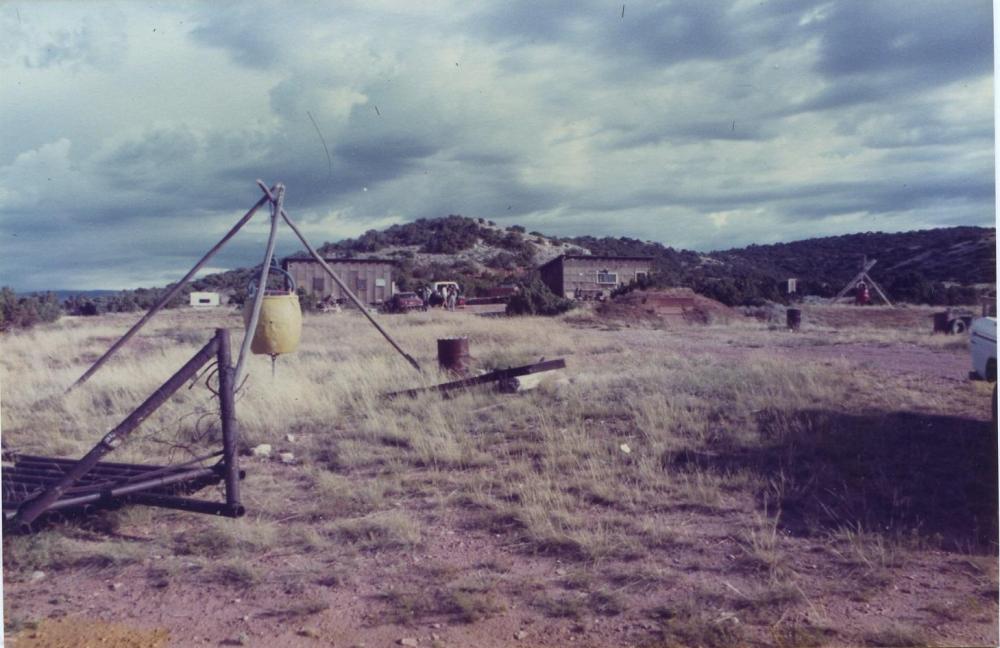
Nah, there's only one place in Wyoming worth mentioning - Armpit. See image from 1982. It's still there, but looking at recent pictures the walls of the sheds have been upgraded in the interim. When I was there, a guy lived in one of the huts over the summer, then went down into the valley during the winter to work on the oil wells at Lovell. As guests, we dossed in the other shed where he kept his dynamite and ammunition! The mining bucket in the right distance was inscribed 'Welcome to Armpit WY. The threshold of a new reality'. The place was one of three uranium mines from the 1930s, the other two being Groin and Earwax, both sadly no more.
-
https://m.youtube.com/watch?v=1ymR82yFYnk&feature=share You couldn't script this.
-
All is not lost - the tabloids are still printing.
-
Hopefully the producer and scriptwriter
-
Yep.