
Rob
-
Posts
12,930 -
Joined
-
Last visited
-
Days Won
371
Content Type
Profiles
Forums
Events
Downloads
Store
Gallery
Articles
Everything posted by Rob
-
I do indeed. Thank you.
-
I don't understand why halfpennies are so difficult to shift. They are much cheaper than pennies, only slightly more expensive than farthings, probably a bit harder to find than the other two in top grade, but the larger of the two denominations that have been around since 1672. Collectors prefer larger module coins for some reason, so they ought to tick a lot more boxes than they do in practice. Ship reverses only cover a couple of decades. Britannia reverses cover nearly 3 centuries. You can pick up an EF or better early G3 halfpenny for a few hundred pounds. Try finding a much younger bun head penny in top grade that isn't a couple hundred minimum. The only bun head halfpenny you are likely to pay 4 figures for is a top end letter by lighthouse 1862. They're cheap.
-
I'm not sure whether the decimal point should be moved one or two places to the left. Somewhere close to one I suspect. Most of the olympic issues will have been bought by non-collectors, so I suspect the collector base to be a little thin. How many people actively collect mint state decimal coins? Lots of people collect from change, but they usually draw the line at spending a premium to face value. Having said that, I have noticed a few people buying decimals of all denominations at fairs. 3 or 4 years ago there were only occasional purchasers, now they are regular visitors to the table.
-
Have you tried emailing Jeff Cope? He doesn't have it.
-
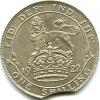 You have fallen into the trap like so many people who know little or nothing about coins - they automatically assume they have found the rarest of the potential options. The gold pattern on the first link is unique or nearly so. It is solid gold, not plated, so you wouldn't find underlying copper which is what the dark marks are when you rub it. Contemporary forgeries are common and are typically a copper core with a silver wash applied. They may also be brass. Both of these degrade in the earth, but the outcome will depend on the pH of the soil, though corroded is the norm. They were made because people could make money from counterfeiting. Nothing has changed. There was a national shortage of all metals during the Napoleonic Wars leading to a hike in prices. This in turn had a knock on effect on the coins which were frquently trading above the value at which they were previously issued. The mint wasn't going to make coins with a face value of less than the cost of the metal. Forgeries were usually lightweight - this was the counterfeiters' profit.
 -
Thanks Colin
-
It all depends on whether people brought silver to the mints for coining. As the coinage was changed every three years approx. by a new design, the existing one is likely to have been superseded as soon as possible, but it is unlikely a blanket ban on striking would be imposed. The world was full of current coins, so adding a few others of the previous monarch whilst awaiting instructions would not upset anyone.
-
wish I could. sorry.
-
If anyone has copies of the following, please could they send me scans as follows: Royal Mint Report 1963 (pages specifically referring to the Petition Crown) The Mint by Sir John Craig p.151-158 Thanks.
-
Welcome . We have already met.
-
Toning Madness Lives!
Rob replied to VickySilver's topic in British Coin Related Discussions & Enquiries
Yep. Been there. It's basic, but good. And the locals eat there too. -
I was assuming it had been deciphered correctly in hand. Anyway, the date doesn't matter because it's a grotty example of a base forgery/token whatever, so no real value.
-
I thought that at first, but if it is 1810, then I'm not sure there are any forgeries of that date. I thought the final digit loked like a 0
-
It isn't genuine, whatever it is. Size will determine what denomination it purports to represent. It's a brass or copper token of some form.
-
Toning Madness Lives!
Rob replied to VickySilver's topic in British Coin Related Discussions & Enquiries
Ah, the good old days of 70s curries - everything was chocolate brown unless it had Tandoori or Tikka in the name, in which case it was bright bright red For anybody going back to the 70s in Manchester, the Plaza cafe on Upper Brook Street should bring back memories- some good, some bad. Choice of 4 curries, mild, medium, hot or suicide, differing only in the amount of red oil on the surface. Ended up in hospital once after 4 curries there in a single dysfunctional weekend. The one for Sunday breakfast was a bit hard going. -
I think the penny should stay. Collectors of pennies will be satisfied and there doesn't seem any prospect of the mint issuing commemorative pennies to flood the market with unwanted tat.
-
Poor quality control in positioning the coin when assembling the slab. If they don't care what it looks like (irrespective of whether it is deemed to be worth a grade or not), why should anyone care about the service? It may be loose in the plastic insert, in which case poor quality control applies.
-
Slabbing may have a value. It may appeal to those who like slabs and are driven by numbers and similarly to those who don't - the latter because they like the coin if not the plastic. Out of the slab it will almost certainly only appeal to those who don't.
-
That's just a fact of life. The analogy could easily be extended to the 999 pages out of 1000 of totally uncollectable, indeterminate pieces of shi*e on eBay. Cleaned, holed, broken, featureless, wrinkly pieces of metal that the seller usually claims were coins at some point judging by the descriptions used. Nobody wants them, but we have to live with it. The same goes for someone who wants to call cents pennies, after all, I've got half a nicker in my pocket. heh, heh, heh.
-
Toning Madness Lives!
Rob replied to VickySilver's topic in British Coin Related Discussions & Enquiries
The best part is I have both the picture and the unsullied original coin. Yeh, ok up to a point. How do you get the colour off the spare? -
Ebay Item Came In Empty Package
Rob replied to rpeddie's topic in Nothing whatsoever to do with coins area!
The weight is at the top of any receipt given by the PO. see attached. Ask for a scan of the proof of posting. If sent by SD it will have your tracking number and address. Assuming these are correct, the weight will say where they went missing.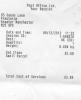
-
Discolouration from what? You are removing the surface toning and metal, to expose......metal. Any discolouration would have to be from whatever environmental conditions were present.
-
Most likely partially dissolved in an acidic solution, whether as a lost coin, or wilfully as a practical experiment/prank.
-
Ebay Item Came In Empty Package
Rob replied to rpeddie's topic in Nothing whatsoever to do with coins area!
If it goes SD the packet will be weighed by the post office. If the weight dosn't tally with their figure it has been removed in the post, if it is the same weight as when it was posted, then the seller hasn't put them in in the first place. Should be simple to establish when it happened. -
'Where have they hidden the extra leaf?' If you are JN Coins as per your signature, why talk about yourself in the third person? Sorry, I'm confused