
Rob
-
Posts
12,800 -
Joined
-
Last visited
-
Days Won
347
Content Type
Profiles
Forums
Events
Downloads
Store
Gallery
Articles
Everything posted by Rob
-
People do miss rare things on eBay, but usually it is a trade-off between rarity and quality. An awful lot of eBay listings are painful to view. Buying them would be a tad masochistic as you would then have to look at them for years to come. eBay has changed with the number of items listed up 10-fold in the past decade, but the days of rarities in a decent grade and selling for bargain prices are generally a thing of the past. People have obviously got too much time on their hands.
-
Horribly mushy.
-
The piece you linked to is one of the best examples available and was always going to fly. The wear to the portrait is minimal in comparison to yours and it doesn't have a hole.
-
It doesn't really matter whether you leave it alone or plug it. If you do decide to plug it, get somebody who knows what they are doing as you still have the potential to reduce its value by doing a bad job. With or without hole, it is still impaired however rare. It's a pity it was holed as the reverse is quite good.
-
Charles I rose farthing
-
1739 Halfpenny. Single exergue line.
Rob replied to Michael-Roo's topic in Confirmed unlisted Varieties.
It is the intermittent nature of the second line that makes me think a bit of remedial work has been undertaken. If a double exergue line was a required feature, you would expect the engraver to be careful not to obliterate it. I am inclined to believe that dies were recut as a matter of course, meaning that recut overdated dies exist for most years and that only the quality of the work stops you seeing the overdate. It was much more cost effective to change the last digit or two of the date rather than make a new die. There are a few differences between your 1739 reverse and the others, The curved line above the shield is notably uniform in width on your 39 compared to my 38 and 39 and is a full arc whereas the other arcs are only half as long. This is seen throughout the issue, so is probably irrelevant. The foot is also very narrow on your 39, but I am not convinced yet that it is a different punch to the 38 because there is a distinctive notch to the shin on the left which is present on all coins from 1730 onwards. The 1729 proofs and Nicholson 201 show no evidence of this notch. If the Britannia punch is the same on all coins and the exergue line is part of the same punch, any wear to the punch of uneven depth of punching to the die could inadvertently make for a single exergue line. To check if the exergue line was an integral part of the punch, coin no. 1675 in the RM museum is a 1730 1/2d whilst item no. 400 is a reverse punch for Britannia for the same issue. Whilst it doesn't guarantee that the same punch was used in 1738-9, the presence of a double or single exergue line on the punch would at least confirm that the two things were entered simultaneously on the die and that the single line is probably due to a weak strike or has been polished away. It might be worth asking the RM museum the question, but don't hold your breath waiting for an answer. -
1739 Halfpenny. Single exergue line.
Rob replied to Michael-Roo's topic in Confirmed unlisted Varieties.
That looks like a distinct trace of 2nd line on the LHS? Yes, a very faint mark.... I don't know what happened to the rest of the line.... I have just edited an earlier post and put down a possible idea as to why it is so - see 5 posts earlier. -
1739 Halfpenny. Single exergue line.
Rob replied to Michael-Roo's topic in Confirmed unlisted Varieties.
That looks like a distinct trace of 2nd line on the LHS? -
1739 Halfpenny. Single exergue line.
Rob replied to Michael-Roo's topic in Confirmed unlisted Varieties.
The question of the number of exergue lines raises a few points for debate. Firstly that it was supposed to be two lines and that the 1 or 3 line reverses are errors. It is also possible that most were cut by one person, so the two lines are an identifier for an individual. Reverses were traditionally the responsibility of the under-engraver. If 2 lines were the norm, it begs the question as to why so many dates impinge on the exergue, and also why they obliterate sections of the lower line when this happens? The later would be compatible with a reworked die. Attached is the reverse of my 1738 V/S which has a possible 8/7 on the last digit. If a digit is filled and the surface smoothed, then loss of exergue line in the vicinity of the repair is a possibility. If this is valid reason for parts of the line missing, then it must be equally valid for a completely missing 2nd line. Bear in mind the lower one is always(?) in lower relief to the top one, so would be polished away earlier in the case of a reworked date and subsequent smoothing.
-
1739 Halfpenny. Single exergue line.
Rob replied to Michael-Roo's topic in Confirmed unlisted Varieties.
Here's the one I mentioned earlier. It won't win a beauty contest but is well struck, so weakness of strike is not a valid reason for the missing bits of the second line.
-
1739 Halfpenny. Single exergue line.
Rob replied to Michael-Roo's topic in Confirmed unlisted Varieties.
I don't have an image immediately to hand as it isn't one for the collection. The R on yours looks to be possibly double cut given the similarity to the foot of the upright. Triple cut? You are in the best position to say. -
1739 Halfpenny. Single exergue line.
Rob replied to Michael-Roo's topic in Confirmed unlisted Varieties.
I have one with one and a bit lines. The date is set high and so impinges on the bottom line, but the line isn't continuous immediately to the left or right of each of the digits, only at the extremes to both sides with just a trace between the 3 & 9. -
I have a spare vol.58 if anyone wants one.
-
Dodgy seller, looks a funny colour, looks modern to me. This person often lists modern fakes that have apparently been in his collection for the past 40 odd years. He is one to avoid at all costs.
-
I quite agree. In the 50s and 60s, Jackson Kent spent 10 years studying the number of harp strings on W3 coins only to conclude that you couldn't infer anything from it. The same would apply to Anne's coinage. That's the point. The question of single stops, colon stops, filled in colons etc is usually nothing more useful than a means of identifying dies, but as to whether they are worth pursuing as varieties then the answer is probably no in the majority of cases. I would consider stop variation only on coins where you can demonstate that the stops have a meaning. Or for example, no stops whatsoever which is a fairly obvious difference. The convention used for stops was a single stop after a complete word or a colon/stop and apostrophe/ 9 etc in the case of a contracted word. In this context the colon after the date might have a case for inclusion as a variety, but then, so might my single stop after FR. Personally I wouldn't get too excited about it unless as part of a means of identifying the handiwork of an individual or some other method of identification. The crucial factor in all this of course is that a publication is available, otherwise attitudes are either boundless enthusiasm or total anathema. Once someone has done all the spadework, everybody has or wants to have the unrecorded example. Somewhat fewer people are interested in the underlying reason for their existence.
-
Some of my British Coins - new pictures
Rob replied to marvinfinnley's topic in British Coin Related Discussions & Enquiries
In Colin's sale it made £2200 hammer graded as good EF -
I believe Rob bought this one last year in the Corbitts sale if i'm not mistaken, the OBV was just as nice Very good, Dave's on the ball. The image is in the coin acquisition thread around end Sept- early Oct last year.
-
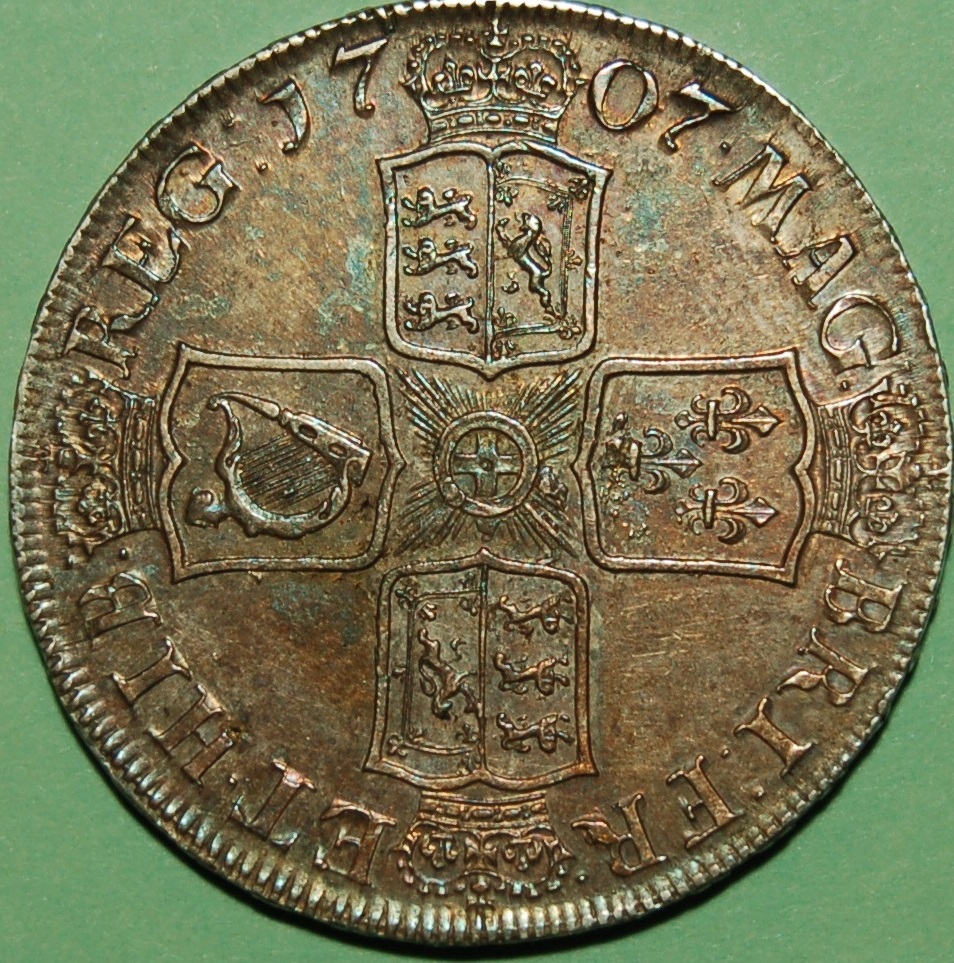
Further to the above, your specimen has 9 harp strings, mine has 13. Lingford had 4 specimens dated 1707, two with 9 strings to the harp, one with eleven strings and one with 13. Paget had 6 pieces, 1 with 9, one with 10, 1 with 11 and 3 with 13 strings. Whetmore had one piece, this from the same die as yours. Another example from the same reverse die was in Spink 62 lot 361, Spink 125 lot 711 and Ferrari 79. Nightingale had one example with 10 strings. Unfortunately, very few E below crowns are illustrated due to the difficulty in finding high grade examples, this despite their relative abundance. The dies tend to be a bit iffy with many exhibiting flaws. Poor flan quality in the form of regular pitting also plays its part meaning that if you see a well struck and fault free example in EF or better, grab it before it goes.
-
The blob between the 1 & 7 is irregular and looks like a flaw as opposed to a character. My 1707E crown also has a single stop after the date. Maybe the various punctuation was used as a die identifier?
-
Renault Clio 1.5dci dynamic
Rob replied to Peter's topic in Nothing whatsoever to do with coins area!
Vert pomme, but Goom can anglicise (fix) that. But French pommes aren't vert! They're a horrible sort of spotty pasty yellow, and described, laughably, as "Delicious"... Blame the translation offered on a google search. Apparently it means pea-green. -
Renault Clio 1.5dci dynamic
Rob replied to Peter's topic in Nothing whatsoever to do with coins area!
Vert pomme, but Goom can anglicise (fix) that. -
Some of my British Coins - new pictures
Rob replied to marvinfinnley's topic in British Coin Related Discussions & Enquiries
Hi Rob. No coin is perfect. One has to view a coin with how it compares to others. These two coins are probably close to the finest business strikes you will see, but are they perfect down to 100x or more? Of course not. As I'm sure you know, if one seeks absolute perfection, one will constantly be disappointed, whether in coins or people. Modern proofs might be the exception, but where is the history of that cookie cutter perfection? The knowledge that for these pictured coins to endure in such a well preserved state, there had to have been collectors down through the years that lovingly treasured them, and, for me, this is part of the allure of coins as an inheritor of their trust. I never meant to imply that these two of my coins were perfect, just that they are glorious examples of the engraver's art and the technology of the Royal mint at the time. And one must remember that, at least for the crown, the dies were cut directly by the engraver into the steel - no reducer used. With the magnified picture (thank you photographer), one can see the painstaking nature of the engraving that went into the hair and fully appreciate the dynamism of the St. George reverse. With the YH half crown, one can appreciate the care that Wyon took with her hair and the girlish nature and openness of her gaze. It wasn't meant as a put-down, just a genuine expression of regret that it was so close to being perfect without looking too hard. A tiny dig in the field, a little scratch in the hair, a miniscule rim ding, bagmarks - we have all been there. -
Some of my British Coins - new pictures
Rob replied to marvinfinnley's topic in British Coin Related Discussions & Enquiries
Nice coins. It's a real shame about the couple of tiny marks on the crown bust. -
Very good again. You might get a permanent position soon as the man who can defeat binary bloody-mindedness. Ta.
-
Very good, thank you. Next question. Why does it have A4 pages on the right hand side at least as far as box DX and probably further. All I want is a file about a thousand boxes long, and 6 wide to fit on A4 in x pages. Ta.