
Rob
-
Posts
12,935 -
Joined
-
Last visited
-
Days Won
371
Content Type
Profiles
Forums
Events
Downloads
Store
Gallery
Articles
Everything posted by Rob
-
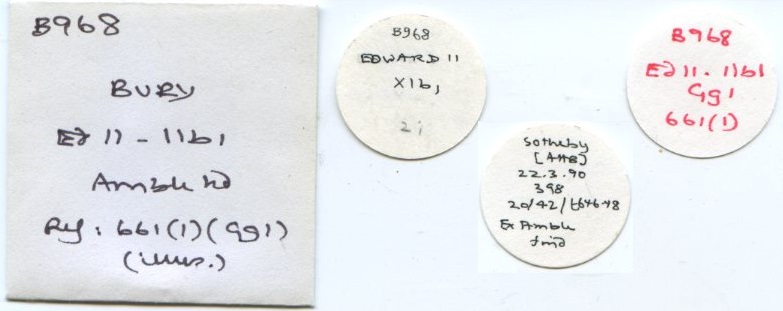
EAGLEN, R J Collection of Edwardian Sterlings sold through DNW in 2017. Each coin came with his 2x2 envelope, and tickets 25mm dia, one giving coin details and provenance, and a second with the references pertaining to his book on the Bury St. Edmunds mint.
-
In terms of storage, a mahogany cabinet might seem expensive to start with, but they are always desirable and as such an asset that you will have little difficulty in recouping your cost. It's worth thinking about.
-
I don't know if you can. Are you in Chile as this is the only place that has changed in the past week unless you are in Morocco which changed in July?
-
STUDIO COINS (Stephen Mitchell) White tickets 29 or 30mm diameter written on one side only. The red line with the monarch above is similar in appearance to those of Dupree.

-
I guess that numismatic slabbing is the equivalent of sciences and the arts in academia. In theory, milled coinage slabbing should just be a straight forward measurement of wear, whereas a hammered coin can be as struck, but flat, or in the case of some of the heavy chunky ancients, have good detail but be relatively low grade, i.e. they are the arts side where the number on the slab is irrelevant, and as always in the arts, beauty in the eye of the beholder. I still stick by my two point grading scale.
-
That last seems overly generous. I've not seen many 60s that warrant better than EF. Uncs are rarely less than 64 and even 65s are often hopelssly optimistic. The bank token I got rid of on account of wear to the laurel, yet got slabbed 66 springs to mind too. We are in danger of having a complete generation with rose-tinted spectacles when it comes to grading. The alternative is to extend the Sheldon scale to encompass the things that are better than 'uncirculated'.There has been a large amount of upwards grade drift over the past generation.
-
Should be A(lmost) U(nreadable) 15ish. There's no way that 50% of the legend is illegible.
-
PARSONS, H A Two collections, the first sold at Sotheby 28th October 1929, the second at Glendining 11th May 1954. Tickets are 1" or slightly less with minimal information.

-
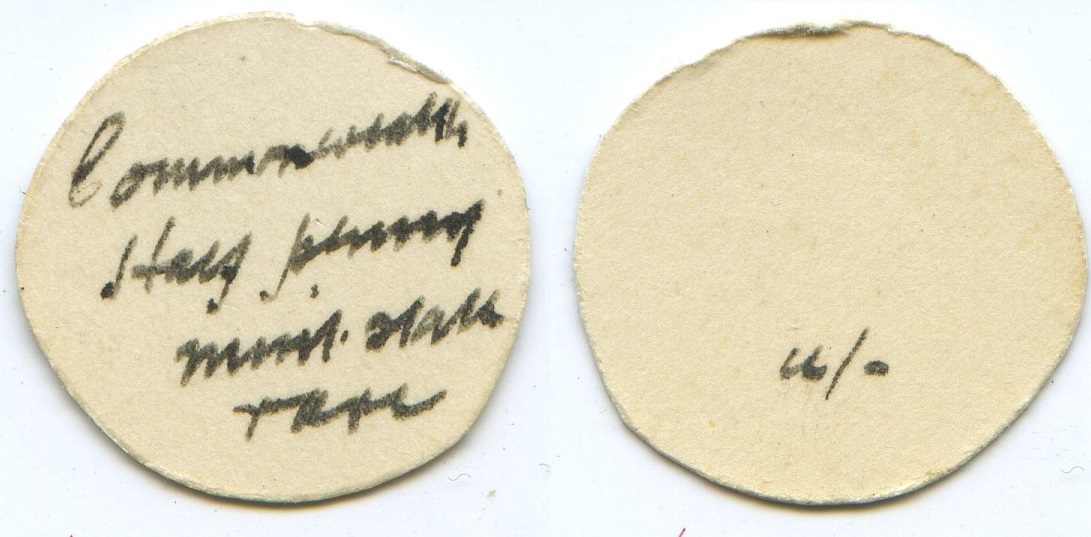
FARQUHAR, H L Helen Farquhar, a collector of mainly Charles I material, the collection sold at Glendining on 25th April 1955. Tickets 29 or 37mm with scruffy handwriting.
-
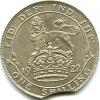 According to ESC half the edge lettering is inverted.
 -
I won the first of the Irish gunmoney crowns, lot 1279. The estimate was a low 100-150, but of the two main protagonists that have pushed up Irish prices in the past few years, one has gone through a divorce, so coins must be sold and it's doubles all round. £220 hammer was a bargain.
-
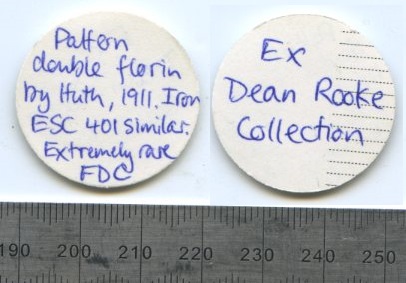
WALLIS, D Collection of British milled coins sold at DNW on 30th September 2009.
-
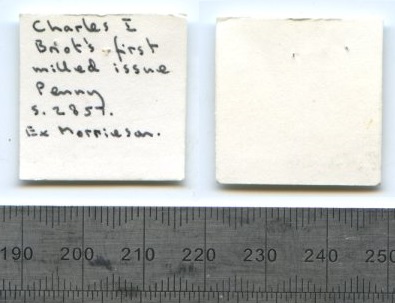
JOYNER, J T Collection of hammered from early Anglo-Saxon through to Stuart sold by DNW on 4th December 2013. White card.
-
COMBER, C Chris Comber is a specialist in Tudor Coinage and a co-author of the standard Elizabeth I reference. The ticket has obviously been trimmed to fit into a tray hole.

-
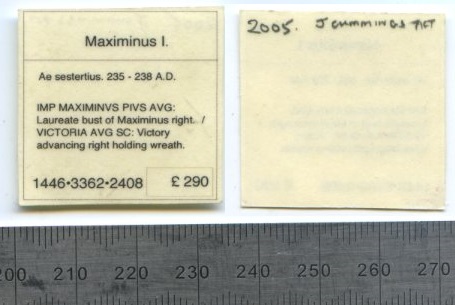
CUMMINGS, J John Cummings is a dealer of predominantly ancients and early coinage. Off-white card.
-
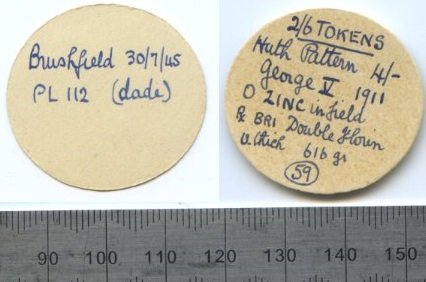
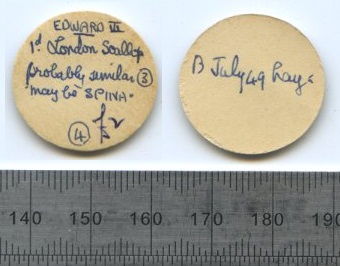
LINGFORD, H M H M Lingford d.1950, a huge collection, much of which was acquired from Baldwin and who puchased the collection post-mortem. Tickets of various size but all the same basic layout.
-
Looks like it.
-
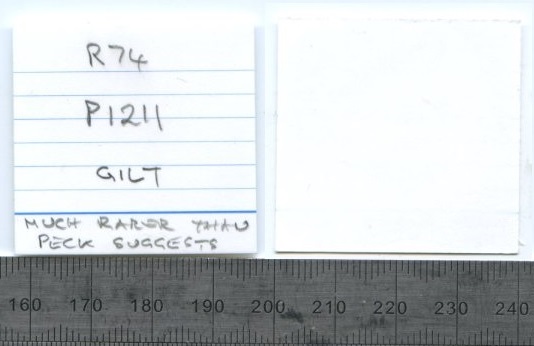
MARTIN M Private collector, a specialist in Soho coinage. White card.
-
DENNIS DUNKERTON (dealer) Square yellowish cream card.

-
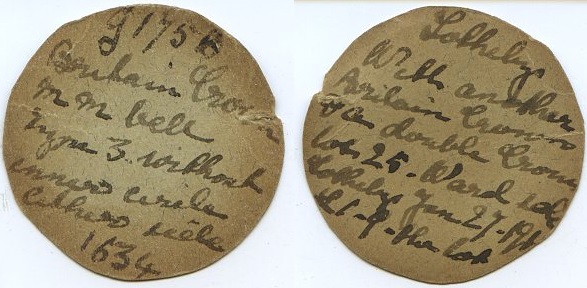
BOYD, W C Collection sold at Baldwin, 26/9/2005, having lain undisturbed for 99 years.The catalogue includes pictures of a number of tickets written by Boyd in the introduction. Assuming they are to scale, diameters are 1" for the small ones, and 1.5" for the large.

-
Personally, I would set the lower/upper estimates to 60/80% of perceived market value (book) and let it go from there. With the juice, that would put upper estimate at around book price. Baldwins made a fundamental mistake in my view of setting the lower estimate at 20% below book because it meant that to get something at 'fair value', whatever that means, you would have to be opening bidder. Any more and you would be paying over the odds. Using my estimates, 150-200 would imply a value of 250. There are a lot of people willing to go twice book - we've all done that, and quite a few prepared to go higher still, so is it necessarily that high? After all, who is to say that the book adequately reflects demand. People seem anxious to point out when Spink book prices are too high, but omit to mention those that are too low compared to what people are prepared to pay, and are paying. Ultimately though, what something ends up at is outside the control of the auctioneer. Since the millennium there has been a huge increase in the number of collectors and investors which has fuelled steep rises in the finite number of coins available. You can triple the number of collectors, but the number of desirable coins remains broadly the same. Sure the detectorists are excavating large numbers of coins, but these are mostly undesirable in collector terms with large numbers being fragments or otherwise damaged. Hobson's Choice is another matter, but that is rarely the case.
-
You have a choice. You can either set the estimate so that an opening bid which is 20% below market value becomes market value with the juice - and you get no competitive bidding. Or the estimate can be low which will entice people to bid competitively. You can also set the estimate above market value and will have to if the vendor has too high a reserve on it. Then you rely on a fool and their money to sell the lot, unless it is an unrecognised variety noticed by 2 specialists.
-
And as St. James's, Baldwins, Morton & Eden...... Blame it on London. It is and has always been expensive to base yourself there. All things numismatic cost several times what they do elsewhere. Take a coin fair in say Bloomsbury. The cost of a table is over 5x that of one at Wakefield, but I bet I wouldn't do 5x the business if I attended, and that loss would be compounded by having to park and stay in a hotel. There's nothing cheap or cheerful about London which is best avoided. In the case of auctions you can thankfully bid from your armchair, but the ability to view the lots beforehand has effectively been blocked for anyone living outside London. DNW used to be good as you could arrive at 8 o'clock and look at your lots in advance of the sale which was across the road. Now you have to do this in advance. Spink have always required viewing to be prior to the day of the sale and when I went to DNW in June to view, I called in at BSJ only to be told the lots wouldn't be ready until the day before the sale. What a waste of time.
-
Misc Amounts are the few itemised things below the lots won (surcharges, insurance and post), and these are VAT liable items. VAT is 20% and has been since 2011.
-
Depends on what you bought. 20% + VAT is the norm, but if it was an import from outside the EU then an additional 5% import VAT is applied and is identified by an x by the lot number. Which lot(s) are we talking about?