Leaderboard


Popular Content
Showing content with the highest reputation on 09/29/2026 in Posts
-
Hello, I am in the midst of writing a relatively large article on the 1887 Jubilee Coinage - estimated to be about 600pgs in total. In the process of such research, I spent about a week at the Royal Mint studying about ~200 tools relevant to the coinage and a similiar number of coins. Unfortunately, it seems that the Mint did not retain the original plaster models designed by Boehm. It often had seemed to be suggested that the relevant item(s) had been destroyed - a fact that I could not bear to hear! Hopefully, continuing the research into plaster models, with some vague hope of finding something, I did come across a 2010 Baldwin's sale, auction 68, which sure enough had a plaster model of the Jubilee Head! Well, I contacted Steve Hill of Sovereign Rarities, who worked at Baldwin's who confirmed that the piece sold to a bidder in Australia, and was since resold in auction 100 of Noble Numismatics (an Australian based auction house) after failing to sell in auction 99. I am now trying to contact the owner of such a piece, though I am having difficultly identifying who may own it. Should anyone have an idea of who may own it, it would be greatly appreciated for this to be shared with me. To my knowledge, it is likely an Australian collector, perhaps someone with a focus on the Jubilee coinage. Similiarly, if anyone has any high quality images of the copper electrotype described in BNJ 1984 by Graham Dyer, please would you be able to share it with me! Kind regards, -Ashley3 points
-
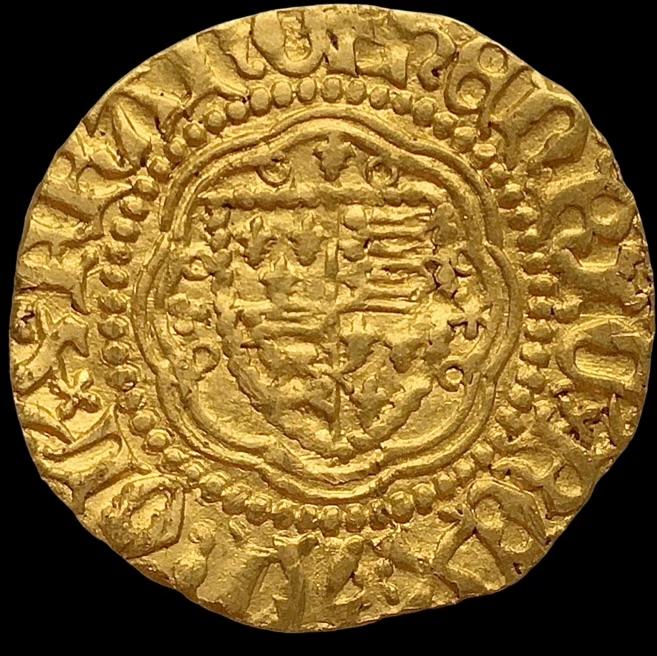
Henry v 1413-22 Quarter Noble Spink 1757Var. 1.71g Obverse: HENRIC REX ANGL FRANC within treasure of arches, stops of various shapes. Trefoil to left and mullet to right. Reverse: EXCVLTABTUR IN GLORIA (“He shall be exalted in glory”). Cross with lions in angles: lis in centre. Mullet to the right was to distinguish the kings new mint master Lewis John. Henry v’s first mint master. Appointed to the role on 14th April 1413. The trefoil was used as a periodic privy mark to identify a specific minting window die variation or administrative shift within the tower mint. The Annulets (small circles) placed around the arches served the exact same high-utility purpose as the ones next to the central shield or to top. They acted as a subtle internal code to identify the exact sub-series, die variation, and specific mint run. The “1757 Var” Designation: in British numismatics “1757” refers to the ID in the Spink standard catalogue of British coins. The “Var” (variety) means it features a distinct die error or sub type -specifically, a spelling variation, in the reverse Latin legend that reads EXCVLTABTVR instead of the standard EXALTABITVR, (“He shall be exalted in glory”).
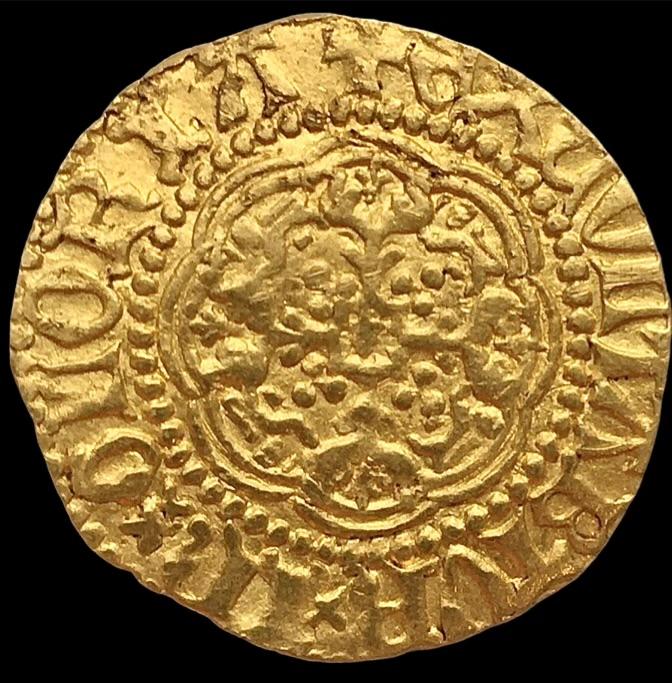 2 points
 -
I am very well acquainted with him! In fact, I worked with Sovereign Rarities on his auction last year, and have since remained in close contact with him! He did almost purchase the plaster model in 2010, but alas decided against it!2 points
-
I always like to see them, and have got better at Identifying them, but I have resisted collecting them. That is one huge rabbit hole to go down!2 points
-
I think I can see the remains of "IMP TRAIAN ..." on the obverse, so Trajan? Reverse legend seems to have some Greek letters, so possibly Roman provincial.2 points
-
https://ebay.io/m/Bvd8Q6 😬2 points
-
He would have said something like "I remember the old mismatics under Obama - they were rubbish, fake."2 points
-
You want to talk to @1887jubilee who knows more about the 1887 JH coinage than anyone I've ever met.1 point
-
Ashley, this sounds phenomenal, I reckon there will be members on here that will be able to help you. The very best of luck in your search, please stay in touch with us all, we love things like this…very exciting! 🙏1 point
-
It has the denomination half-crown on the reverse does it?1 point
-
Spot on. It could in theory be a class 1a2, 1a5, 1b1, 1b2 or 1c, but 1a2 is immediately ruled out because there is no square C or E and 1a5 because there is no stop after LVND. The others rely on observing a stop between S and R on the obverse (present on 1b1 and 1b2, but omitted on 1c). The round C and the R are clear enough, but is the gap between the two letters big enough for a stop? I'm not sure. In the end it doesn't really matter, because the coin is pretty much toast, but I enjoy getting as far as possible with these hopeless cases.1 point
-
My thoughts on the German forgery is that I reckon they had bigger fish to fry in 1945, than to bother themselves with bronze pennies1 point
-
Hello Paddy... unless already spotted historically I bought blindly any coins (way back pre computers day) that looked old enough to be a important find, I think the seller claimed it was Roman and I cant remember how much it was but knowing me it was under a £1, 30 odd years ago...... Paddy, many thanks for all of your time taken in dealing with my challenges. all the very best "H"1 point