All Activity
- Past hour
-
I would not feel comfortable offering a grade opinion without seeing the coin in its entirety-including the reverse. Also, we are opining on a photograph which may or may not capture a realistic view of the coin. Grading standards across the pond are different and standards really should not be intermingled as that can be misleading.
-
 I am curious as to whether the Whitman blue book shelf coin albums were ever popular in the UK. These were produced by Whitman probably starting in the early 1960s and offhand I have no idea when they may have been discontinued. I know there was a Victorian type set album; a two volume 20th Century type set album; various albums for farthings, 1/2 d and 1 d coins. I believe there were type set albums for Australia, South Africa and possibly Ireland. I have only one… the second volume of the 20th century album that started with Shillings. The Whitman small blue folders were more available back in the day than the book shelf albums. I should also add that the book shelf albums were not inexpensive… I recall seeing the Whitman Victorian type set album as a young lad and could not commit to buying it because it cut into my minimal coin budget… and that was over 50 years ago. So were these popular back in the day or was there ever a resurgence at a later time?
 - Today
-
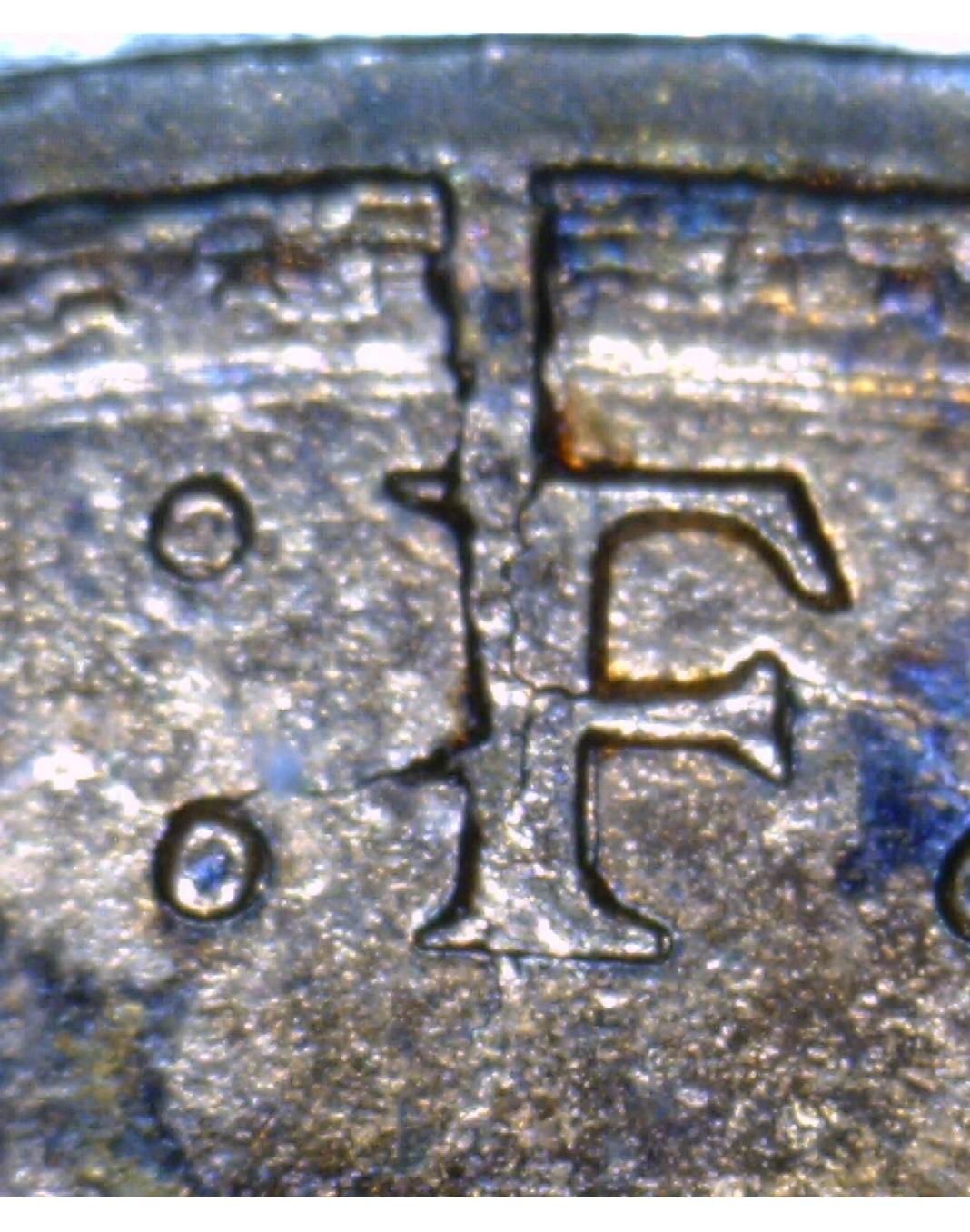
 If you check my ebay listings, I have an F-275 Last 1 over 1 listed. I also have an F-275 HIGHER F OVER F in F:D: listed. I have never seen another and had questioned Iain Dracott about it, but as he had not seen the purported F/P, he could not be sure whether my coin was actually what was identified as the F/P. See attached image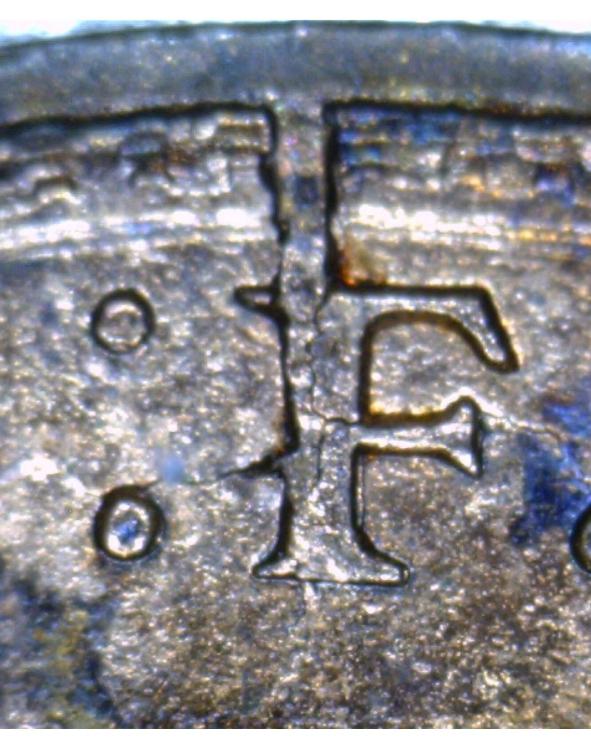
-
Interesting page on Heritage Auctions UK comparing NGC grading to PCGS. This has been up for several months at least, it's dated 2015, and the unsigned writer clearly states his views. The link (heritageauctions.co.uk) doesn't seem to post so I've c&p'ed and compressed the paragraph spacing: HERITAGE AUCTIONS The grading of quality and rare coins is a highly specialised skill which can impact tremendously on coin values.signed There are 2 main international grading companies - NGC and PCGS both primarily based in the USA. As they both claim to work according to the Sheldon Scale of grading , one imagines that there should be a high degree of uniformity and consistency in the grading of coins, notwithstanding that sometimes human objectivity may sometimes be compromised if a grader is having an " off " day, for instance. However, levels of consistency can be compared when coins are submitted for " cross-over " grading which is where one of the 2 main companies undertakes to grade the coins at the same existing or other specified grade and will only encapsulate that coin in it's own plastic slab if the coin meets the minimum grade specified by the person submitting the coin. Otherwise the coin is returned intact in the original plastic slab and the submitter is told that the coin did not " grade ". My own experience of crossover is one where the great majority of my PCGS graded coins have failed to cross-over into a NGC slab at the same or a higher grade. I will be providing statistics as time permits. This surely is disturbing? This is why I buy as many NGC graded coins as possible from Heritage Auctions in Dallas, USA. It will be seen by looking at any of their coin auctions that a large proportion of the slabbed coins that they sell are in NGC holders, and given that they are the largest Auction house in the world that must surely say something! OldCopper now: So for older slabs at least, an interesting take. Perhaps things may have changed since.
- Yesterday
-
Halfpenny Obverse 5 die flaw
Rob replied to absence of uniformity's topic in British Coin Related Discussions & Enquiries
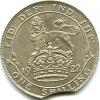
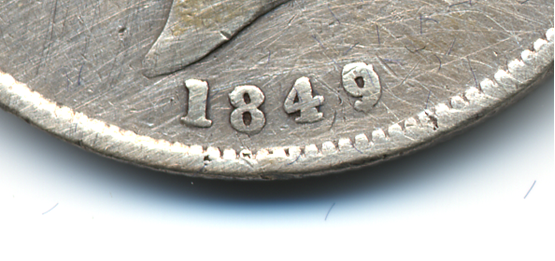
Given the scarcity of it, I would think a few dies are involved. Most of the metal composition/flan preparation/striking force issues were solved in the multitude of patterns struck in the previous few years, with some types only known with laminating flans for example. Never underestimate the Mint's ability to produce a number of rogue batches from time to time. In the mid-1840s, they were only getting a couple thousand from a die pair. A quick perusal of Linton's article in the BNJ regarding the 1848 halfcrowns is quite enlightening regarding flan quality for much of the decade. ‘The half-crowns of 1848’, 29 (1958-59), p.191-93. According to records, 91872 halfcrowns were struck in 1848. The mint had 13 obverse dies available at the end of 1847, all dated 1846. A further 16 (presumably unfinished) 184(-) were made in 1847, but not required, leaving them available for use in 1848. A potential 29 dies for the 91K struck, but only a handful of the unfinished dies (2 or 3) were completed and dated 1848, most being 1848/6. (One can assumed to be dated 1847, just to test the die batch). The previous year, a total of 22 obv. dies were used to destruction for an output of 367,488 coins. Hardly a long life by normal expectations. Again, there was an 1848/7 in the Adams collection which was possibly 8/7/6, but not conclusively so in hand. Similarly for the 1849/7/(6?). All very interesting, but requiring much speculation until clearer examples come to light. The 1849 in particular, was a real dog of a coin, but even so, unambiguous for the 9/7. Just because it has been given R16, it is only a reflection of the percentage of coins examined during research relative to other 1861s. What if a ton or two of output was lost at sea following despatch? We don't know.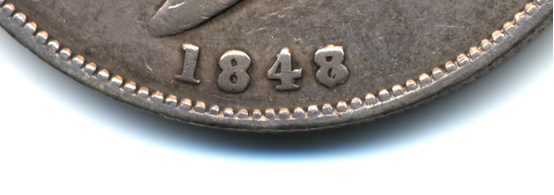
-

Halfpenny Obverse 5 die flaw
Zo Arms replied to absence of uniformity's topic in British Coin Related Discussions & Enquiries
Dracott lists as 1 known. I know of no images If you're going down the Halfpenny Road, have a read of the halfpenny ID thread. You'll learn plenty. -
 Thanks for this info. Is there images online of the F over P in F.D do you know? The F over P in HALF looks like a die flaw to me just a blob/apostrophe of metal making the F look like a P. I was wondering if 1861 5+G F2755+G F over P in F:D: ?R20 Is a clearly defined P? Thanks
 -
Without knowing for sure if the coin has the flaw on the obverse but the lighthouse doesn't match that of G I'm thinking its probably E?
-
Do you think this to do with the change over from copper to bronze? And the difference hardness in the metal? Thanks
-
That a nice really nice example, its interesting mine doesnt show any of the die cracks and the flaw on the forehead less pronounced on yours? If its R16 does that mean all the obverse 5 coins come from the same single die? Surely if multiple dies were in use more coins would of been struck? Its also surprising a die would deteriorate after only strikng a 100-200 coins.
-
Halfpenny Obverse 5 die flaw
Zo Arms replied to absence of uniformity's topic in British Coin Related Discussions & Enquiries
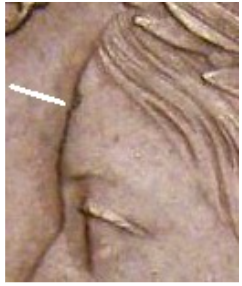
The dent in the forehead is unique to obverse 5 but not all obverse 5's have it. However, all obverse 5's have the scalloped, middle top leaf. For 1861 there is a range of recut, first and last 1's. Some rakish angles too. For 5 + G, Dracott lists an F over P in F.D. -
Ok thanks, according the Richards site there is also 1861 6+E F2766+E 1st 1 over 1 I dont think you are seeing things, the date alignment is what caught my attention initially. There appears to be some doubling on E and Y of penny aswell.
-
 yes, now I think it's 5+G which makes me doubt what mine is (my picture is a blow up of a lifesize scan, so it's not clear). However I think mine is more likely to be 5+G also, as the features for Reverse E simply don't ring true.
 -
Halfpenny Obverse 5 die flaw
Rob replied to absence of uniformity's topic in British Coin Related Discussions & Enquiries
FWIW, this is my 5+G. The obverse die is close to destruction and the coin somewhat spotty, but all features are clear.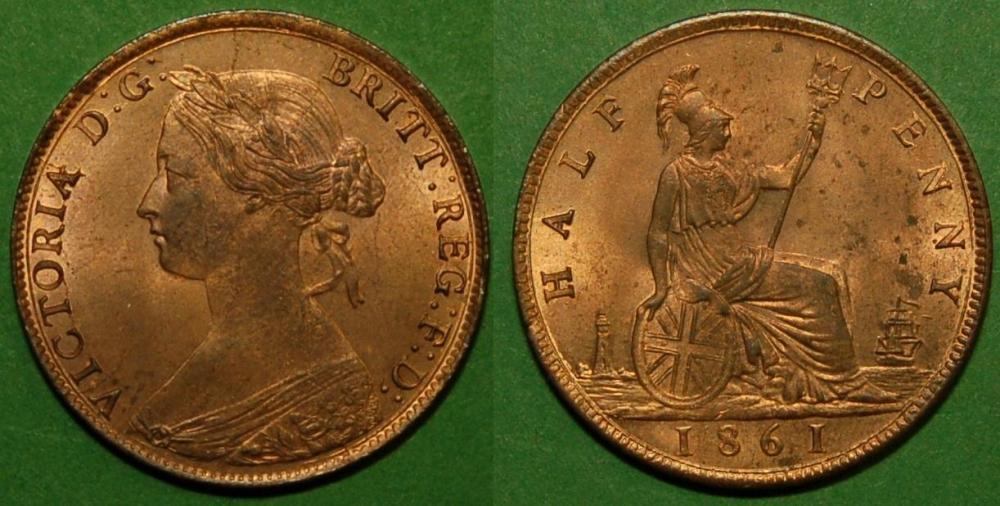
-
Halfpenny Obverse 5 die flaw
Rob replied to absence of uniformity's topic in British Coin Related Discussions & Enquiries
I am not aware of any other obverses which show a similar flaw, but that is only what I have seen. The lighthouse is reverse G because the shape is more of a gaussian distribution with a pointy hat. E has straighter sides. I know 6+G exists with the first 1/1 as I used to have one, but the recut is lower, not higher. I do wonder if your coin has been slightly double struck on part of the flan, as the obverse rim shows a slight discontinuity(?) at 11 o'clock with another between 1 and 2. That could account for the crazy date alignment which is what sticks out most to me,, unless I am seeing things. -
I'm not sure I think it is G the coin I have by the difference in the shape of the lighthouse, also reverse E has L.C.W above the 8 & 6 in the date. From what I can see the ace of clubs to the left of lighthouse is on G and not E. The rock to the right of the lighthouse on my coin is different and appears to match better with G.
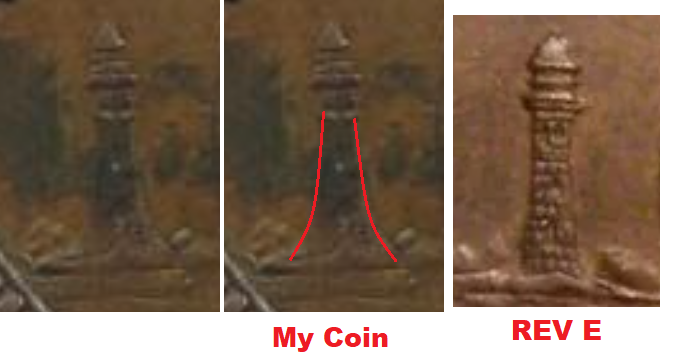
-
I have the Obverse 5 1861 halfpenny (the dink in the forehead is the giveaway), but pretty sure the shield and lighthouse are different. In my database it's listed as 5+G which means yours would be 5+.E ?
-
On the LCA website I just found an example of 5+G that appears to show the 1st 1 over 1, but the coin was not listed as such. Of the 51 to 100 known surviving specimens that is potentialy two of this minor die variety that exist.
-
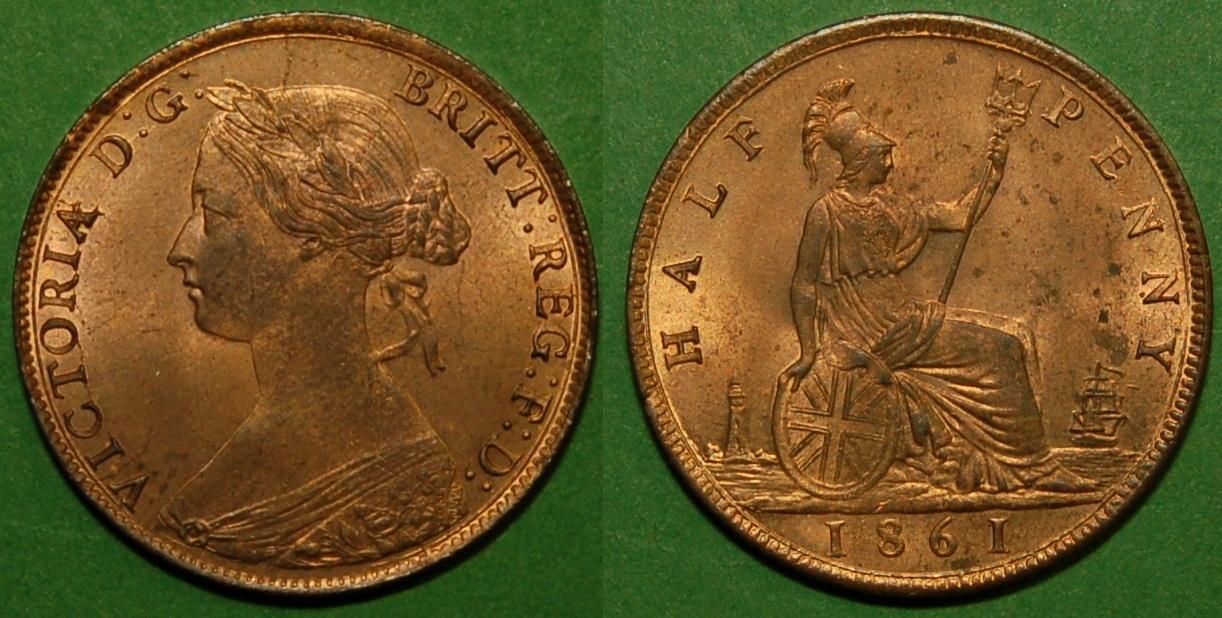
Here is the coin in question; The die flaw leads me to beleive its Obverse 5. The only two reverse options for a obv5 coin is E or G and the lighthouse does not match that of a Reverse E. The images show the flaw on the forehead and the lighthouse of Reverse G and the 1st 1 over 1.
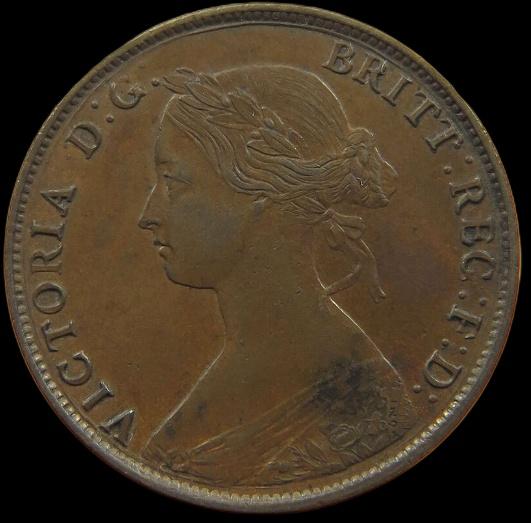
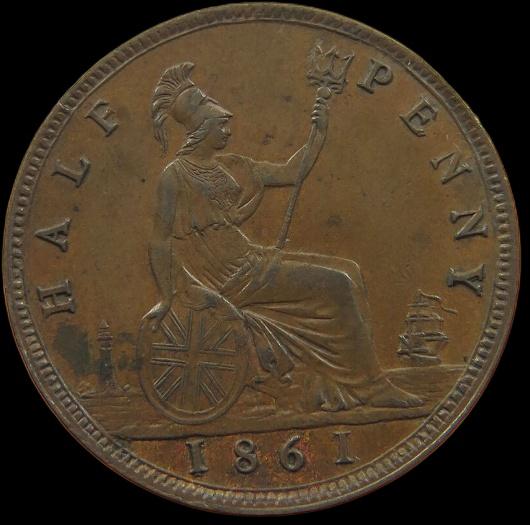
-
Hi, Can I ask please; (I have tried myself to find the awnser without success) Can anyone please confirm whether any other obverses show the die flaw shown in the attached image in the halfpenny series? I have taken the image from @secret santa website, thanks again for this great source of info. I found a halfpenny which I think is 5+G die paring the coin also appears to show 1st 1 over 1. 5+G is listed as R16 but I cant find reference to this pairing showing the 1st 1 over 1. The coin looks to be in ok condition, slightly rarer pairing with the added bonus of the 1st 1 over 1. Thanks.
- Last week
-
And the threepence by far the most common victoria date
-
The 1887 shilling is arguably the most common Victorian coin, even in high grade - the sixpence is also very common but at least you have two types to collect.
-
Coins of the year 1887 are really common, just be discerning and not in a rush, I must admit unc and a/unc are harder to find but they are out there don't fall for these con merchants
-
Apparently so! You’d normally expect to be ‘safe’ around those grades…staggeringly bad!
-
What is the American MS64 - our GVF?