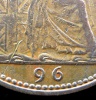
RChris Posted July 10 Posted July 10 (edited) Having lost interest in my penny collection and getting on in years, I decided to sell some. Someone else may as well enjoy them. It's a long time since I used this forum so having forgot about it, I put some on eBay. Is that a good place to sell or better on here? I listed this 1965 heavy flan but had no interest so it's re-listed. I also put a collection of errors on there. https://www.ebay.co.uk/itm/127966667173 https://www.ebay.co.uk/itm/127965963419 Edited July 10 by RChris added urls's Quote
wlewisiii Posted July 10 Posted July 10 Damn, that's lovely. I'm really much more into silver than bronze coins but that one is so lovely that all I can say is "thank you" for sharing it. 1 Quote
Rob Posted July 11 Posted July 11 Interesting as it might be, it will be a random strike on a blank intended for something else. You can hazard a guess as to the intended blank, but if you send it to the Royal Mint, their records will tell what issues were being struck in that year on blanks of that weight. I have a 67 florin which was apparently struck on a blank for a Burundi 10 Francs, which I would not have guessed. i.e yours could be a blank for anywhere on the planet. Best ask the question. Value will be minimal, but does have some value above the regular issue. Quote
absence of uniformity Posted July 11 Posted July 11 1 Penny 1965 Mint Error - Mis Strike, struck on a thicker heavy flan and weighing 12.11 grammes, A/UNC the obverse with traces of lustre, Sold £280 Quote
absence of uniformity Posted July 11 Posted July 11 1 minute ago, absence of uniformity said: Here is your coin which sold through LCA, maybe it was you who purchased it ? 1 Penny 1965 Mint Error - Mis Strike, struck on a thicker heavy flan and weighing 12.11 grammes, A/UNC the obverse with traces of lustre, Sold £280 06/03/2016 Quote
absence of uniformity Posted July 11 Posted July 11 I quickly checked a few of the obvious commonwealth countries I cant find a bronze coin that size and weight. Quote
RChris Posted July 11 Author Posted July 11 (edited) Thanks chaps....yes, I saw it on the LCA website when researching the value and included that in my eBay listing. I honestly can't recall if it was I who obtained it from LCA as it is obviously the same one. It's nice in hand, quite obviously heavier. If I did pay that much for it I assume I will be lucky to get my money back. I may be wrong but get the impression there was much more interest back then. Edited July 11 by RChris Quote
absence of uniformity Posted July 11 Posted July 11 2 minutes ago, RChris said: Thanks chaps....yes, I saw it on the LCA website when researching the value and included that in my eBay listing. I honestly can't recall if it was I who obtained it from LCA as it is obviously the same one. It's nice in hand, quite obviously heavier. If I did pay that much for it I assume I will be lucky to get my money back. I may be wrong but get the impression there was much more interest back then. Did you set a reserve? It would be a shame to let it go for a fraction of the price it has previously made.. Surely it's not a common coin? Then again it's quite obscure in the sense you need to be looking for it and weighing 65's to find one. Quote
Rob Posted July 11 Posted July 11 The problem with spurious Mint emissions is that a deliberate anomalous product commands a much higher price than a random blank picked up and thrown in the bucket for use. i.e. if you could prove it was a striking specifically tied to a certain mint action, such as trying out a regular mix on a different thickness blank, or a test for a new currency contract from a foreign country, you will do better than the unintended oddball. Wrong flans occur regularly, which is not surprising given the billions of blanks cut every year. Clearly even a hundred wrong'uns would be extremely rare, but in the context of mint operations would only amount to a rounding error if checked for weight. So to consider the above point, it is definitely not common, certainly excessively rare (in the context of a currency issue) and maybe even unique. The problem lies in documentation, because errors are by definition, not struck for the records. 2 Quote
secret santa Posted July 11 Posted July 11 Interestingly, I bought a heavy 1967 penny (13.43 gm) at London Coins auction in September 2013 along with a couple of decimal errors for £95. Mint Errors (3) Penny 1967 struck on a thick flan and weighing 13.43 grammes EF, Decimal Two Pence 1978 uniface Obverse only NEF, Decimal Penny 1976 VF with raised unusual collar. Quote
RChris Posted July 12 Author Posted July 12 On 7/11/2026 at 12:07 PM, absence of uniformity said: Did you set a reserve? It would be a shame to let it go for a fraction of the price it has previously made.. Surely it's not a common coin? Then again it's quite obscure in the sense you need to be looking for it and weighing 65's to find one. No reserve......I figure these things will realise their current value. As I said in my OP, I may be wrong but I get the impression demand is not what it was 10 -20 years ago. Am I wrong? 1 Quote
secret santa Posted July 12 Posted July 12 11 minutes ago, RChris said: Am I wrong? Sadly, I think you're absolutely right. I imagine most penny collectors became interested during their school years in the sixties and are now in their twilight years (me included) and it seems that the interest in copper and bronze will fade away with them. I shall probably sell my collection next year and am resigned to losing money on many if not most of the coins. Quote
RChris Posted July 12 Author Posted July 12 1 hour ago, secret santa said: Sadly, I think you're absolutely right. I imagine most penny collectors became interested during their school years in the sixties and are now in their twilight years (me included) and it seems that the interest in copper and bronze will fade away with them. I shall probably sell my collection next year and am resigned to losing money on many if not most of the coins. Same here, checking my mother's purse for pennies when she came home from work every night during the 1960's. It was good while it lasted but I'm now at the age when it's time to move them on. So those I've purchased since have not been a great investment but the fun was in the collecting. It's a shame today's youth are mostly into their phones. Quote
absence of uniformity Posted July 12 Posted July 12 3 hours ago, secret santa said: Sadly, I think you're absolutely right. I imagine most penny collectors became interested during their school years in the sixties and are now in their twilight years (me included) and it seems that the interest in copper and bronze will fade away with them. I shall probably sell my collection next year and am resigned to losing money on many if not most of the coins. I was under the impression in recent years interest had spiked, not from my own experience but various things I have seen/read. I only buy unattributed coins so loss in the future i doubt will amount to much for me, but same for the collection will probably never amount to much waiting for coins that are never going to appear. Quote
Rob Posted July 12 Posted July 12 Whilst the interest in collecting from change may fade away, the interest in rarities, especially nice ones, is likely to be subsumed into the general collector desire for quality rarities seen across all spheres. Otherwise, how do you explain the prices paid for hammered coins, none of which circulated in living memory. Their desirability stems from the history and all coins are part of that same history. Not all denominations have a large following, but one day their turn will come when relative rarities are fully appreciated. Take halfpennies. Much rarer than pennies in top grade because alongside farthings, they were the mainstay of the working class cash economy. That means a high grade example is always a good long term bet given they weren't normally set aside and collected per se. It is a common thread throughout history. Look at Roman sestertii as an example. These were the circulating base coinage of the Roman era, and again, not something the rich and famous would set aside. However, the Bolsena Hoard found in the late 19th century in northern Italy provides ample evidence that even 1700 years ago someone thought them collectable. As the hoard contained a large number of top grade sestertii spanning a few centuries, it beggars belief that they were collected from circulation. The hoard only makes sense as a collection. i.e. we are just the latest in a long history of people who collect from interest, rather than as an investment. As I wrote in my testimony to Cope part 2. We 'met' on ebay. He, as my regular nemesis, eventually asking if I was a copper collector. Silly and obvious really. When we had both bid over twice book on a lustrous 1718 halfpenny that came back in the sale as a 65RB, it was clear that we both appreciated the relative quality of the coin, and how infrequently they turn up. High grade modern pennies will also fall into that same collectable category once enough have been melted and are no longer readily available, and this might happen sooner than you think. In the past 20 years, I estimate that I have consigned somewhere near a ton of bronze to be melted of all denominations. Why? Because nobody wanted them, so you melt to free up cash. The odd rare piece will have gone through undetected, but the vast majority will have been worth scrap value. I am not alone in having done this. This will increase the relative abundance of the rarities over time. Every dog has its day, and as far as I can see, always will do so on a recurring basis. 3 Quote
Peckris 2 Posted July 12 Posted July 12 1 hour ago, Rob said: In the past 20 years, I estimate that I have consigned somewhere near a ton of bronze to be melted of all denominations. Why? Because nobody wanted them, so you melt to free up cash. The odd rare piece will have gone through undetected, but the vast majority will have been worth scrap value. I am not alone in having done this. This will increase the relative abundance of the rarities over time. I know I've said it before, but the ratio of rare to common specimens has narrowed steadily since decimalisation, but the value guides don't really reflect this. The rarities are still rare but the common dates have become scarcer over such a long time. Quote
safi Posted July 13 Posted July 13 I have been giving my unwanted pennies to a charity shop (animal not human they are too greedy) and when I go in to see how they fared they are always sold out, apparently its youngsters going in to buy them, so maybe its an upward trend, hopefully 2 Quote
PWA 1967 Posted July 13 Posted July 13 Although i dont bid on attributed coins on eBay, i would pay £300 for a thick/heavy flan penny today, if anyone has one they want to sell. Quote
RChris Posted July 13 Author Posted July 13 1 hour ago, PWA 1967 said: Although i dont bid on attributed coins on eBay, i would pay £300 for a thick/heavy flan penny today, if anyone has one they want to sell. You'll have to forgive my ignorance on the finer points of collecting. You don't like the one I'm offering? I'm not familiar with the advantage or difference it makes between attributed and unattributed but would appreciate learning. Quote
PWA 1967 Posted July 13 Posted July 13 16 minutes ago, RChris said: You'll have to forgive my ignorance on the finer points of collecting. You don't like the one I'm offering? I'm not familiar with the advantage or difference it makes between attributed and unattributed but would appreciate learning. Ones that are not attributed i have a better chance of getting cheaper and worth spending hours looking for, unless someone tells the seller what they have. Ones sold correctly attributed and starting at 99p but worth a lot more, i prefer to leave. Quote
absence of uniformity Posted July 13 Posted July 13 (edited) 8 hours ago, PWA 1967 said: Ones that are not attributed i have a better chance of getting cheaper and worth spending hours looking for, unless someone tells the seller what they have. Ones sold correctly attributed and starting at 99p but worth a lot more, i prefer to leave. How do you intend to look for one without buying hundreds and weighing them? Edited July 13 by absence of uniformity Quote
absence of uniformity Posted July 13 Posted July 13 8 hours ago, RChris said: You'll have to forgive my ignorance on the finer points of collecting. You don't like the one I'm offering? I'm not familiar with the advantage or difference it makes between attributed and unattributed but would appreciate learning. If it was my coin I would set a reserve. If a dealer was prepared to pay more than what the coin made 10 years ago clearly its worth more today. Quote
absence of uniformity Posted July 13 Posted July 13 18 minutes ago, absence of uniformity said: How do you intend to look for one without buying hundreds and weighing them? To me thats what will keep these few and far between and the premium up. @RChris I have had another look tonight trying to find a country the RM has struck coins of a similar weigt and size without any luck. 1 Quote
Recommended Posts
Join the conversation
You can post now and register later. If you have an account, sign in now to post with your account.