

Martinminerva
-
Posts
550 -
Joined
-
Last visited
-
Days Won
32
1 Follower

Recent Profile Visitors
17,121 profile views


Martinminerva's Achievements






-
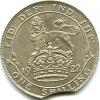
Definitely just post mint damage as Chris says. I think someone back in the late 1800s actually suspected it might have been a forgery (it's not, but many were at the time) and has cut or chopped the flan to test. The metal displacement can be seen along the entire length of the cut on the top side of it (so chopped at an angle upwards from SW to NE) and subsequent circulation wear has smoothed it out a bit including blending it into the beads, and separating off the bottom serif of the I to make a big blob. Not a mint fault, I'm afraid. You're actually not far wrong when you say hit with an axe! More likely a chisel.
-
Halfpenny ID check
Martinminerva replied to mrbadexample's topic in British Coin Related Discussions & Enquiries
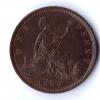
Think it's a penny, Bob - bust of Victoria too big and too near linear circle at top to be a halfpenny. D'oh !! -
You are quite correct on your first point - only the bidder knows their maximum. And whilst of course a seller cannot bid on their own item, asking a friend or relative is also what's known as shill bidding and is, rightly, utterly against ebay rules and is highly illegal.
-
Yes. I hope he was grateful for my detailed and thorough answer (!). This sort of ebay nonsense, inspired by poor journalism by the tabloids, really gets me going, thus I feel obliged to explain why this sort of thing is NOT an error or valuable. Viz. too "upside down" edges on former pound coins and £2's. As the lettering is done first, it's 50:50 which way up the lettering will be when the two sides are struck!
- 6 replies
-
- 1
-

-
- guy fawkes
- gunpowder
- (and 2 more)
-
You've answered your own questions/observations perfectly.
-
And this seller is someone I have bought from in the past and have never had any qualms about. I guess he has been hoodwinked himself - wonder what he paid for it, and from whom...?
-
These lettering "defects", I'm afraid, are simply the product of how the edge lettering and graining is manufactured: firstly, the blank planchets are incuse lettered by rolling/rotating them under pressure through drums or wheels which contain raised, "mirror" image lettering to impress the correct words into the edge. Then the lettered blanks are struck between regular dies with a plain, grained collar which imparts the "milling". And herein lies the problem - metal flow under the significant pressure of the dies where the milling coincides with the incuse letters can produce these anomalies as metal can fill some of the interstices to some or full degree. On your specimen above, the diagonal downstroke of the R is actually still visible, albeit faint, and even full "Pemember" examples are just where the metal flow has obscured that part of the R. Likewise with the M's - they are not a smaller font, just where metal has encroached on the incuse letter somewhat. A curiosity, yes, but common, yes, and error or variety, no, sorry. And as for value - two pounds, I'm afraid.
- 6 replies
-
- 1
-
-
- guy fawkes
- gunpowder
- (and 2 more)
-
Yes. And yes too for authenticity, I believe...
-
I am inclined to agree with you, Paddy, now I see all 3 together. But, keep looking for a 1915 recessed without the broken tooth as they do exist. I have one!
-
A Dodgey 1927 Florin.
Martinminerva replied to ozjohn's topic in British Coin Related Discussions & Enquiries
Not at all... Genuine 1927 florins are proof only, barely 15,000 struck and typically change hands for £120 - £150 and are sought after. A Chinese poor quality copy (which this is just one of many, many examples peddled on ebay, Alibaba etc) can be got for maybe a fiver, so a disingenuous soul can easily make a huge profit... See above! -
Yep, standard 4+D die pair - very common. The N indeed is just flattened through extreme wear. Nothing special here, I'm afraid.
-
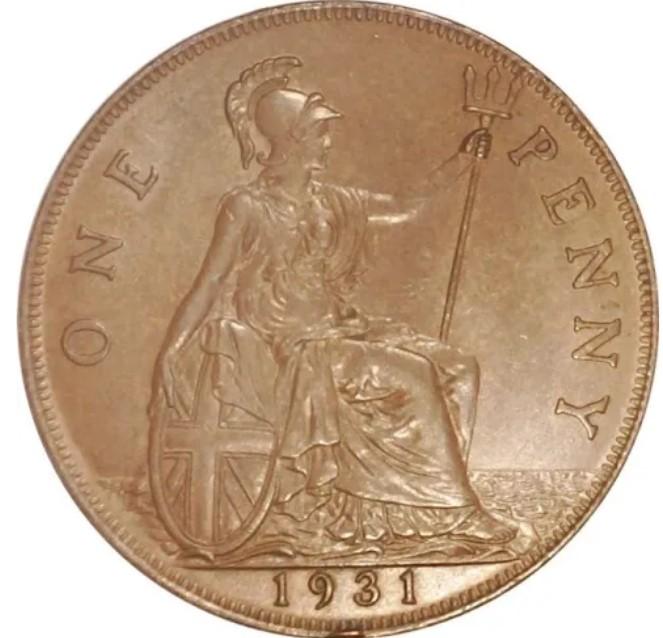
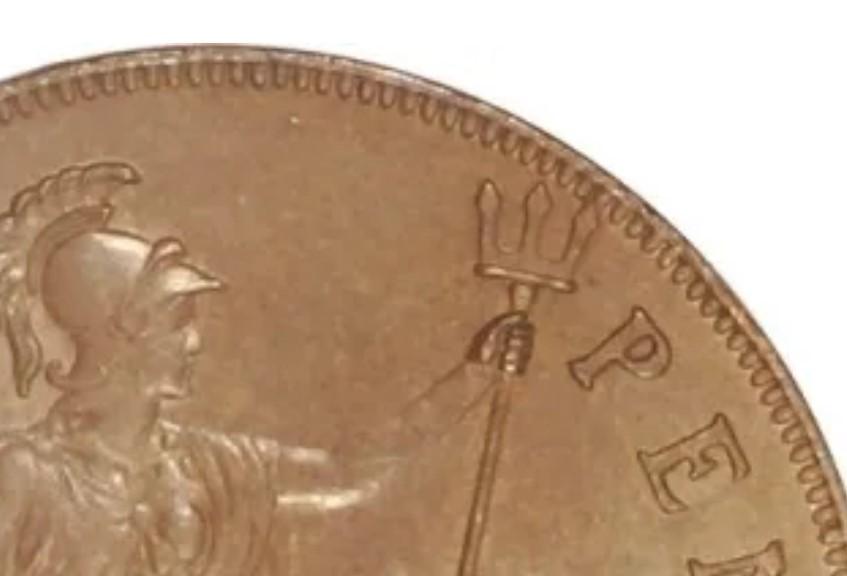
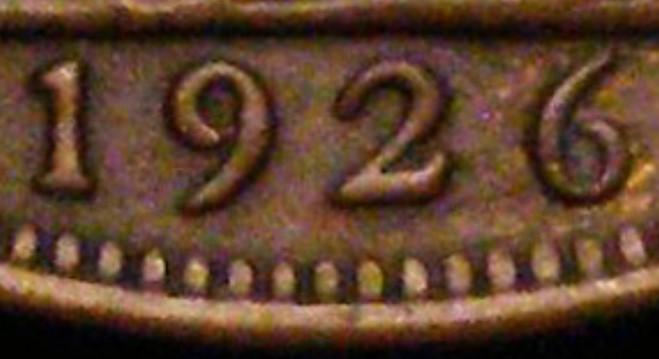
I see what you mean, Terry. How curious... Would they really have made two dies for this experiment?? Just to add another spanner in things, here's a picture of a normal (albeit missing waves) 1931 reverse (from Richard's site) which also seems to have the smaller Britannia, longer teeth, thinner thumb, bigger gap from trident to teeth etc such as Richard has identified for these trial pieces. Are there actually BOTH subtly different Gouby reverse d's known for all dates 1927 to 1936, perhaps as a result of hubbing variations, and so this could after all be a doctored 1927 piece???? Or is it just for 1931? I'm going to have to trawl through all my GV pennies later!! If anyone on the forum did buy it, PLEASE have a good look at it through a microscope!
-
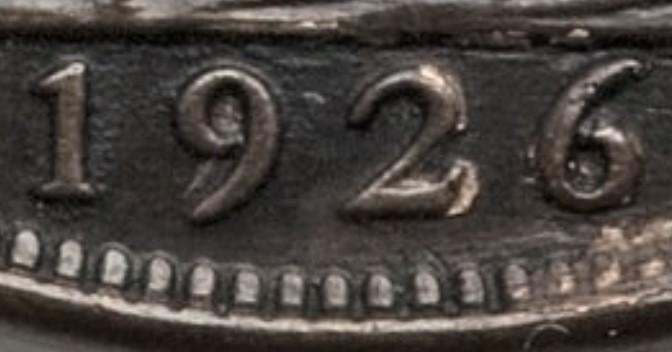
Hi Richard. I saw it at the time and was considering putting a bid in but concluded it was a doctored specimen: the 6 on the LCA specimen is surrounded by lighter coloured metal consistent with it having been transplanted from another coin onto an original 1927 coin. Quite apart from that, it would have to be a different die too as on your ex-Freeman one, the 6 is over a gap between teeth and rotated slightly clockwise, whereas on the LCA one, the 6 is bolt upright and over a tooth. I can't believe two trial dies were produced striking one coin each! Happy to be proved wrong if anyone here did buy it and microscopy eliminates my suspicions...
-
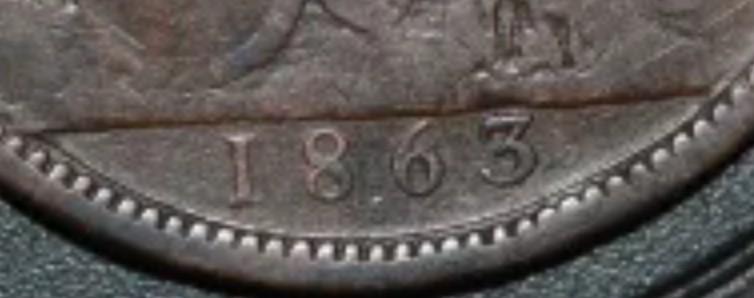
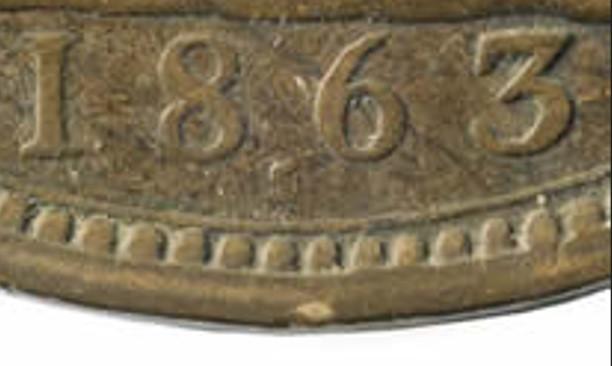
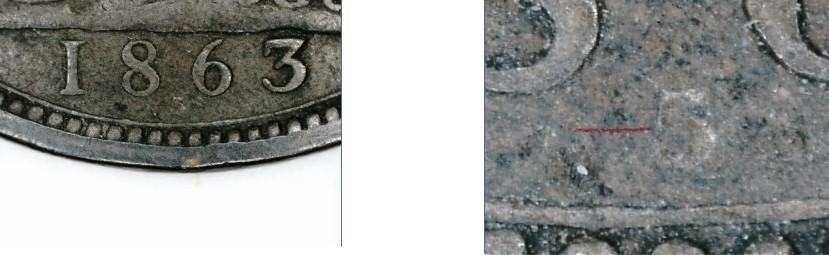
You're seeing things. Another classic case of pareidolia, methinks. On a genuine die 5, the die number is much larger than your "blob" and also slightly to the right of a border tooth. Your anomaly is to the left... See below:
-
Isn't it a brockage? No. Just a die clash - see original post at top of thread. This picture immediately above is an overlay / superimposed, not what the coin actually looks like.