alfnail
-
Posts
792 -
Joined
-
Last visited
-
Days Won
84
Content Type
Profiles
Forums
Events
Downloads
Store
Gallery
Articles
Everything posted by alfnail
-
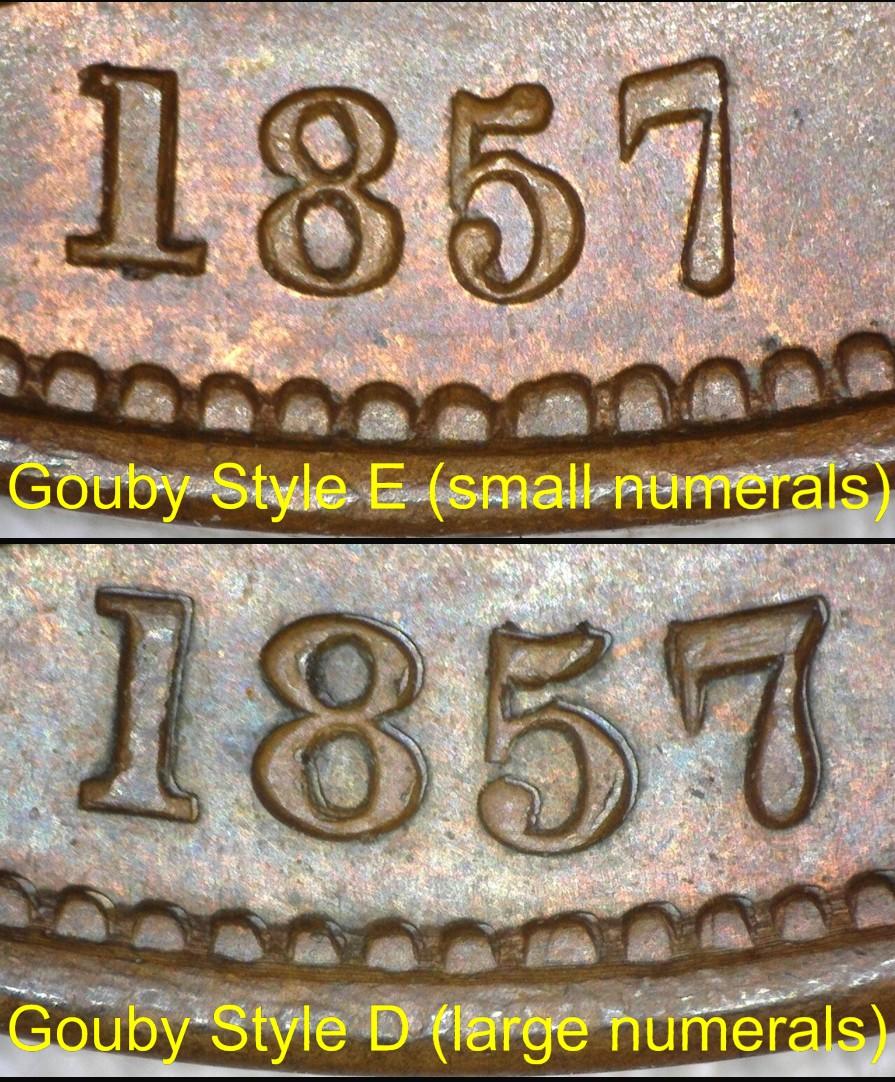
I agree with Mike that the 1857PT referenced as “much smaller figures” by Spinks in 1895 must be the same as the one shown below, known as Gouby Date Style E, with the tall slim 7. This can be compared to the picture directly underneath, an example of a larger numeral type for this year. Each has been shot at the exact same 60x magnification, with same 1280 image widths, so that a true comparison of the dates can be made. I have tried to centre each coin so that the larger border tooth is 4 teeth from the right hand side of the images. I have spent my spare time over the past couple of days carefully going through my images of all 1857 penny ebay sales over my 5 year study period. Nothing from this sample of 621 coins appears to have smaller numerals than seen on Gouby Style E. In this sample there were 66 Gouby Style E pieces, around 10% of the entire 1857 population. In my 5 year study period this 1857 Gouby Style E sub-variety actually appeared less often than say an 1846, 1845 or even an 1843. The numbers are more on a par with an 1849, or 1853 Plain Trident. This may surprise, but perhaps partly explain the 1895 Spinks wording. One other thing that I noted was that Plain Trident 1857’s represent 68% of the population, slightly at variance with Bramah’s observations where he states on his Page 109:- “for 1857 the P.T. are commoner than the O.T. as about 3 to 1, and the latter may be regarded as scarce”.

-
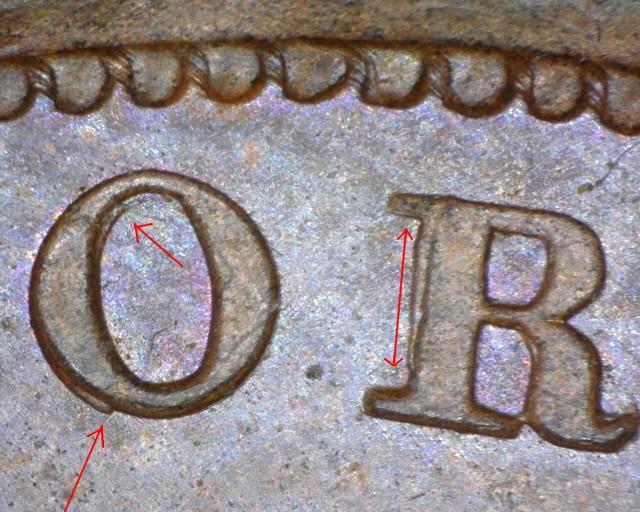
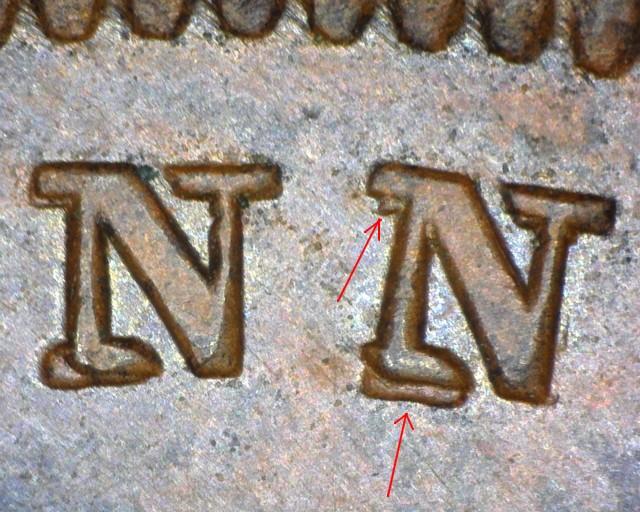
The numerals on the atlas example are in the correct position for it to be a 5/5, although the top of the 2nd 5 looks straighter than I have seen before. I'm still thinking that it is most likely a 5/5. I have owned 8 examples of the 5/5 over the years and they all have the same obverse / reverse legend features. Atlas, suggest you check the obverse to see if yours has the small protrusions I have highlighted on the OR of VICTORIA, and then check the reverse (which should be a Plain Trident) to see if the NN of BRITANNIAR looks like the picture below.
-
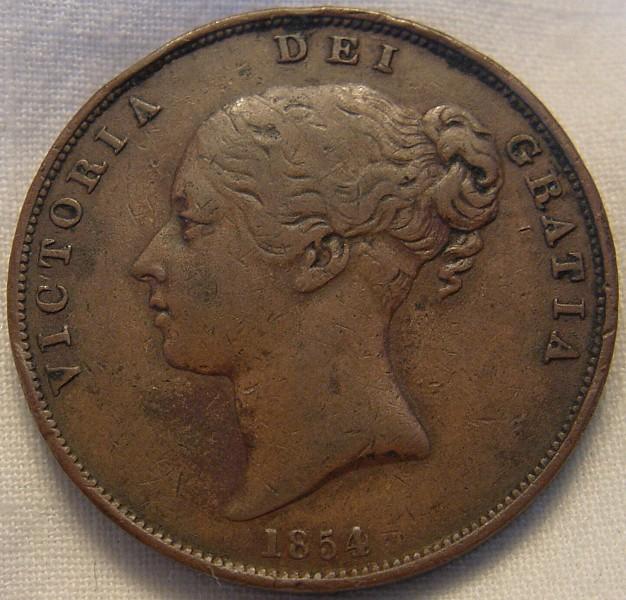
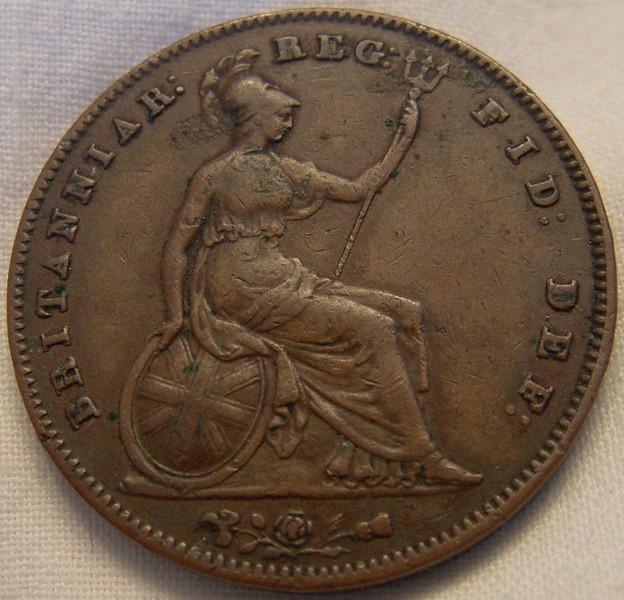
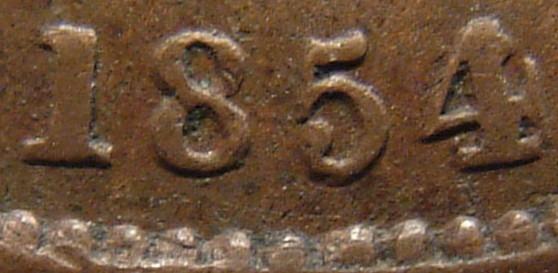
Here's an 1854/3 which I bought on ebay for £7.50 in 2008. I sold it to Andy Scott in 2014, and presume it was sold as part of his collection through Spinks, think 2015........but I don't know where it went. I owned this piece before I had a digital microscope, so pictures of 4/3 in date are not great. However, if you stare at the overdate you can see the 3 appear from underneath, including the tip of the middle bar poking out at the right hand side of the inner part of the 4.........not often seen.
-
Anyone know why 8 came out as a smiley face in my above post!!??
-
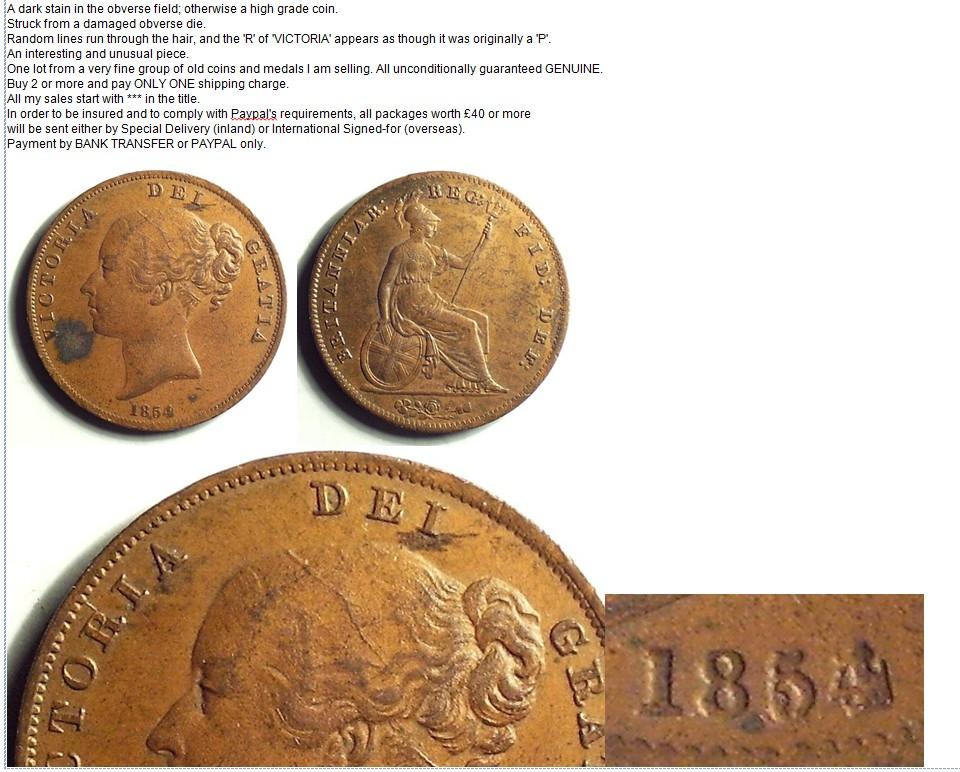
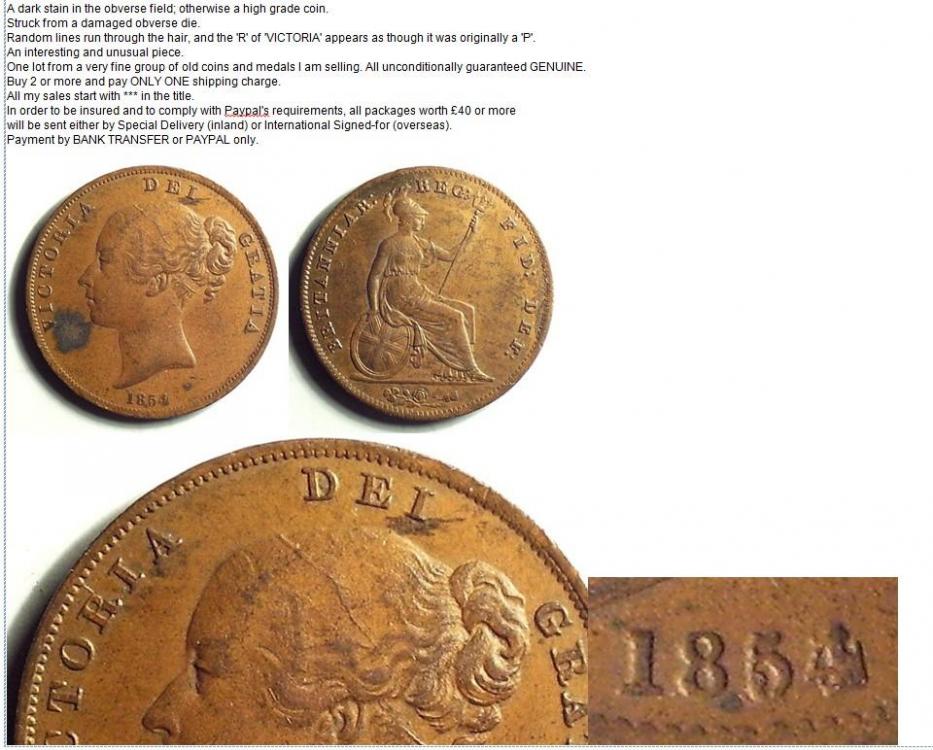
Hi Richard, I did a screenshot of this one, sold on ebay in December 2009 by Michael Freeman. He added a couple of interesting comments, hope they are clear enough to read in my image. Just checked your 'rarestpennies' site for the 1854/3's and I'm certain that your last Example, (Number 😎 is not an 1854/3 as you suspected. All examples I have ever seen are paired with a reverse which has a particular set of legend features; amongst other things these include a slanted colon after BRITANNIAR which is higher than usual + the top dot clearly more distant from the R than usual. Example 8 on your site has a very different colon position.
-
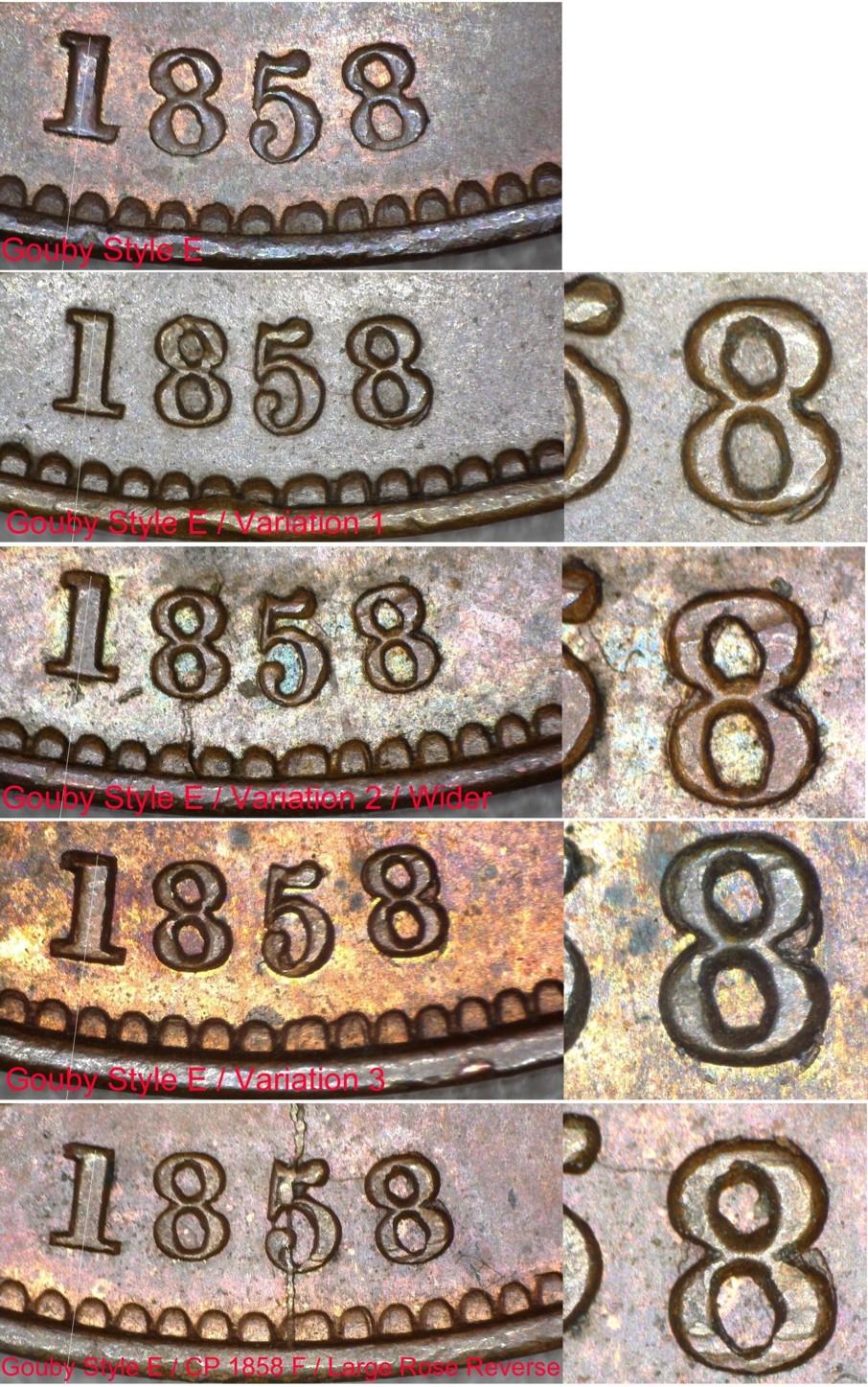
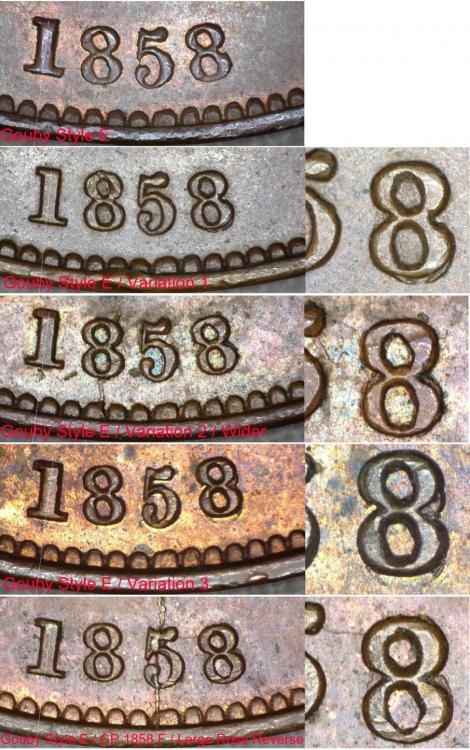
Hi Richard, I don't think the 1858 with smaller numerals (not 8/6) is particularly rare. London Coins past auctions may not be the best place to assess this; a quick look at ebay reveals at least 2 on there at this moment. I have sold quite a few 1858 smaller numerals over the years, and have examples from 5 slightly different smaller numeral obverse dies in my own collection.......including the large rose type with the flaw through the 5. These can be seen below, noting some slightly different numeral locations in respect to border teeth, and the different repairs to the second 8. The large rose / small date being at the bottom of this set of images. I'm sure that there will be more examples than your 20 limit for 'rarestpennies'. Hope this helps, Ian
-
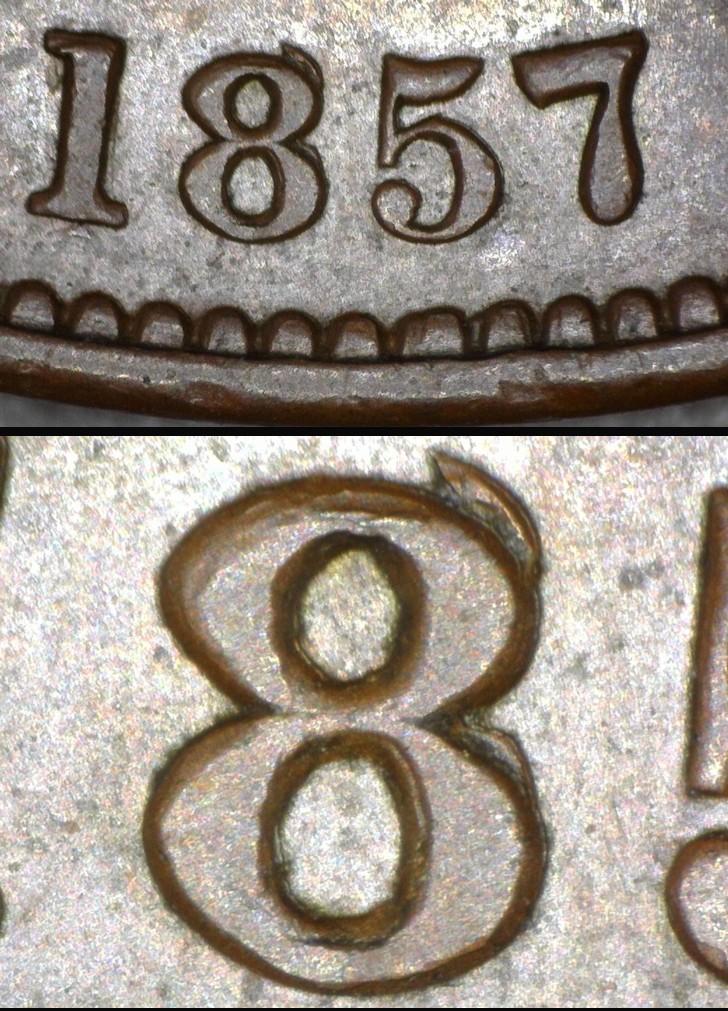
The 1857 Gouby Date Style C is seen paired with both OT and PT; I have both types in my collection. I'm pretty sure I have seen it paired with the Ornamental Trident less often, but I have not attempted any stats on this. The most interesting one I have found is this one (Plain Trident Reverse), which has a 'repaired' numeral 8. Just back from holiday last night, internet was not good whilst away. Can see I missed a few posts about Victorian Copper pennies, and think I may have a few additional comments to make when get time.

-
Silver Marks / Help Please
alfnail replied to alfnail's topic in Nothing whatsoever to do with coins area!
Many thanks Jerry -
I'm hoping that there will be an expert on the forum who can read silver markings. I'm not actually sure that the piece is solid silver because it looks quite tarnished, almost plated with some wear, but the markings do also look like they could be hall marks to me. Felt sure there would be brains on here to help, rather than me wasting time on the internet trying to pin it down. Thanks in advance.

-
Well spotted though Jerry
-
Don't see many of the B26a's nowadays Mike. I think most are tucked away in collections. I'm sure I saw them more often when I first started collecting. I ought to try and do some stats on that variety from my 5 year ebay sample when I get time.
-
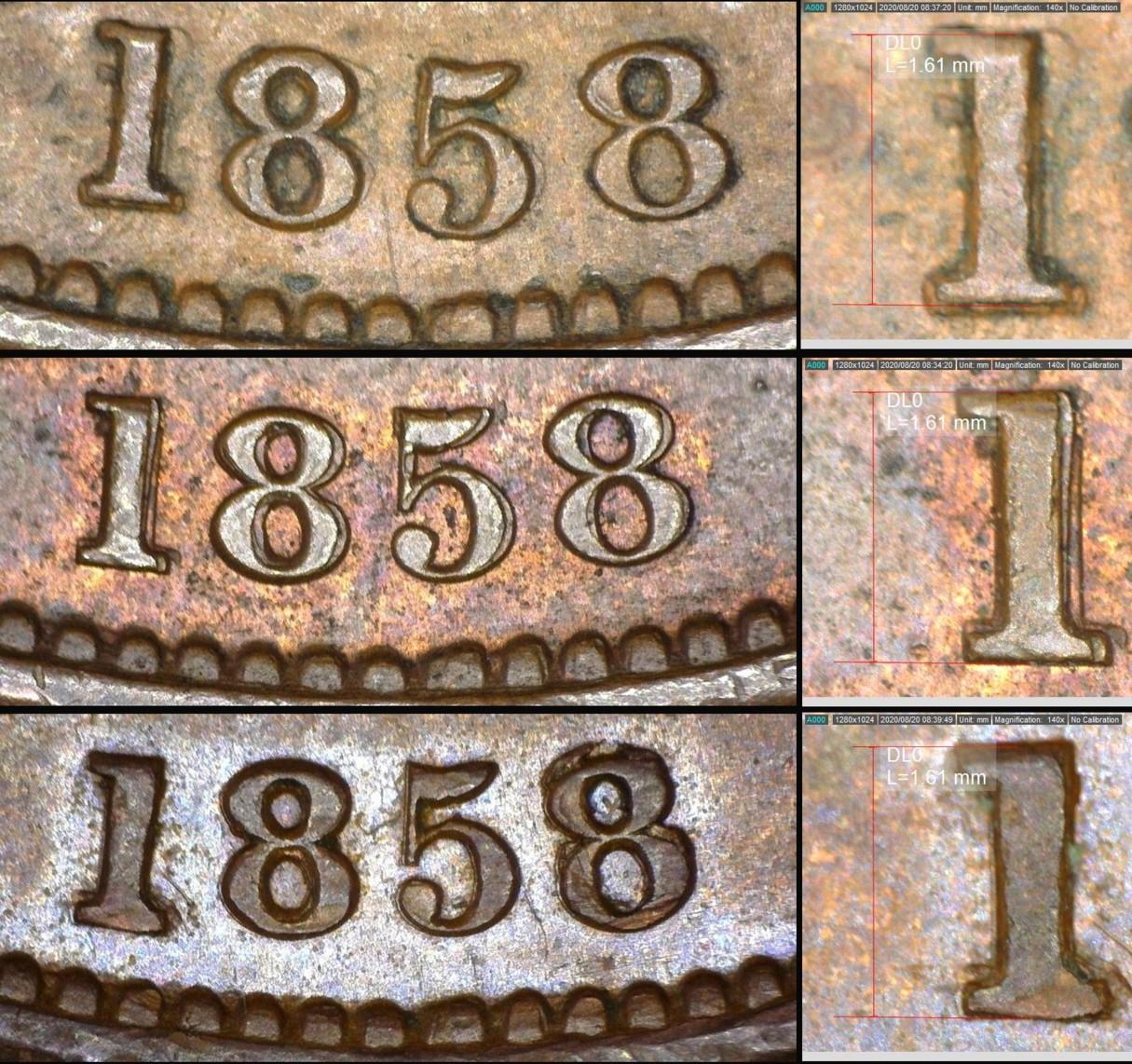
My own experience of the ‘No W.W.’ 1858’s are that the numerals are always the large type. I have seen all three numerals with different repairs, some more obvious than others, but I think that each numeral retains the same font type. I believe that some collectors think there is a tall thin numeral one, and a different smaller type, but I think this is an optical illusion due to the position of the base of the 1 in respect to the border. I show below 3 different dates (all No W.W.) with the numeral 1 at varying heights in respect to the border teeth. At first sight, one could be forgiven for thinking that the 1 in the top picture is a taller type. When looking under a digital microscope, however, the numeral 1 appears to be the same height (and type) on all 3 coins. The pictures on the right hand side, taken at 140x mag, illustrate. I actually took the middle picture first, and measured at 1.61 mm height, and then slid the other two coins under the microscope without changing the magnification. I think that is why the other two pictures are marginally out of focus, due perhaps to slight differences in thickness of coins and wear of numerals. Nevertheless, I think it illustrates the point I am making. It can also be noted that the top bar of underneath numeral 1, protruding towards the top left, can be seen at different heights.

-
Penny Acquisition of the week
alfnail replied to Paulus's topic in British Coin Related Discussions & Enquiries
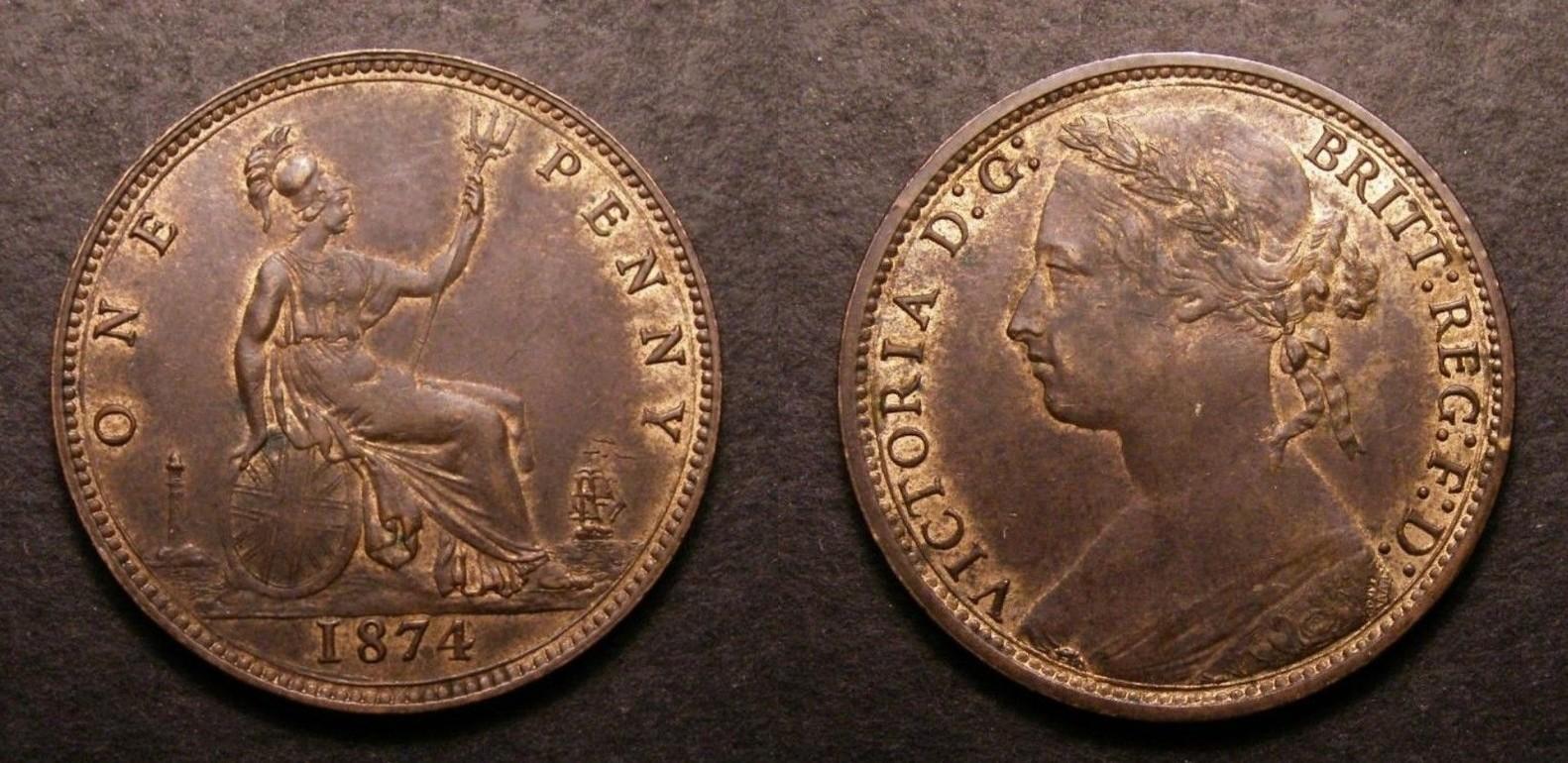
The recent purchase is a gilded piece. Thought it was interesting the way the 'full-coin' pictures have come out. I found that when I zoom in close with super-macro setting, trying to optimize the detail, the coin didn't particularly look gilded. From a distance, however, without super-macro it looks much more like the gilded coin does 'in the hand'. I'm no expert on photography, so not really sure why that happened, but show both sets below for info.
-
Penny Acquisition of the week
alfnail replied to Paulus's topic in British Coin Related Discussions & Enquiries
Managed to get a decent example of the other type of 1889 Narrow Date. Have labelled them both up as Gouby B for the moment, expecting they will most likely be Ba and Bb in Michael's revised pages.

-
No worries Mike. Yes, I did buy it.... very soon after it was listed as a BIN, back in 2014. I thought it may have been this one because don't often see a lustred F78.....but I have recorded it as costing £190.
-
Some breed of 'Cocker' Terry?
-
Penny Acquisition of the week
alfnail replied to Paulus's topic in British Coin Related Discussions & Enquiries
I was quite pleased with this one from last week, only £20. It’s a common year, but a nice grade and also a variation on the documented date types on MG’s website. The date is half a tooth wider than other ‘No W.W.’ date types documented by Gouby, with the 5 now slightly to the right of the larger border tooth, and the last 8 directly over a gap rather than a tooth. The numeral ‘1’ is, however, the most interesting feature. The underneath, smaller 1, now showing clearly to both the left and right hand sides of the top 1…….which is also double struck. Documented CP 1858 H date variations can be seen on this link:- http://www.michael-coins.co.uk/cp_1858.htm


-
Was it this one Mike?

-
I thought it looked like Jimmy Savile...... am I allowed to say that!? 🤪
-
Barely visible on any of them until the Hiram Brown one..... which I understand he didn't even know he had
-
It's the one on this link Cliff
-
....and here's the Medusa

-
bargains1* = Alan Stevenson
-
I'm sure the 1847 Medusa is still less than 20 Richard, and likely to remain so. There was only one of those on ebay in the 5 year period. It was around £15 until the last few seconds, I was amazed when I bid £500 about 3 seconds from the end and was outbid. It was the chap who used to buy on ebay with ID bargains1*, now sadly passed away, with his coins sold off very poorly and cheaply. Re. the Large Rose again, I would be intrigued to see how long it will take you to get to 20. If you were to regard as two separate types then I really think you would struggle to get to 20 examples. My guess is that you may not even get there with the Small Numerals type with the flaw through the 5. I could keep my 13 pictures to one side, or share with you first if you wish, and then they could be cross checked to any new ones reported. Depending upon sub-level, within each year in this series, there may be other candidates. Off top of my head, 1854/3 (real ones!), Bramah 3b, the 1843 DFF, 1853PT with the italic 5 date style, a couple of 1845 date varieties (not the obverse with the big die flaw at front of truncation).........and then there are always the dots, ha ha!! Just a thought
-
That's 13 in 5 years on ebay Richard, not the total population. I reckon that's definitely in excess of 20. My study was just 5 years of ebay. I have seen several others in the past 9 years, including my best large date specimen.