
Nick
-
Posts
2,063 -
Joined
-
Last visited
-
Days Won
31
Content Type
Profiles
Forums
Events
Downloads
Store
Gallery
Articles
Everything posted by Nick
-
CGS and Verd...Sorry!
Nick replied to Coinery's topic in British Coin Related Discussions & Enquiries
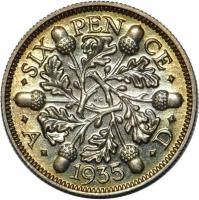
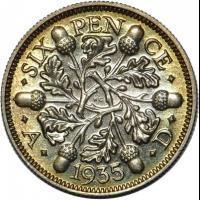
Agree with Peck about the wearing die on the obverse. The reverse also looks a bit weak on the left side of the wreath. Yours looks to be on the brighter side of dull than most and is certainly brighter than mine (attached). Most that I have seen are dull or even duller. As an aside, looking at the statistics contained within the Royal Mint annual reports shows that of all the silver coins (excluding Maundy) the threepence invariably gives the lowest coins per die pair strike average. For example, in 1873 when the Royal Mint were struggling to obtain good quality steel for dies, the figures show that it took 763 obverse and 193 reverse dies to produce just over 4 million threepences (or 8,462 threepences per pair of dies). Interesting - it's counter-intuitive, you'd almost expect the opposite, that small coins would not wear out dies as quick as halfcrowns and pennies. But maybe it has something to do with the force of the blow applied by the machinery? I'm assuming it was equal for all denominations and therefore was higher than it really needed to be for the small ones. I'd have to disagree about your 3d Nick - it's a stronger strike for sure, but I'd say it is actually brighter than Coinery's, not duller. Or so it seems to me, comparing the pictures. The dull or bright quality is difficult to judge. I believe that the bright finish coins were blanched and should therefore look rather silvery, whereas the dull ones should look that yellowy colour of the early 1920's silver. Therefore I tend to try and judge by colour rather than brightness, but I may be completely wrong. -
CGS and Verd...Sorry!
Nick replied to Coinery's topic in British Coin Related Discussions & Enquiries
Ah, 1922 is an interesting date. For pennies, it was the second occurrence of the redesigned portrait (which had been done for silver coins in 1920-1). However, the problem with G5 obverse strikes - 1st series - is confined to the larger denominations. It doesn't apply to the 6d, farthing, or 3d, which had no obverse redesign until the Modified Effigy, as they didn't need it. You will see the same portrait design on those from 1911 to 1926, with slight variations in 1911 : all denominations, and 1914 onwards : farthings. Therefore I would suggest your 1922 3d is simply a wearing die for the obverse. But do also bear in mind that getting crisp detail on such small denomination dies was extremely difficult, and you will see a lot less detail on the sixpence lion reverse than you do on the shilling reverse, even though it's the same design! Just for reference: the difficult dates in high grade for GV 3d are : 1925, 1926, 1928, and 1930 (though oddly, I've seen more high grade 1928s than the other dates mentioned). Thanks, P, I don't know how you remember all this stuff! I've started copying and pasting these types of posts to Word! Agree with Peck about the wearing die on the obverse. The reverse also looks a bit weak on the left side of the wreath. Yours looks to be on the brighter side of dull than most and is certainly brighter than mine (attached). Most that I have seen are dull or even duller. As an aside, looking at the statistics contained within the Royal Mint annual reports shows that of all the silver coins (excluding Maundy) the threepence invariably gives the lowest coins per die pair strike average. For example, in 1873 when the Royal Mint were struggling to obtain good quality steel for dies, the figures show that it took 763 obverse and 193 reverse dies to produce just over 4 million threepences (or 8,462 threepences per pair of dies). -
CGS and Verd...Sorry!
Nick replied to Coinery's topic in British Coin Related Discussions & Enquiries
Which flavour of 1922 threepence is it? Dull or bright? -
CGS and Verd...Sorry!
Nick replied to Coinery's topic in British Coin Related Discussions & Enquiries
A visit to the GP might be in order. -
CGS and Verd...Sorry!
Nick replied to Coinery's topic in British Coin Related Discussions & Enquiries
Apparently, the dreaded green can be copper carbonate, chloride or acetate. These three compounds are soluble in acetic acid, ethanol and alcohol (or water) respectively. However, knowing bugger all about chemistry - I can't vouch for the correctness of this info. -
I think that to a certain extent that is just a marketing ploy pushed by the grading companies to make the punters believe that the cost of slabbing can be immediately offset from the perceived gain.
-
Richard III Documentary
Nick replied to Coinery's topic in Nothing whatsoever to do with coins area!
I watched the first one and kept expecting (hoping) that Tony Robinson would pop up and punch her lights out. My 'favourite' bit of the first program was the incredulous look on the faces of the two Medical Consultants when The Woman had to leave the room on account of it being all too much FOR ALL OF US! The second program was excellent, I look forward to more scientific facts emerging from the ongoing investigation. Shame R3's not a cheap series to collect...will the prices go up? Mine too. The chap's face especially - I've never seen such expression from a pair of raised eyebrows. -
Richard III Documentary
Nick replied to Coinery's topic in Nothing whatsoever to do with coins area!
I watched the first one and kept expecting (hoping) that Tony Robinson would pop up and punch her lights out. -
Nice coins are nice coins, slabbed or not. Always worthy of discussion.
-
Blimey Declan! That capsule must be the size of a side-plate.
-
Just based upon percentages, the 65's should be better than the 85. (65/70 = 92.8% whereas 85/100 = 85%). By this yardstick, a CGS85 is roughly equivalent to a MS60, but I know which I'd rather have. You can't compere these two grading systems, they are very different. MS 60 would hardly be CGS EF and to achieve CGS UNC 85 you will need (generally speaking)at least MS65 - ideally from PCGS. I agree, the numbers are entirely arbitrary and therefore useless. The whole idea of a grading system is to take the guesswork out of grading.
-
Just based upon percentages, the 65's should be better than the 85. (65/70 = 92.8% whereas 85/100 = 85%). By this yardstick, a CGS85 is roughly equivalent to a MS60, but I know which I'd rather have.
-
Can you point me to a webpage where this guarentee is defined? I'd be interested to see the terms and conditions. The one thing I do know about the guarentees offered by the grading companies are that they are entirely worthless if you buy a slabbed coin. The guarentee only applies to the original submitter of the raw coin.
-
If you want to use just a part of a previous reply, you'll have to edit the raw post data. Just be aware that the tags (items in square brackets) appear in pairs, so just be careful what you delete and if you are not sure - use the preview post to see how it will look.
-
Sounds interesting. It may be a challenge on the photography front though. Getting a decent impression of anything proof-like is difficult, but within a slab is even more tricky - but I wish you luck.
-
I don't think it can be a Maundy. I may be wrong, but I thought that the 1926 Maundy threepences were all the first type (I of BRITT to space). You mean not the M.E.? Which makes a certain sense I suppose, as the minting for Maundy would have to be done quite early in the year, to be ready for Easter. Indeed. According to Davies the M.E. wasn't used on the maundy coinage until 1928. Wow - that would make the 1927 Maundy set an interesting oddity in its own right, as the only 1927 coins to feature the pre M.E. portrait. Yep, the only picture of a 1927 Maundy 3d I could find does have the first (pre ME) obverse.
-
I don't think it can be a Maundy. I may be wrong, but I thought that the 1926 Maundy threepences were all the first type (I of BRITT to space). You mean not the M.E.? Which makes a certain sense I suppose, as the minting for Maundy would have to be done quite early in the year, to be ready for Easter. Indeed. According to Davies the M.E. wasn't used on the maundy coinage until 1928.
-
I don't think it can be a Maundy. I may be wrong, but I thought that the 1926 Maundy threepences were all the first type (I of BRITT to space).
-
Having exactly this issue right now with a 1942 florin. I could buy hundreds like the EF one I received, which the seller is insisting is the same coin, despite the fact I've pointed to another of his listings that has an image of the coin I've got! I did get a 'perhaps you can give me a call to discuss this'? Which I duly did, without the call being answered OR returned! I even offered to post the coin on to the winning bidder of his other '42 auction that was due to finish, just to save us all a lot of time and wasted postage...but no! Happens all too frequently, I'm afraid.
-
You: "Do you want my business?" CGS: "No"
-
eBay listings using stock photos that don't mention the fact. Then some shocking piece of shite turns up that looks nothing like the rather nice coin you thought you'd bought.
-
My 1911 set is a even steely blue, I have never understood why a coin would tone from the edge in, especially when the edges are protected by the case. If anything the edges should show the least tone and the middles the greater amount. But if the toning is caused by an interaction between the silver and a constituent chemical of the case then the closer the proximity to the contaminant the greater the effect. However, it would seem to be extremely unlikely for a cased proof set to tone similarly on both sides.
-
I'm not sure about the toning but I'm very happy with the price!! :D It's an old page that hasn't quite been removed properly. That set was sold long ago. I don't think GK have ever sold anything that cheap!
-
Given that NT and AT both occur and at some point the boundary between the two must become a little blurred. How does anybody decide what is natural and what isn't? It seems to me that the opinion here is: if it's brightly coloured or multi-coloured then it must be AT, otherwise it's NT. What is your opinion of the toning on this 1911 proof set? The toning is pretty similar toning to that of my 1911 proofs.
-
Peck - "artificially toned, as issued"?
Nick replied to Coinery's topic in British Coin Related Discussions & Enquiries
You mean like the photo below. I'm honestly not sure of the reason, but it only seems to affect the proofs. The top grade currency strikes all seem to have good lustre. It could be that because many 1950 pennies circulated in the Caribbean for a while, the sea air got to them and gave them a tone quite quickly? Possibly? I've had 3 decent 1950 currency pennies through my hands now, all with that uniform tone you can see on accumulator's penny, which is never the way you see other coins of the period tone? But isn't Accumulator's picture a proof? Or have I got the wrong end of the stick again?