
Peckris
-
Posts
9,800 -
Joined
-
Last visited
-
Days Won
53
Content Type
Profiles
Forums
Events
Downloads
Store
Gallery
Articles
Everything posted by Peckris
-
Question for you knowledgable types
Peckris replied to azda's topic in British Coin Related Discussions & Enquiries
I think you'll find it was bankers (in both senses). Aided and abetted by governments who didn't regulate them. -
Wartime pennies - again!
Peckris replied to davidrj's topic in British Coin Related Discussions & Enquiries
Maybe they were paid a few pennies for the (forced) work they did? -
Question for you knowledgable types
Peckris replied to azda's topic in British Coin Related Discussions & Enquiries
Ah, but the differential between "bullion value" and "coin value" will always be huge with respect to copper. Only VG (or even worse) will be worth hoarding for metal value. -
1882 London Mint penny ?
Peckris replied to 1949threepence's topic in British Coin Related Discussions & Enquiries
Not with any enthusiasm, but then if I look at my accumulation of pennies collected in the 60's, I have very few post 1894, "modern" except H & KNs didn't interest me at the time. I wonder how current bronze clad steel will look in 100 yrs time, will they rust with age? David More to the point, has anyone heard what the "new" composition of CuNi is to be from next year? -
Wartime pennies - again!
Peckris replied to davidrj's topic in British Coin Related Discussions & Enquiries
Doesn't have the feel of fire damage, no heavy oxidation It really doesn't look like a minting problem though. But there looks to be a rather nice 1919KN lurking beneath that scurf! -
1882 London Mint penny ?
Peckris replied to 1949threepence's topic in British Coin Related Discussions & Enquiries
Freeman isn't gospel, of course. There are significant differences between his first edition and his second. The point here though is - the main striking for 1882 was done by Heatons. They were supplied with dies by the Mint. The London striking was done by the Mint and was possibly only a tiny experimental run. It is therefore much less likely that unknown die combinations will turn up, as Heatons were commissioned to produce a significant quantity of pennies. It is MORE likely that an unknown combination will turn up with an H than without, considering that was the main source of striking that year. -
You're welcome. (When I wrote it, I could actually hear a Roy Cropper voice in my head, complete with anorak, so decided I'd better make it fairly brief )
-
That particular issue was something of a one-off. The edge milling is somewhat strange I admit. (I'm not sure what technology they used, but remember, this was only 10 years before the first official 'machined' coin of 1797). Yours looks a little more exaggerated than usual, but it may just be the lighting. I think your coin is perfectly ok.
-
Sadly "for its age" cuts no ice when grading coins, Rachel! It's rather pitted and damaged - the overall wear would place at Fine, without the damage. Which would mean it would have been worth £5 or £10 depending on variety (3 or 4 berries in the wreath). Sadly the damage would mean it's barely worth a couple of pounds, but it's a nice design. Historically it's interesting, being the first farthing of the machine age, minted using Matthew Boulton's impressive new steam-driven presses.
-
1823 Halfcrown
Peckris replied to bob.phillips's topic in British Coin Related Discussions & Enquiries
A filled die often means that dots don't get struck up, but are more noticeable when letters or numbers go wholly or partly missing. They tend to go in and out of fashion. For example, there was once a variety of 1961 halfcrown where the designer initials "EF" were missing on the reverse. It carried a modest premium in most price books. Then it fell out of favour, and you won't see it listed anywhere now, except perhaps in DAvies or (at a pinch) in ESC. Filled dies are quite common from the machine age (1797) onwards, and there are quite a few in the 19th Century. Interesting about that 1961 halfcrown, I have one where both the EF and CT are missing, had it since I was a kid. Definitely worth hanging onto! Who knows, it may come back into fashion? I also have several Elizabeth II cupro nickel coins that would be classed as "polished blank" (like the 1961 halfcrowns) but which aren't recorded. -
So it's "goodnight from him" and it's "goodnight from him", then?
-
1823 Halfcrown
Peckris replied to bob.phillips's topic in British Coin Related Discussions & Enquiries
A filled die often means that dots don't get struck up, but are more noticeable when letters or numbers go wholly or partly missing. They tend to go in and out of fashion. For example, there was once a variety of 1961 halfcrown where the designer initials "EF" were missing on the reverse. It carried a modest premium in most price books. Then it fell out of favour, and you won't see it listed anywhere now, except perhaps in DAvies or (at a pinch) in ESC. Filled dies are quite common from the machine age (1797) onwards, and there are quite a few in the 19th Century. -
unlisted varieties!
Peckris replied to chris's topic in British Coin Related Discussions & Enquiries
What are we looking at, here? Care to talk us through the main points? -
James Workman Penny sale
Peckris replied to Chingford's topic in British Coin Related Discussions & Enquiries
That's not a completely unattractive hole - have you thought about putting it on eBay? -
No, I meant the tiny thin trench left by the rim appearing to come adrift from the coin. You can see it on the reverse, from the word DEF round to the word CROWN.
-
No I meant maybe someone messed with the coin long after it left the Mint. People do crazy things to coins!
-
1823 Halfcrown
Peckris replied to bob.phillips's topic in British Coin Related Discussions & Enquiries
Duh Bob? They never used full-stops on the coins back then. Thanks for the comment and I can only assume you are right and they did not use full stops. I am just a beginner in this but 'after the G' there is not a colon, as you can see from the picture. There is 1 dot. Maybe it's a forgery??? - or maybe it's a miss - strike. I'm just seeking help from the experts!!! Regards, Bob P. Actually, there is the faintest of impressions of the missing dot - it's level with the horizontal serif stroke of the lower upcurve to the G, which is where it should be. It's probably a filled die. -
The more I look at it, the worse it seems. The biggest clincher is the gap between the field and the rim. Can't believe I didn't spot that right off.
-
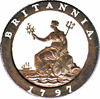
Definately Reverse B, the gap between the trident prong and P of PENNY on Reverse A is twice as wide. The other way to tell is that Reverse A has a VERY low tide, and no sea at all behind Britannia.
-
The weird thing is that the '1' is exactly where the 'I' should be. Either that's a major coincidence, or someone has been tampering with the coin deliberately.
-
Interesting this came in a big box of coins I bought (mostly foreign) I do notice that there is a slight dip where the VI is on OBV and the I appears like a number 1 at top but I think that is probably as it is flattened and the top of serif may be stretched out. I dont know if a 1 could have been used intead of an I ? Here's a pic So what makes you think there are more??? Have these manufacturing flaws been recorded on the 1944 before? I was thinking of contacting Spink or would they just laugh in my face?? Regards Russ777 That's definitely a "1" - see how its base extends further into the field than the letters? Compare its size with the 1 in the date - they should tally.
-
I know I keep banging on about it but it's also got the broken R in George. This is Edward lol Luckily there is an R in Edward as well What an entertaining gap filler... It is actually quite attractive in hand esp the reverse and is very similar in color to one of my 1906's although Eddy looks a little haggard on the gap filler. Coincraft notes that these pieces often look ghostly or concave esp obverse and I think there is some reference in there about being made in Lebanon in the 60's. It weighs 14.1 gram. Going back to the 06, the rim is about 2mm wider on the currency issue. It doesn't ring true when gently dropped and I think there is a seam just inside the collar. I've had it 10 years and it still fascinates me. How do these people get their hands on dies? I think they make them from a genuine coin. They use a genuine coin to produce a mould then produce a casting from it
-
No problem with me David Strange, It's just this one forum, no others.
-
testing. Anyone else have a problem with this forum? It shows as "New Replies" every time, even when there aren't any. All other forums are fine.
-
1913 dates there is a difference in spacing and the relationship of numerals to border beads, but font is essentially the same to me David Very slight difference David (to my eyes) : the lower 3 is higher which overall gives a slightly slenderer look to it, where the top one is reduced ever so slightly in height, giving a more compact appearance. (The bottom one is the first reverse?)