

Rob
-
Posts
12,935 -
Joined
-
Last visited
-
Days Won
371
Content Type
Profiles
Forums
Events
Downloads
Store
Gallery
Articles
Everything posted by Rob
-
Nothing obvious.
-
Thanks Jerry, Mike & Chris. I can see that it is a completely different beast to a forum, but based on what I see, I have to be somewhat cynical about the level of control a person has over their membership. If I search RP Coins and Facebook, I get a link to my own account despite never having had an account, so this must have been made by Facebook and without login details have no control over it, but presumably you can all join my group if you so desire. I also get referrals from Facebook, as my website tells me that people viewed an average of 7.2 pages and stayed for less than a minute using this route. So much for being in control. Still, each to their own I guess. Better let the conversation revert to the original topic.
-
Your name is 1949 threepence - should be 1949 penny. Everything is not as it seems. My point about joining groups is that if you don't know anyone outside of social media, you are unlikely to be invited into a social circle randomly unless already acquainted. I'm not sure I or anyone else would want to accept a Facebook invitation to join given their ulterior motives. Because Facebook blocks those who aren't allowed access, this has to be the biggest hurdle to getting new faces. At least on this forum you can post as a guest in some areas, and register as a member without being automatically blocked from communicating. Although social media is unquestionbly more popular than a forum, I still fail to see how it can provide the ease of access of the latter.
-
I always assumed that it was so for historical reasons, i.e. the first was a low grade coin which provided a benchmark price for 'finest known/highest graded', but following subsequent submissions, it dawned on the slabbing community there was more than one example out there, and they really weren't so rare after all! As the whole question of slabbing is an attempt to commoditise coins, or provide a recommended retail price such that they can be bought unseen, the lower graded but higher priced items are waiting for the market to catch up because repricing is rarely downwards and if done would p' off those who buy as an investment leaving the TPGs open to litigation.
-
Help for the digitally challenged please
Rob replied to Rob's topic in Nothing whatsoever to do with coins area!
Problem sorted -
Is this really so surprising? Your somewhat diversionary handle replied to terrysoldpennies in the previous post for the simple reason that you are both into pennies. Surely this forum is society and its habits on a local scale? People who collect coins will migrate to a collective centre just as any other interest group would do. Certain geographical areas become known for their ethnic mix because they are full of people who are culturally similar. The Eisteddfod is mainly frequented by Welsh people. So when you have to 'friend' (I think the phrase is?) someone to join a Facebook group, it is not surprising they have the same interests as you because that is how you became acquainted in the first place and why they were allowed to join the group. I know this is a chicken and egg situation, but like-minded people will always find their own. The real problem is finding people who are not part of a social group and integrating them, and we all know that many collectors are fairly reclusive.
-
With the detail being incuse on both dies, any impression from clashing will be raised on the die. This will result in depressed detail on a coin. These new areas of detail will also suffer from wear and you can have clashing on more than one occasion, so it is difficult to say exactly where in the life of the die something has occurred.
-
Clashed dies. The lines are from the drapery between the shield and right knee. The drapery towards the back of Britannia can be seen between the ties and the back of the neck. These marks are seen frequently and is due to the dies coming together when there is no blank between them. The harder of the two dies will make an impression on the softer one and so depending on which is harder can be seen on both obverses and reverses. The London Coins reverse also shows a faint sign of die clash emanating from the knee, being the section of bust from the chin up to the lips,plus there is more die clash behind Britannia. There is a bit of exergue between the bust and V plus a bit of shield between the ties and terminal D.
-
Thanks Pete
-
Does anyone have either the Gruffalo 50p or the Wedgwood £2 in original RM packaging, and if so, who is the attributed designer for the reverses listed in the specifications? The RM website gives company names, but not the person. The company name listed on the site for some earlier issues, sometimes has the actual person responsible listed on the packaging. Anyone?
-
Bad News on the Auction Front
Rob replied to oldcopper's topic in British Coin Related Discussions & Enquiries
As I said. The makeup of the final price can be whatever you want. Only the total cost matters. -
Bad News on the Auction Front
Rob replied to oldcopper's topic in British Coin Related Discussions & Enquiries
If working to a strict budget, just reduce your bids by 5% from what you would have gone prior to the increase. Alternatively, if the increase really bugs you - sit on your hands. Although we all have boxes that need ticking, when it comes to a hobby there isn't a single thing that can't wait for another day. If you really want it so badly, you are unlikely to be affected by the increase as it is only £50 per £1K, which is easily lost in a fit of frenzied bidding whatever the premium. -
1901/1902 Half crown mule reference
Rob replied to rpeddie's topic in British Coin Related Discussions & Enquiries
A workshop job has to be favourite. Take 2 worn coins and make a die pair, or do the machining and drop in trick. I also wonder if, alternatively, it is related to the 1861 etc halfcrowns. A third option would be using an obverse die for the 1902 proof sets if they needed a replacement, as with the 1839 halfpenny obverse die. -
The more pertinent point is that they could use independent policemen who willingly report for free if they so decided, but there's no PR advantage in that. We 'invest' over £6m is their attempt at showing they are doing something. Ignoring people who are more actively involved in identifying shill bidding only p's off a handful of the public, the remainder presumably taking their action at face value. For ebay to take down the reported shills would probably cost them a few million in lost fees when taken across all the sites. They ain't gonna do that.
-
No dealer is privy to the past, present or future internal operation of the Royal Mint, who remain the sole source of any info that may be relied on. Whether it's accurate or not is moot, but is the only first hand account available.
-
Maybe she means Robert Armistice? Judging by the literacy level of the listing, anything written could mean, well, anything. Maybe marleybob has located and procured some of Diane Abbot's missing zeros to add to the price?
-
The 1933 should be a recognisable known copy because the obverse legend is the same thick, clumsy font as the date. If it was a changed date, the obverse used would be irrelevant.
-
So, Brexit....What's happening?
Rob replied to azda's topic in Nothing whatsoever to do with coins area!
Given the relative amount of money per head sent north from London to Scotland under the Barnett formula, studiously avoiding the north of England on the way, the best way to achieve Scottish independence would be a nationwide referendum. -
Halfpenny ID please
Rob replied to mrbadexample's topic in British Coin Related Discussions & Enquiries
Small three. Tall 3 below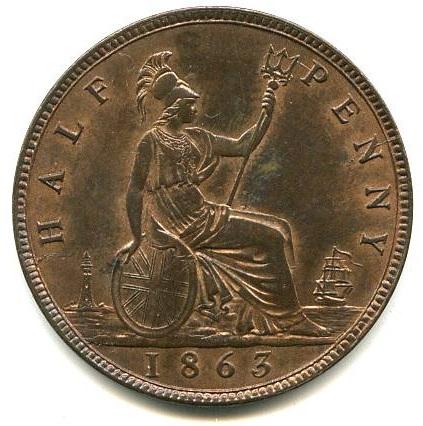
-
Is that an offer or a have done?
-
1937 Edward VIII Penny in Auction
Rob replied to Colin88's topic in British Coin Related Discussions & Enquiries
I'd love the opportunity to stick that in an electron microscope. -
If a 6 is involved, it is more likely to be as a result of an attempted repair to a blocked character, as from the 1816 coinage until around the time of the mint refurbishment in the early 1880s, the last two digits only were added by hand, 18 only being on the master. This point is mentioned with reference to shillings in ESC 5th ed. p.135, footnote 1. Examples of unfinished dies are known elsewhere, e.g. the 18 copper penny in Baldwin's sale 44, lot 417.
-
I get plenty of people buying cheap or lower grade items, from washers to things that are practically as struck, so you shouldn't let that put you off. Aim for as early as possible though for the reasons outlined before. I would guess there would be 25-30 dealers with appropriate stock based on what you wrote. Whatever, nothing ventured, nothing gained. FWIW, I'm on table 43, on the left hand end of the island facing as you go in.
-
It is easy to find as the Motor-Cycle Museum is accessed off the roundabout at the motorway junction. Be there on time as dealers drift away after 2 o'clock because most of the buyers have finished looking. If you had a shopping list, it might be possible to find some things in advance and take them along. Doors open at 9:30, but with 40-50 tables, there won't be enough time to thoroughly examine what is on offer on every table.
-
Independently verified