

Rob
-
Posts
12,799 -
Joined
-
Last visited
-
Days Won
347
Content Type
Profiles
Forums
Events
Downloads
Store
Gallery
Articles
Everything posted by Rob
-
I believe 2020 has finally seen Trump's cov[id]f[re]ef[re]e text clarified. You couldn't make it up.
-
It's a lottery, as it always has been. Don't believe all that is written. Coins in plastic or without are are all subject to the same rules. That was just an observation as to why slabbed coins could reasonably still attract import duty even if the 'Made in Britain' bit applied to the contents.
-
'Fraid you do. Anyway, the plastic bit would be an import. I also think they should be treated as returned goods, but can see it might be difficult to prove they were exported from here, not to mention actually made here in some cases.
-
Penny Acquisition of the week
Rob replied to Paulus's topic in British Coin Related Discussions & Enquiries
Who promoted you to pedant in chief? Peck's still in office as far as I am aware. -
Penny Acquisition of the week
Rob replied to Paulus's topic in British Coin Related Discussions & Enquiries
No it's a comparison of equals. We're all nerdy types, just our subject matter is different. Typically, when someone visits the table and asks if you have a particular type of coin, you point out the desirability of a particular variety at which point most shrug their shoulders and tell you they are just looking for a cheap, decent basic example. Maybe 10-20% are looking for the more esoteric. -
Pricing has always been an issue, whatever the publication. All people need is an easy to use list for reference and a feel for how much they should pay based on what the market does, not what a price guide compiler thinks. Making your own list and noting the prices paid for the outliers is probably the best way to do it. You don't need, and it doesn't matter whether one guide says £2 each and the other says £4 if it's a commonly available coin. Just look what people are charging on lists, at coin fairs and wherever else you can glean information, then absorb the info and go shopping. Don't forget typos can also throw the market. Last year's CoE had a typo for the 1887 YH halfcrown UNC price, giving EF at 300 and UNC at 350 instead of 850. All the other UNC prices are in the 600-900 range which is roughly where the market is. Consequently I've had more than the odd offer from potential buyers to purchase the one I have listed at a more realistic 300 because this is in line with the book (despite being a better date). So people do pay attention to what is written, but clearly give it little thought.
-
Penny Acquisition of the week
Rob replied to Paulus's topic in British Coin Related Discussions & Enquiries
If it's not in a widely read publication, nobody cares because they don't know about it. If it is published in a reference with a good reach, everybody has one and describes the coin to maximise returns. The collecting interest however is mostly limited to nerdy types and because we all live in our own little bubble, we fail to appreciate that a majority of collectors are overcome with indifference when it comes to micro-varieties. The best you can usually hope for in a description is an overdate, legend variety or anything else that's obvious. -
That's the 2021 book which is not out yet and will be available from the 31st December according to the listing. The listing is for pre-orders. You can wait for it if you want, but as it comes out every year, you might as well get one and update every two or three years unless you are intent on keeping up with the latest RM issues (which is a mammoth task in itself, given their diarrhoeic output).
-
copper plated steel is magnetic, bronze isn't. The bronze changed in 1992, so should be the only year where both can be found. The 5p & 10p changed to nickel plated steel from cupro-nickel in 2011. Again, one is magnetic, the other not. Five portraits have been used during the reign, those by Gillick, Machin, Maklouf, Rank-Broadley and Clark. The initials are below the truncation. I suggest you get a copy of Spink's Coins of England decimal section, which lists all the decimals since 1968 and is well illustrated for all the denominations. This is the current issue. www.ebay.co.uk/itm/SPINK-COINS-OF-ENGLAND-2020-DECIMAL-SECTION-ONLY-NEW/133549771118?hash=item1f182fc96e:g:QiAAAOSwSbRfeIMV
-
Royal Mail and Parcelforce are different companies, so their methods of processing orders is likely to be different too - hence the above.
-
The Dorian & Magens shillings came close, but the nearest an official strike came to complete melting was probably the 1945 silver 3d. However, that was related to the need to pay off debts and [presumably] the cessation of silver coinage was proposed by the time they were struck. Any wholesale withdrawal of coinage is usually politically motivated or for financial reasons. A copper penny doesn't fall into either camp.
-
I'm not too enthusiastic about the mint bringing them all back to be melted. I would have thought given the problems with dies in the past few years, that any coins made would be retained for release, even if not required at that moment. The previous few years had seen a lot of coins made with the wrong date for the year of manufacture, so why would they melt something they were guaranteed to need in the near future. The world wasn't predicted to end in 1852, and 1853, 1854 and 1855 are hardly rare years. But, crazier things have been done.
-
It would probably help if it is possible to get an approximate number of dies used per annum for the period in question. 1825 halfpennies for example had a mintage of 200K ish with 4 identifiable die pairs (though could be more if identical dies were produced). Whatever, 40-50K struck per die pair is a reasonable guess under normal circumstances. However, we do know that things went awry at the mint in the late 1840s when die life plunged dramatically. According to Linton's article on the 1848 halfcrown in the BNJ vol.29, in 1847 a total of 367K halfcrowns were struck from 22 obverse dies, implying only 16 or 17K per die i.e. roughly half. This accounts for the relatively large number of overcut dates in the second half of the decade, when existing dies were reused, presumably to maximise die use when the supply of new dies was uncertain. The same bar stock was almost certainly used for pennies as for halfcrowns, given they are about the same diameter and so presumably experienced the same problems if it was a metal problem, or if a metal treatment problem then it would apply to all dies. It is unhelpful that the mint records for 1848 to 1852 inclusive are missing according to Linton. A mintage of 236K would suggest between 5 and 13 obverse dies were used in 1852 depending on whether they had sorted the die life problem. My gut instinct is that it was only a temporary blip given the output of 'Godless' florins in 1849 and so we would be looking at somewhere between 30 and 50K per die - i.e. 5-8 dies. Wikipedia gives a mintage of 432,224 for 1851. Does this include 1852 for which none are given? Where does the figure of 236K come from or any quoted figures for the other years in the period 1848-52? How many discrete 1851 dies can be identified? If we are looking at a number well in excess of what you would expect based on expected output per die, then clearly much of the 1852 output was likely struck from 1851 dies, though you couldn't exclude the use of other existing dies, after all, 1849 was a relatively scarce year.
-
The evidence from clashed dies tells us that the softening and hardening processes are not a precise art, as clearly one die was harder than the other for it to make an impression. But given the degree of heating required to soften the die, I think you would struggle to get localised differences on the same die. I presume they will put it in an oven/furnace which should give even conditions across all surfaces. The key to any grease escaping has to be whether it is restrained by a well fitting collar or not. Liquids are virtually incompressible, so at the pressures we are talking about here a sealed unit would have no problem stopping the dies from making contact.
-
That's because slabbing has effectively commoditised the product, just like things have a recommended retail price in the shops
-
Silly prices, but the rationale for putting on a higher price is that you can always come down, but never put the price up. eBay's a difficult one to suss psychologically. Do you just do a BIN at 15% over what you want, or do you put a higher price on it and make the buyer feel better for getting a discount. But then you find that some people won't make a best offer because they are afraid of paying more than they need to, or others will only ever make a derisory offer and presumably are happy with the occasional trophy, whilst most of the time the vendor recognises that valuations are poles apart and either declines or ignores the offer. To go back to the original post, a 100% premium is not outrageous when compared to the typical offer at 50-60% of your asking price, irrespective of whether the BIN is a fair price or not. Make an offer at 50% of the listing price and see what happens, assuming that is reasonable.
-
All I have is Krause which says 0.500 silver
-
Albert must have been stroking Vicky's hair for a change.
-
I don't think so because the serifs at the end are much wider than the connecting bar, which looks to be very thin in the middle section. The I is a normal size, which on a halfgroat is small relative to the letters on larger denominations, but there isn't a lot of downsizing possible in the letters, with only 3/4d, 1d & threehalfpence as possibilities. On these you are still looking at a wider I than seen, if it was one. But thinking out loud, a datal 1 on a three farthings is smaller, so should probably be added to the mix even though the serifs are not usually that much wider than the upright.
-
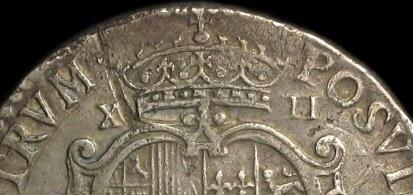
The closest I can come up with is the cross on the orb at the top of the crown on P&M shillings, or the one below that. That's possible because the crown was made of composite punches. e.g. this one that was on AMR
-
Currently unique is probably more appropriate given the tendency for more examples to come to light once a new type is discovered. That guy had it for 10 years before he noticed. It's reasonable to assume that others have been similarly overlooked.
-
I'm not too fussed about the inverted A for V as this occurs on a regular basis across many reigns. The I over a cross however, is somewhat more intriguing as it looks to be a style of cross which I am struggling to find used on Elizabeth's coins. It's not the same cross as that seen on top of the crown and it's not a letter X because this would have to take the form of a cross pattee saltire, which is most improbable. That leaves us with a cross pattee of a style that harks back 300 years. Is anyone into medals that could possibly find a use for such a cross?
-
New one for me.
-
Another 1695 Dei Gratia Half Penny
Rob replied to rooneydog's topic in British Coin Related Discussions & Enquiries
The Nicholson P565 went through LCA in both Nov. 2004 and June 2005 @ £2K and £2500 hammer respectively. It went to Japan on the second occasion, which is where I remember that from, and the previous November's sale had Stone's collection. I now remember why I didn't go for the W&M at both sales. Stone's sale in 2004 had a lot of rarities that commanded my attention including the 1719 grained edge 1st issue 1/2d (Peter Jackson had bought Nicholson's, but still bid against me in the room) and I picked up my 1734/3 halfpenny, which despite only a bit better than VF-gVF is still a full grade higher than the few others I've seen. It was a case of being spoilt for choice. Included in a few purchases at the second sale there were a couple of 1947 proof shillings which I wanted, and a 1673 halfpenny slabbed NGC MS65, which was obviously a 1675/3 in hand without magnification and would be a sensible replacement for my previously PCGS MS64 slabbed 1673 (also 5/3). Having waited for the 1673, I picked it up at opening bid , so sold the 1675/3 and replaced it with the new one, only to discover later that the new 1675/3 was in fact 1675/3/2. I never got round to replacing the 5/3. In addition to these three, I eventually ended up with a proof 1957 halfpenny, Nicholson's P607 and half a dozen others from the collection, a Weyl 1887 tin halfpenny, a few Vicky shillings and halfpennies and several hammered shillings in the space of a few days. Given sufficient liquidity I could have happily spent 10 or 20 times the amount considering the rarities on offer at that time, with both the LCA sale and Goldberg's Cheshire Collection up for grabs on successive weekends. Prices then look so much more affordable from today's perspective. -
Another 1695 Dei Gratia Half Penny
Rob replied to rooneydog's topic in British Coin Related Discussions & Enquiries
In that case I was thinking of something else going to Japan.