Leaderboard

Popular Content
Showing content with the highest reputation on 10/05/2018 in Posts
-
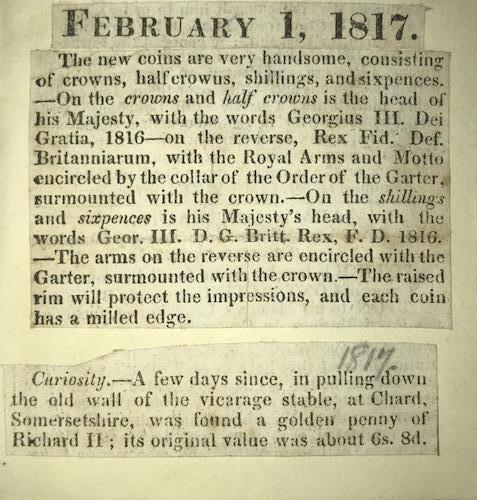
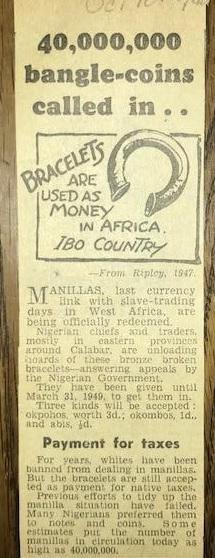
The recent thread concerning the myth of 1922 pennies containing gold caused me to reflect on how much numismatic and social history is buried within the pages of long-lost newspapers. Over the years I've found several such clippings between the leaves of old discarded books, invariably put there by our predecessors for safekeeping. I thought some of you might be interested to see some of them. Would make a great read in book form, for those so inclined. The right-hand clipping in the first photograph also refers to the 1922 penny as being valuable....maybe because of the gold myth? Don't want to incite a rampage down to the Vicarage stable at Chard but.........


 2 points
 -
As I mentioned earlier in the thread, it was fairly unusual to find the pre-1947 silver shillings and florins/two shillings in change in 1990. When I was in the betting shop I would receive hundreds of 5p/10p coins over the counter every day, and found only 5 pre-1947 silver coins in a year. This was a massively higher hit rate than I had found in change over the previous 10-plus years, probably no more than another 5 in total!1 point
-
Just for those of us with a neck that goes straight up and down.
 1 point
 -
Thanks for your replies, I appreciate that it is a difficult thing to quantify the proportion. That's sort of how I remember it as well, they were just "funny" 5ps and 10ps. Sort of strange really. Maybe because it felt weirdly regressive to call them shillings and florins, like when you have a dream about someone you know who's dead, being alive - It's not very nice.1 point
-
I assume that when there is a genuine bid, but below the reserve, they have to introduce a ‘house’ bid before they can knock the item down, otherwise the genuine bidder might think he has won the item. Not an issue when there are no bids at all, of course. Jerry1 point
-
In some cases (this being a prime example) it certainly is, much like how a teacher can be wrongly accused of pedophilia but still have their career ruined. Not sure what you can do to prevent this though - on the flip side it would seem that Bill Cosby is guilty of his charges, and the only reason those allegations went anywhere is because multiple people were saying the same thing.1 point
-
Sorry to return to this topic, but at the risk of sounding thick, I'm not sure I entirely get the point of introducing what is in effect an imaginary bidder in some cases, while in others, in the absence of any bids, the lot is announced by the auctioneer as unsold. Probably something I'm overlooking, but not sure what.1 point
-
I'm at the stage of formulating a methodology for comparison and have been messing around with GIMP. I'd like your feedback! The first stage of my analysis will be to categorise reverse dies by their most easily discernible features. I consider this to be primarily the relative positioning and alignment of the date. Hocking describes two surviving reverse matrices of the sixpences in the RM museum, the first of which is dated "17--" only and the second of which is dated "178-" only (thanks @Rob). This suggests that the last digit or last two digits were hand-punched into the die, confirmed by the wide variation of their relative positions in my sample of about 500. While the figures themselves degraded with die use, their relative positions should not have changed. I intend to use GIMP to align the Irish shield as closely as possible to perfectly horizontal and vertical after which I'll resize the shield so that it becomes 300 pixels across. This will provide an absolute point of reference for each specimen in my database. A foreseeable drawback is that not all of my sample images will be of high enough quality to treat in this manner. It's possible, though, that they would have been unusable in any regard. Here's an experiment I did this morning: The next stage will involve making each edited image semi-transparent and comparing the date positions two at a time, progressively developing categories which may then need to be further refined in order to determine dies. I will also need to ensure that each of my samples is unique. My images have largely come from coins being sold. If they've been sold more than once in the last ten years or so it's possible that they appear more than once in my database. I can't have this as it will throw out my statistical description/inference of the relative number of coins produced by each die. A comparison of toning, mottling, haymarking, die degradation and coin wear should achieve this task. I'm inviting criticism of my proposed methodology from anyone, especially those who've done die studies before. Thanks! Nathan1 point
-
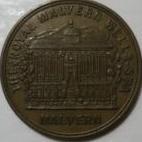
Latest Bath token1 point
-
I really like the design on this one and its a nice example, near unc on the reverse the obverse about ef
.JPG.b044194781ecffd4c90f6620e3b97e30.JPG)
.JPG.97929622691415cfbbb1ff4deb82d532.JPG) 1 point
1 point -
Have a search for "How We Know Kavanaugh Is Lying" by Current Affairs. It's a long read (my saved version is over half a megabyte) but the evidence presented is pretty convincing.0 points