All Activity
- Today
-
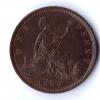
 Im pleased to own one of the few that was made in London for 1882! Taken from the RM website: In 1810, we left the Tower of London and moved to a new purpose-built facility at nearby Tower Hill which could better accommodate steam-powered machinery. Eight massive presses stood in the Coining Press Room, each capable of striking about 60 coins a minute. In the 1880s, the factory buildings were reconstructed and smaller, faster and quieter machines replaced the presses. At the turn of the twentieth century, steam power gave way to electrification and master tools were increasingly produced using reducing machines. Instead of engraving by hand, at size in steel, an artist could prepare a larger plaster model. A mould was then taken and electroplated with nickel and copper, yielding a reproduction known as an electrotype that could be mounted on an engraving machine and scanned. These movements were communicated to a rotating cutter, which copied them at coin size into a block of steel.
 -

Whitman Blue book shelf type coin albums
Peckris 2 replied to coinkat's topic in British Coin Related Discussions & Enquiries
Very popular. I remember as a schoolkid in the late 60s that Whitman folders and Sandhill cases were THE main holders for coin sets - the Whitmans for date runs, the Sandhill for type or year sets. -
"During the Victorian era, coining presses were entirely mechanical. " Really? I thought that around 1882 they changed over to electrical, which is why virtually the entire 1882 penny mintage was done by Heatons while they were converting?
-
Update the seller said I can return the coin if not happy so Im going to go for it.
-
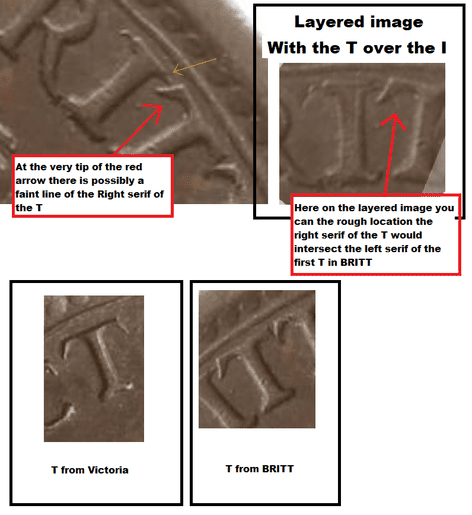
Thank you, I made one last observation; (Now il move on😅) The T in Victoria has a much thinner crossbar when layered over the image possibly fits better. Would there be a punch for each style of a single letter? So a punch for the T in Victoria and a seperate punch for T's in BRITT? The attached image shows the original image, the layered image and the two seperate styles of T found on the same coin, it also points out a potential faint line of the right serif and the layered image shows the location of where the two serifs would intersect. Thanks.
-
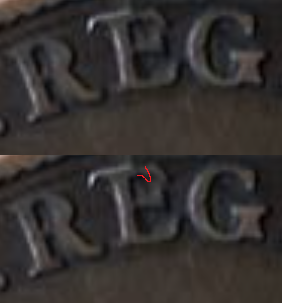
Thanks alot ! I have asked if they will sell upon approval, also asked for extra images. Not sure if you remember the coin in the attached imaged but when it arrived the apparent crossbar of the T was nowhere to be seen?? Reminds me of that...
-
Halfpenny Obverse 5 die flaw
jelida replied to absence of uniformity's topic in British Coin Related Discussions & Enquiries
I wouldn’t put much faith in the AI ‘facts’ and suppositions without reliable references that can be confirmed or are contemporary. We have an issue here in that once published on an academically respected forum such as this search engines and future AI searches will in turn propagate this thread leading to the AI pronouncements gaining traction. While elements of the AI interpretation may be logical, we should make it clear to future readers that it is an opinion (machine generated) and a starting point for careful research rather than being worthy of quote as a matter of fact. Jerry -
You’ve put in some good work there, but sadly the original sellers image is not sharp enough to be confident either way. Can you get it on approval? Most professional sellers would do that. Otherwise it’s a balance of lower likelihood of very significant gain against a higher likelihood of moderate loss. Might be worth trying to get a clearer photo from the vendor. Good luck! Jerry
-
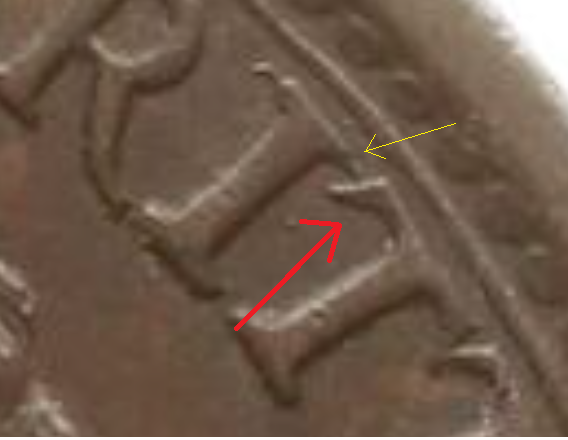
One last detail, at the very tip of the red arrow there is a possible faint outline that could represent the right serif of the T. The tip of the yellow arrow marks where the I serif should stop and there also appears to be a faint line.
-
The imagination is running wild now I know; if a mint worker went to repunch the T using a T punch and suddenly realised at the last moment the punch wash infact over the I and the punch was struck partially could this little visible flaw be the result of that? I know all too well using a metal punch when marking base metal objects with my makers mark if the force is not right and the punch is not perfectly square to the object half of the imprinted mark is often missing.
-
Its quite expensive, the coin is for sale so I dont have it in hand and the images are all thats availible. The penny is from the 1870s, not a rare pairing. For the price of over 100 there is no luster and the coin is not anything special in my opinion. Concerning location of the serif I made a layered image Jerry to show the serif is actually quite close in terms of location. If I had the coin to hand I could look closely and take macro images. Thanks for the input so far.
-
Thank you for the response it's frustrating this type of enquiry ofcourse I have a hopeful imagination but also have learnt things are more often than not what they seem.
-
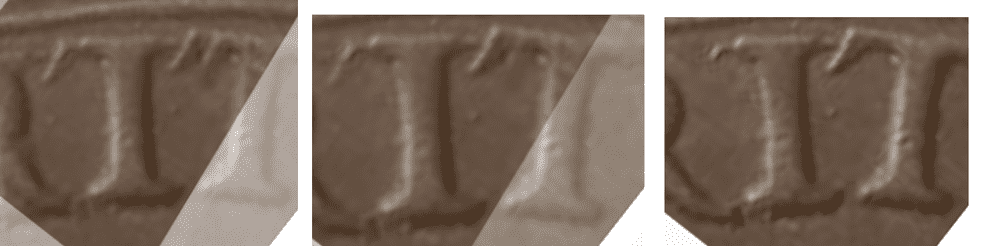
In the attached image I have rotated the image and layered the T over the I from left to right I have faded out the top layer with T becoming more transparent from left to right.
-
I think it may be worth a punt if not too expensive if you don’t have it in hand. The issue could certainly be clarified by microscope close-ups. It’s worthy of note that you see virtually no letter repair errors after the first three or four years of bronze penny production so the date might be relevant too. A die flaw can certainly flow through a letter but an overstrike is not impossible. Jerry
-
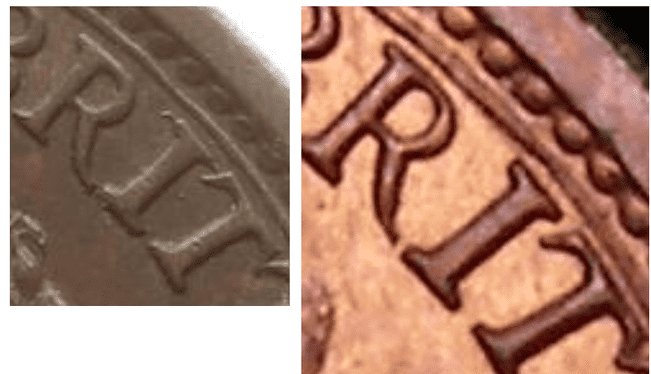
Here I attached an image of coin with what I think is the same pairing note the top right serif of the letter I does not extend far also shown in image is the coin in question for comparison. None of the coins I have looked at for the same pairing show the top right serif of the letter I extending and almost touching the T.
-
I don’t think it’s T over I either, the ‘serif’ starts far too close to the vertical and there is nothing visible to the right . But it is interesting, even if just a die flaw. I do have an 1860 BRTTT and the overstrike repair error is very much clearer. But do you have a USB microscope for clearer close-ups? A close look at the edge of the flaw/overstrike could be illuminating. Jerry
-
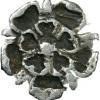 I’ve definitely seen less convincing overdates and legend errors…I personally think that is a very intriguing coin. I’ll leave it to the penny gurus but, for me, I could easily be convinced there’s a T involved.
 -
The coin is a Penny, and for the year there is no listed I/T listed from what I can see.
-
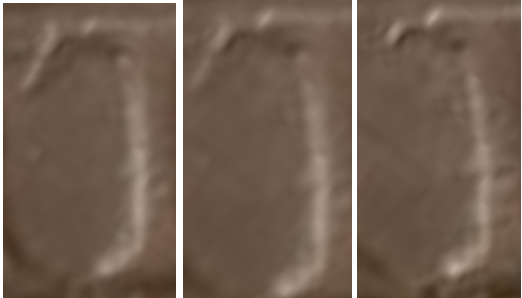
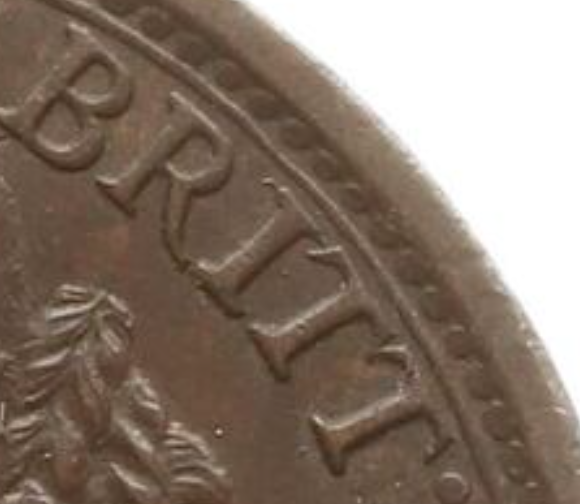
Please dont feel I'm relying on the opinions shared here to make a decision to buy, I'm not. I'm simply asking what others think; I dont think it is I over T but the truth is I dont know ! What do you think? In the image attached there appears to be a what looks like a crossbar extending left of the I. I would appreciate hearing what you think. The only reason I'm not sure the tip of the crossbar shows a similar angle of the serif of the T also the crossbar possibly appears to extend to the right of the I. Thanks
- Yesterday
-
Halfpenny Obverse 5 die flaw
Rob replied to absence of uniformity's topic in British Coin Related Discussions & Enquiries
It also isn't very logical. The wife sold something weighing 1.13kg on ebay, which AI determined should be passable as a Royal Mail large letter (max weight 1kg). Maybe the taxman will round down my bill to £1 on the grounds that subsequent zeros mean nothing. Hope springs eternal. -
Its a shame I didnt copy the initial interaction because I called it out, AI was claiming the die flaw to the forehead was not uniqe to Obv 5, then I said The flaw is unique to 5 and AI bactracked and said yes you are correct I made a mistake lol. I realise I am feeding into to algorithm I'm pretty anti AI but over the last few weeks I have tested it on a few different subjects and mostly the information is incorrect in real world facts. It will hash together what it thinks you want to hear. Rather than stating I dont know.
-

Whitman Blue book shelf type coin albums
copper123 replied to coinkat's topic in British Coin Related Discussions & Enquiries
In the mid to late seventies whitman folders retailed around 25p to 50p range its now virtually impossible to get them for less than a £5 note. On their own they have been a great investment -
 paveltul joined the community
 -
I put the question to AI, why only a few hundred 5+G are estimated to remain and pressed AI for the reason. the text above is what was regurgitated. Use it at your peril, very often the information is incorrect. Hence me asking how likely that information is accurate.
-

Whitman Blue book shelf type coin albums
Paddy replied to coinkat's topic in British Coin Related Discussions & Enquiries
@coinkat's OP mentioned "blue book" so I assumed the blue folders were what we were talking about. I have encountered the posher Bookshelf albums that @Bronze & Copper Collector refers to, but I don't recall the colour of those? They were an improvement in storing coins, but seem to have been much less popular - possibly much more expensive? The blue folders were a great way for a young collector to get started, particularly when many of the coins could still be picked up in circulation.