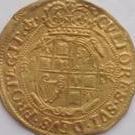
Gaz T Posted yesterday at 07:57 PM Posted yesterday at 07:57 PM Has anyone come across the half penny having six strings to the harp. I believe it should only have five, the strings are also very thick possibly a double strike but looking at the rest of the harp I’m not so sure. Quote
absence of uniformity Posted 14 hours ago Posted 14 hours ago Marked by the red lines are areas of the sheild and harp that appear to be doubled. Is this the cause of an apparent 6th string I'm not sure maybe? Quote
Coinery Posted 12 hours ago Posted 12 hours ago Hey, Gaz, I did take a look at my own example but, even under the loupe this morning, I couldn’t confirm the number of strings on mine, due to strike weakness. There is this post… …where Rob’s and Jelida’s examples show 5 strings. I did notice however that Coys’ Penny, shown in the same thread, displays a harp with six strings. I can’t imagine that the 1d harp punch hasn’t at some point been shared across the denominations? Quote
Coinery Posted 12 hours ago Posted 12 hours ago Having said that, the strings are likely added separately from the harp punch itself, so anything is possible I guess? Quote
Gaz T Posted 5 hours ago Author Posted 5 hours ago I believe the slight double strike is definitely a possibility, I’m sure the penny should have seven strings, so six strings on the penny is an odd one. I suppose when cutting the die on something so small is quite easy to make the mistake, like you say coinery anything is possible. I have had a good search but can’t find any half’s with the six strings so hopefully another one will come along 👍 Thanks for the input guys. Quote
Gaz T Posted 5 hours ago Author Posted 5 hours ago Not my coin. This one has quite a bit of doubling to the harp and shield but sill only the five strings, so possibly as coinery says maybe the strings were added after the shield, really difficult on a coin so small though. Quote
Rob Posted 5 hours ago Posted 5 hours ago Stuart. For your own sanity, stay calm. Jackson - Kent spent 10 years analysing the string numbers on W3 coin harps only to conclude at the end of it that there was no significance. Personally, it makes more sense for the stops to be personal privy marks as an engraver id, as there are a number of types used, but thick string or thin string in varying quantities is never going to fly given die degradation. Stops however, are rarely confused. 1 Quote
Gaz T Posted 4 hours ago Author Posted 4 hours ago Looking carefully at this tiny coin, it definitely has six thick strings with possibly a lozenge or raised pellet shaped stop at the front of the strings. Could this be of significance! It looks lozenge shaped but through two loops on top of each other it’s impossible to make the shape out perfectly. Quote
Coinery Posted 3 hours ago Posted 3 hours ago 1 hour ago, Rob said: Stuart. For your own sanity, stay calm. Jackson - Kent spent 10 years analysing the string numbers on W3 coin harps only to conclude at the end of it that there was no significance. Yes, I don’t think halfpenny harp strings are a thing I’m planning to get sidetracked by…very happy to read about Gaz’s upcoming discoveries though Quote
Ukstu Posted 2 hours ago Posted 2 hours ago 1 hour ago, Coinery said: Yes, I don’t think halfpenny harp strings are a thing I’m planning to get sidetracked by…very happy to read about Gaz’s upcoming discoveries though Agreed. It's the only forum on here i take a real interest in. Posts are few and far between on here so happy to see people still posting stuff as it gets neglected abit. 1 Quote
absence of uniformity Posted 1 hour ago Posted 1 hour ago I did come across what appears to be a 8 string Penny also possibly no stops either side of the 1. Maybe there is a ghostly outline of the left pellet/dot I'm not sure? I see there is a recorded variety BULL 229 In textbook English Silver Coinage Since 1649 by Maurice Bull—Bull 229 explicitly indexes the Commonwealth Silver Penny struck with "no stops at mark of value". "this specific reverse layout is a recognized, recurring variety. Auction listings track this exact variant as "Very rare without stops on reverse," Quote
Rob Posted 56 minutes ago Posted 56 minutes ago (edited) I can understand the logic of considering the lack of stops by the mark of value as a true variety as they provide a finite area for visual confirmation of the coin's face value, making it very difficult to add extra strokes to 'increase' its value. Given the random weight distribution at certain periods in history, this would provide some reassurance as to what it was. Urban myths are not a new thing. Edited to add, I think the right hand pellet is on the left hand side of the vertical light area, but the left hand dot isn't clear on my screen. It is also important to remember that dies were normally recut after the old one had been rubbed down, meaning it could show old detail anywhere on the flan, or not depending on where it was re-engraved on the die stock. The die shaft was not necessarily the same diameter as the coin being struck. Edited 45 minutes ago by Rob Quote
Recommended Posts
Join the conversation
You can post now and register later. If you have an account, sign in now to post with your account.