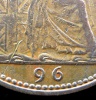
RChris Posted 12 hours ago Posted 12 hours ago Another acid bath victim perhaps? Any other theories? It weighs 9.1g Quote
Rob Posted 12 hours ago Posted 12 hours ago The visible lettering is too crude and close to the rim IMO. It looks more like an abused attempt at a cast copy to me. Any attempts at acid cleaning will thin the letters and reduce dimensions on all 3 axes if there is total immersion. The weight of a cast would obviously depend on the amount of metal poured into the mould, so I think not relevant in this instance. 1 Quote
oldcopper Posted 6 hours ago Posted 6 hours ago 45 minutes ago, Coinery said: Definitely…wot Rob said! I would say it looks like acid immersion - porous surface, and the designs plus fields will erode downwards as they originally rise up from the coin. Quote
Rob Posted 6 hours ago Posted 6 hours ago It is the rim metal covering the legend that gave me the response above. It may well have been both processes to clean off any surface marks from cooked material in the mould (if cast), with force applied (?) to produce the inner ring. I'm struggling to reconcile the ring lip with a linear circle, as it would have to impinge on the legend too as seen. Only the person responsible for it knows the truth. Quote
Coinery Posted 6 hours ago Posted 6 hours ago 5 minutes ago, oldcopper said: I would say it looks like acid immersion - porous surface, and the designs plus fields will erode downwards as they originally rise up from the coin. I really don’t see the date, for example, holding such a clear, crude form after submersion, myself…and especially for all the other devices to be so poorly positioned, if it were really the genuine article! Quote
copper123 Posted 5 hours ago Posted 5 hours ago Must have been really hard up to forge a Ell penny Quote
Coinery Posted 3 hours ago Posted 3 hours ago 1 hour ago, copper123 said: Must have been really hard up to forge a Ell penny That’s a VERY valid point… Quote
oldcopper Posted 37 minutes ago Posted 37 minutes ago 4 hours ago, Coinery said: I really don’t see the date, for example, holding such a clear, crude form after submersion, myself…and especially for all the other devices to be so poorly positioned, if it were really the genuine article! I see your point. The designs of modern coinage, including pre-decimal QE2 as here, are low relief to prolong the die life, almost 2-D with negligible depth, and thus it might not need much acid dunking to erode any shallow raised detail, if it were treated so. As the adjacent field would also be dissolving that may produce the expanded effect as shown, almost like a ghost image, but that's just thinking of a theory and probably doesn't make sense. The marks aren't acid marks either, they're loads of small cuts, perhaps kept in a tin with other coins for many years. Quote
Recommended Posts
Join the conversation
You can post now and register later. If you have an account, sign in now to post with your account.