
alfnail
-
Posts
813 -
Joined
-
Last visited
-
Days Won
89
Content Type
Profiles
Forums
Events
Downloads
Store
Gallery
Articles
Everything posted by alfnail
-
Penny Acquisition of the week
alfnail replied to Paulus's topic in British Coin Related Discussions & Enquiries
http://www.ebay.co.uk/itm/Victoria-1860-Penny-/162491735352?_trksid=p2047675.l2557&ssPageName=STRK%3AMEBIDX%3AIT&nma=true&si=7RDoOpuZZZbfHBuDft04pscgIrw%253D&orig_cvip=true&rt=nc ...but not me.....anyone owning up to it!? -
Thought you had a career in IT Richard; the first thing an IT help desk always advises is "try re-booting your PC"
-
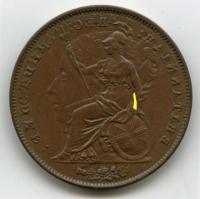
Although I can no longer see the CGS population report, as I have not paid a fee, I believe the 1855 variety with the 3 dots has been documented by them as their variety PE.V1.1855.03, and described along the lines of “a raised dot giving the appearance of a 3rd colon dot after FID”. I attach a close up picture of one of my own pieces for reference. Unlike some dots which we see on Victorian pennies which are clearly unintentional, and result from flaws or specks of dirt getting into the strike, I think that the top dot near the rim on this 1855 is most likely an intentional repair to the weaker ‘clogged’ half-dot seen immediately below.….but a repair done rather badly. This would not be unreasonable as several other examples of repaired / re-struck colon dots are seen in this series. I prefer to think of features which are created by a person, either intentionally or unintentionally to be regarded as true varieties rather than random dots which are not man made. I realise that this will no convince those with an 1897 dot or 1875 canon ball penny!

-
Thanks for clarifying this Pete, much appreciated. I see that the one which was on ebay on a BIN for £60 sold earlier today, perhaps to someone reading this thread http://www.ebay.co.uk/itm/GB-Queen-Victoria-bronze-penny-1862-/162438645295?
-
Thanks for the picture Richard, might have guessed you would have one! I had previously thought that the Jerrams comment was referencing the type which I have pictured below, a currency piece which I have now sold. Interestingly this type with underlying 2 was also sold as a proof example at London Coins last March; the link below. http://www.londoncoins.co.uk/?page=Pastresults&auc=152&searchlot=2390&searchtype=2 If John had sketched an image in his book, like he has for other over-date examples, then we would know which of these two types he was referencing.

-
Anyone got one of these?


-
Yet another variation thanks Cliff, and I think more unusual to be over to the RHS touching the second 8. I probably ought to go through all my previous sales pictures to see if I can spot some more H locations on the 1881's. I did that for the 1882La's I have ever sold, to see if I could find anymore of type with the protrusion at the top left of the H, but couldn't find a single one out of the 6 I have owned but now sold on. P.S. You haven't cracked the duplicate picture posting yet
-
Thanks for the pictures Cliff. Attached is a reference picture of the 1881H (P + p) where, as Mike mentioned, the H is distinctly to the left rather than dead centre between the 8's. I think our conversations, and pictures, over the past 24 hours have given us an 1881Hc, Hd and He to add to the Ha and Hb on Gouby Page 77.........expect there will be even more
.thumb.jpg.cc4a8ca12bf1738c0a36151117d87861.jpg)
-
Thanks Mike, think that's the highest complete H I have seen, certainly higher than the examples on Gouby Page 77.
-
Thanks for the replies, Terry's 'second' piece seems to confirm that the protrusion was introduced at minting. The H's on 1882's and 1881's seem to be found in many slightly different locations, and also varying sizes. Below is an example of a smaller, much lower, and also repaired H on the common 1882 variety. I guess it's not inconceivable that the protrusion on the La was from an earlier underneath H, although it does seem to be very high and quite a 'miss' from the intended spot. Does anyone have an example of a complete 'high' H where the top is level with half way up the bottom loops of the 8's?
HRepair.thumb.jpg.4cce367440e02353b303841d11501193.jpg)
-
Not the best of pieces but looks like there is a protrusion above the H on this Gouby 1882La (R + p) penny. Anyone seen this on their own higher grade example / have any idea what it may be? Don't think I'm imagining!
BitaboveH.thumb.jpg.8b3a2061d5542c830c1706acf96d6211.jpg)
-
Thanks for the pictures Richard. It looks like this coin is a die pairing I do not have. I wonder how many obverse and reverse dies were actually used in 1841. I believe there were something over 900,000 pennies struck bearing this date, and seem to remember that someone with more knowledge of minting than me advised probably around 50,000 could be struck from a single die. If that is the case I may have examples of only half of these in my own collection. Can any other members offer thoughts on this please?
-
Hi Richard, please could you send full pictures of this 1841 so I can check if it matches one of my existing no REG colon pieces? If your images are too big for Predecimal please email them to me if possible. Many thanks, Ian
-
Many thanks Terry, I had wondered whether you were teasing me. So your reverse is a 2nd one paired with the wide date obverse. The protrusion which you show to the RHS of the second A of BRITANNIAR is a good indicator to help me find one of these for my own collection. Such a protrusion is often seen the LHS but I think rarely to the right, at least on 1841's. While we are on the subject of 1841 pennies here are some different numeral fonts I have observed

-
Thanks for the confirmation that your coin has the same obverse features as my own Terry. That being the case I would then expect the reverse of your coin may be the difficult Bramah 2c with the serious repair to the F of DEF (see attachment). That pairing is the one I have in my own collection. It is not 100% certain though, as you may clearly have a coin with the same obverse as mine, but paired with yet another reverse die. Please can I ask for your further confirmation one way or the other? Cheers, Ian

-
Hi Terry, as my picture with all the 1841 date variations was low definition I attach a single picture of the widest date I have seen, the one at the bottom. If your coin is an exact match then I am expecting that it will also have a VICTORIA C with the small protrusions at the top as seen in my second attachment. Do you have the facilities to check and advise please? Many thanks, Ian


-
Hi Terry, thanks for your input. Yes, agree your 1841 REG: must be an earlier strike with flaws just commencing. To date I have found 9 different 1841 obverse dies, best illustrated by their date style differences, which I do not believe anyone has yet tried to document. I have attached a further picture showing these 9 different date types although I have had to reduce from over 3MB to less than 500Kb to get onto the Predecimal system, so the differences are not as easy to see as would be the case with higher definition. I have ordered these, top to bottom, as narrowest (Date 1) to widest (Date 9) and you can see I have shown Date 5 twice as this is the REG: obverse type with or without the flaw through the date. Date 7 by the way is Bramahs rare 2a variety. Also, the dates / obverses which I have named as Date 6 and Date 9 are two different obverses which are both seen paired with the Bramah 2c variety (repair to the F of DEF). I do find it interesting to use flaws and other 'tell-tale' features to plot a timeline of how dies have been paired, but guess that's serious anorak stuff for most! If anyone wishes to have sight of the 3MB image with these 9 dates then please contact me and I will also be happy to describe the differences if anyone is struggling to see them.

-
......and the promised full pictures of my 1841 penny with obverse flaws further developed...


-
A few years ago I saw something of interest on an 1841 Victorian Penny. Recently I was able to purchase a high grade example with these features of interest, and this now enables me to properly share my find with other collectors of this series. Collectors will know that there are two currency varieties documented for this year, the common type without a colon after REG, and the much rarer type with a colon after REG. When I document coins for my collection I always take note of any unusual features. In particular I note the presence of any die flaws and, with additional specimens, how these flaws may develop as a given die ages. It was by studying such flaws that I discovered that the single obverse die which was paired with the rare 1841 REG: penny was subsequently paired with a reverse die which does not have a colon after REG The combined pictures below show the exact same obverse flaws present with both types of reverse die, the flaw through VICTORIA being more developed, as expected, on the coin without the REG colon. I have examined 17 examples of the REG: variety and only seen these flaws on 3 pieces, suggesting that these are ‘late strikes’ and the obverse die deteriorated quite late in life when paired with the REG: reverse. Also, I do not think this same obverse die was used for very long paired with the REG no colon reverse. I have only seen two examples, although I do not spend time specifically searching for more specimens. For reference, I will follow with an additional post showing full pictures of my 1841 penny without the REG colon. Full pictures of a flawed REG: specimen can be seen on the following link, or by examining the example on Richard’s English Pennies website, should you have access. 1841 (A + a) and 1841 (B + a)?…..lots more work to be done http://www.londoncoins.co.uk/?page=Pastresults&auc=142&searchlot=2621&searchtype=2

-
Penny Acquisition of the week
alfnail replied to Paulus's topic in British Coin Related Discussions & Enquiries
It is also interesting that the exact same 'dot' obverse seems to have been paired with an OT reverse. Close examination of the location of the date numerals, in particular the protrusion top left of the 5 which appears to be part of an underneath 5, give me confidence that I have correctly identified this to be the case..........date picture attached for information...........which appears to be a slight variation of Gouby Style Ab.
-
Penny Acquisition of the week
alfnail replied to Paulus's topic in British Coin Related Discussions & Enquiries
Pete / Richard, the dot between the I and A of GRATIA has always been present on all 3 examples of this PT italic 5 type which I have ever owned. Attached are pictures of the example retained in my own collection.

-
1897 one penny high tide variation
alfnail replied to chris's topic in British Coin Related Discussions & Enquiries
I sold that one several months back Pete, the only other one I have is the one I have just pictured and posted this morning on the 'More Pennies' thread, illustrating the teeth count differences between high tide and normal tide (173 compared to 163) as perhaps an alternative method for differentiating between the two types where one is uncertain of the other features. -
.....or if you are an avid tooth counter like some on this site, and cannot be sure about where your 'P' is pointing , then try the counting teeth method. The high tide reverse has 173 border teeth whereas the normal 1897 has 10 teeth fewer, so even allowing for a few teeth which may be difficult to see there is still a decent margin for counting errors. Attached images refer


-
Penny Acquisition of the week
alfnail replied to Paulus's topic in British Coin Related Discussions & Enquiries
Fixed -
Penny Acquisition of the week
alfnail replied to Paulus's topic in British Coin Related Discussions & Enquiries
Really love the golden lustre!




.jpg.946c0679988bc32dcce0ba97da642fec.jpg)
HRepair.jpg.e66119cda225390a44ffbe82054ad00c.jpg)
BitaboveH.jpg.67035f4d67fe160b68885af0bed3b25e.jpg)


