

Paddy
-
Posts
2,311 -
Joined
-
Last visited
-
Days Won
171
Content Type
Profiles
Forums
Events
Downloads
Store
Gallery
Articles
Everything posted by Paddy
-
... Reverse:

-
I picked this up at market today amongst a lot of other coins. I am struggling to get a complete ID on it. Measures about 44mm across (1.75 inches) and is in white metal - probably pewter. I have found one described in the V&A: http://collections.vam.ac.uk/item/O176361/medal-kempson/ but this gives no BHM reference. It is also here: https://collection.nam.ac.uk/detail.php?acc=1986-04-14-1 but again without a reference. I know a dealer who is keen to buy it off me, but I would like to get a BHM reference first and some idea of value? I have found similar designs used on medals and token boxes at several auctions (DNW and London Coins included) but not as a straight medal.

-
 I can't see anything with that date in the Withers list, which is all I have to go on.
 -
Scrap value of a 1d please
Paddy replied to copper123's topic in British Coin Related Discussions & Enquiries
Last time I scrapped in a bunch or old pennies and halfpennies I got £3.30 per kilo. If my calculations are right, that means £1's worth or old pennies would get about £7.50 scrap - just over 3p per penny. (Time has passed, so the rate may have gone up by now.) Even though the coins are bronze, not pure copper, I have found most scrap dealers will give the same price as copper. -
I agree websites are probably the best way forward and I am glad you have taken precautions to ensure yours carry on in the event of a disaster. It would be great if someone could recover and rejuvenate the Farthings site for posterity. Maybe a small consortium of serious collectors from this forum could form and fund a joint venture to ensure the long term future of these sites? With that security, we might be able to expand to include other/all GB denominations?
-
Help for the digitally challenged please
Paddy replied to Rob's topic in Nothing whatsoever to do with coins area!
I can't say I visit your site, or any other dealer site, regularly as I mostly buy through auctions or when people bring me coins at market. I have just had a trip round your site - I can see no problems. It loaded quickly and without issue. I navigated around it with ease and there were no long pauses to load pages or pictures. The design is fairly simple - but I prefer that. (Too many bells and whistles can make some sites difficult to comprehend as well as slow.) Not having a website of my own I do not know what all the statistics mean, or whether they actually have any affect on the usability or findability of your site. I would suspect Google is just trying to persuade you to spend money with them. -
These stink to me: https://www.ebay.co.uk/itm/1951-King-George-V1-Penny-1950-Penny-1949-Brass-3-Pen-All-to-be-Sold-Together/333721667783?hash=item4db35c88c7:g:q7sAAOSwpQdfVn8T
-
That's exactly how I read it, and it is born out by experience. Around here there has been a glut of the 2016 Shakepeare History coin - all brand new and uncirculated. Unfortunately I suspect the ones they produced for packet-only were in much smaller numbers and went straight into wrappers, so I don't foresee them coming into general circulation any time soon.
-
Interesting article o the minting of £2 and 2p coins from the Royal mit, as well as a discussion on the future of cash versus digital currency: https://www.bbc.com/news/business-54196300 It seems the Royal Mint has huge stockpiles of coins ready for issue - which explains why no new £2 designs have made it into circulation in the last few years and why we occasionally get a glut of older issues in brand new condition.
-
I used to use my HP 4500 (Envy) for scanning and the results were "ok" for unimportant coin pictures. The scanner can be set at up to 1200dpi, but at the higher rates gets slower and slower. I gave up using the scanner when I got a decent digital SLR and I use that on a tripod with magnifying rings, small aperture and long exposures to get the best I can. Bear in mind with scanners that you never get any depth of focus - the parts of the coin in contact with the glass can be sharp but any depth of detail will be progressively more mushy.
-
Medallion - Emperor Alexander Peace 1814
Paddy replied to Paddy's topic in British Coin Related Discussions & Enquiries
Thanks for that - clears it up for me. -
Token - 18th century Lancaster/Ireland Mule
Paddy replied to Paddy's topic in British Coin Related Discussions & Enquiries
That is brilliant! So it looks to be DH76, which is good enough for me. The comment about these being for general circulation suggest that the "Current Everywhere" edge is appropriate. -
Token - 18th century Lancaster/Ireland Mule
Paddy replied to Paddy's topic in British Coin Related Discussions & Enquiries
Aha - thanks! Is it 231 then? Does it mention anywhere any varieties of edge lettering? -
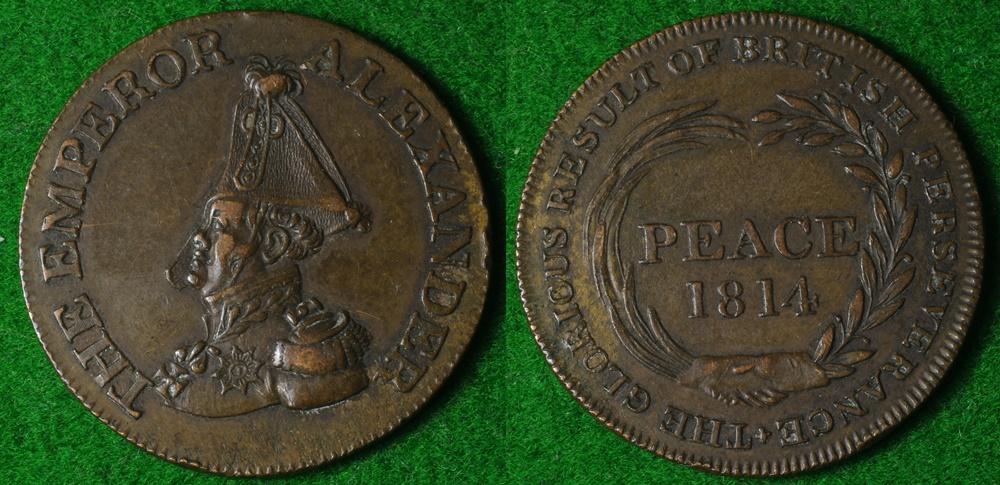
This was the other interesting item from today's auction - a little medallion (24mm diameter) celebrating the peace in 1814 and the role of Britain and the Emperor Alexander of Russia in achieving it. I believe the BHM reference is 810, but that is quoting from someone else's Ebay listing - can anyone confirm? Also, all the other examples I can find are holed - were they issued unholed or is this a later copy?
-
I picked this up at a local auction today. Obviously not in great condition but appears to be a mule of the John of Gaunt halfpenny with an Ireland halfpenny. I can't find it in Withers as a recognised mule - anyone know any better? The edge reads "Current Everywhere".

-
Not convinced that is just a spot of dirt!
-
... and promptly re-listed. Serial fraudster - needs to be locked up.
-
I didn't think you were allowed to sell wives on Ebay: "RS Job Lot , Flat Nose , Snipe Nose , Cutter , Screwdriver , Wench ,. Some as new not used , Wench has been used , see photos, Dispatched with Royal Mail 2nd Class." How "used" is the Wench?
-
Not scarce originally, but as they have been out of circulation for years and many have been handed in to the banks for re-cycling, they do fetch a reasonable premium. I can usually sell them at market for £4 or £5 depending on condition. Again it is the avid 50p collector that needs them to complete the type set.
-
I don't think all the 1992 50ps were all proof - the 109000 figure is for the circulation issue. I have seen them loose and in BU blister packs. They are very sought after by the 50p collectors as there are just 5 different styles for the large 50ps, and this is far and away the scarcest.
-
Stuff to Make Us Laugh
Paddy replied to Madness's topic in Nothing whatsoever to do with coins area!
The little earwig was a keen footballer almost from the day he hatched. Despite his disadvantages and bullying he worked his way up to the school first team, where he was head-hunted to join his local professional team. The manager struggled to find kit to fit him and had to have a special shirt made for him. Due to an error at the manufacturers, it had the number "0" on the back instead of the intended "20". At his first match he was on the subs bench for the first half, but sent on early in the second with his team 2-0 down. Quickly his amazing ability to weave through the opposition defence proved decisive and he kept scoring! Soon the home fans were rejuvenated and as he slipped in his third to take the lead, you could hear them chanting: "Earwig Oh! Earwig Oh! Earwig Oh!" -
Rare coin lost in post
Paddy replied to secret santa's topic in British Coin Related Discussions & Enquiries
A couple of years ago I had one tracked to the US. Tracking showed it handed over to the Customs people at JFK and thereafter, disappeared. Customs refused to acknowledge receipt, Royal Mail refused refund as it had left their control. £200 coin lost. -
Rare coin lost in post
Paddy replied to secret santa's topic in British Coin Related Discussions & Enquiries
I had a package for Israel - it got sent to Illinois when the Royal Mail misinterpreted the international country code "IL". It came back to me about 3 months later and I resent it to the buyer, so eventually he was happy. -
Don't get me wrong - if I see one (or for that matter "any") decent penny going cheap enough, I will bag it! I have built up most of my collection "on the cheap" and occasionally made a decent profit on the side too. But I am not a "serious" variety collector, unlike many on here I know. I don't feel comfortable laying out a lot of money on a variety that requires a magnifying glass and an expert book or website to identify. Each to their own! 😃
-
Not that I go for all these varieties, I would fight shy of that one because the really interesting feature - the Medusa's head - is not visible. We know it is there because of the other identifiers, but you can't see it in the pictures.