
Sword
-
Posts
2,498 -
Joined
-
Last visited
-
Days Won
133
Content Type
Profiles
Forums
Events
Downloads
Store
Gallery
Articles
Everything posted by Sword
-
Come to think of it, we should have asked for 02/02/2020 to be Brexit Date instead of the rather ordinary 31/01/20. (But I doubt somehow that EU would agree)
-
I remember the Beijing Olympics starting at 8:08pm on 08/08/08. That's also a palindrome.
-
I think it is just some problem in translation. It probably relate to the strike of the coin. I have used Google translate on the paragraph on "coinage" and got the following: "Coining In evaluating a coin, it is very important, especially for the oldest ones, in particular for those minted with a hammer, to examine the quality of the production process and the materials used for minting. Specimens that have a large fracture-free rod, where minting is centered both on the straight and on the reverse, will receive a high rating. Coins that show a minting with a strong beat such as to produce high reliefs, will also receive a high price. On the contrary, specimens made with an insufficient beat or that have coinage slips, will obtain a lower rating. The same importance is reserved for the production made with non-worn and non-rusty coins."
-
Since the Royal Mint is State owned, it ought to be making as much money as it can. They should have sold the thing at a higher issue price and have a higher mintage. I mean why a mintage of 1500 for a gold proof? At least go for 2020 pieces and say that's because it is the year of brexit.
-
Of course you wouldn't. Destroying 50p coins is also a silly thing that people won't do either. :-) There are however reports that some people won't accept them; Alastair Campbell because he doesn't believe in the slogan, and Philip Pullman said it should be "boycotted by all literate people". Hence, you have an even bigger chance of building a hoard if you want to.
-
Scare? Dream on!
-
The prices are finally out on the Royal Mint site: Price LEP Gold Proof £945.00 1500 Silver Proof £60.00 47000 Brilliant Uncirculated £10.00 Unlimited Two-coin set £30.00 5000 Strike on the Day Sovereign £800.00 1500 A number of gold Sovereigns will be struck on the day and these particular coins will feature a portcullis privy mark. I really want to get a BU example. It will however cost me 50p as I will get one from post office or bank or circulation 😀 As usual, I prefer to collect a currency coin than a proof.
-
What I meant was that the statement isn't true today, won't be true on the 31st and will not come true in the foreseeable future. It cannot be achieved by Brexit or by remaining in the EU. History tell us that we will unfortunately have to go to war in the future. There will always be governments we will not be on friendly terms with. How can we ever claim prosperity with all nations when there are so many human beings living in proverty. Hence, I said that the phrase "Commenoration of Brexit" would be better as it is direct and to the point. "Peace, prosperity and friendship with all nations" just sounds pretentious.
-
I do not object to the Oxford comma (although I wouldn't use it on this occasion). I just object to the word "all".
-
Sir Philip Pullman is protesting about the Brexit 50p coin. He is complaining that the "Oxford comma" is missing from the coin's wording: "Peace, prosperity and friendship with all nations." https://www.bbc.co.uk/news/entertainment-arts-51269012 It's the first time I have heard of the term "Oxford comma" which is a comma in front of the word "and". I was taught at school that comma is optional and I have never used it myself. Let's do a poll on the number of people for and against this comma. Wouldn't it be funny if it is an ironic 48:52 split.
-
Childhood excitement!
Sword replied to blakeyboy's topic in Nothing whatsoever to do with coins area!
Mine too! It is incredible how well children remember an unexpected extension to a school holiday! -
Childhood excitement!
Sword replied to blakeyboy's topic in Nothing whatsoever to do with coins area!
I was too young then to know what happened to the stock market ...😀 -
Childhood excitement!
Sword replied to blakeyboy's topic in Nothing whatsoever to do with coins area!
Yes, I remembered that well. Michael Fish so famously predicted that we would not be badly affected the night before. I woke up the next morning and was shocked to see that so many of the wooden garden fences and tress have fallen over. The wind blew off part of the school roof and the kids enjoyed an extended half term break. -
Childhood excitement!
Sword replied to blakeyboy's topic in Nothing whatsoever to do with coins area!
I remember collecting those cards in PG Tips boxes when I was a kid. The two most memorable series were flags of the world and unsolved mysteries of the world. It is a shame that they have stopped these more than 20 years ago. -
I don't think this will be an issue once contactless payment becomes the norm for all small amounts. The retailers will then simply factor the transaction fees into the retail prices. (Hopefully, fees will also be lower if there are more contactless transactions assuming the banks don't get too greedy) For example, a shop selling suits expect nearly everyone to pay with card, and so the retail prices have already factored in the card fees.
-
Stuff to Make Us Laugh
Sword replied to Madness's topic in Nothing whatsoever to do with coins area!
This mistake is actually quite common. You can find a number of examples if you Google. E.g. https://www.nhp.gov.in/hospital/scared-heart-hospital-delhi-north-delhi The sign in my photo wasn't altered by Photoshop. It was actually taken from the screenshot of a movie. -
Bo Jo quite understandably would want everyone to handle the 50p commemorating his handiwork. 10 million sounds about right.
-
Stuff to Make Us Laugh
Sword replied to Madness's topic in Nothing whatsoever to do with coins area!
Should be "Sacred" of course. But then, who wouldn't be scared if you are having a heart operation?
-
veiled head half crown reverses
Sword replied to Mr T's topic in British Coin Related Discussions & Enquiries
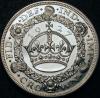
Standard A reverse is shown below:
-
veiled head half crown reverses
Sword replied to Mr T's topic in British Coin Related Discussions & Enquiries
CGS /LC describes this as "1893LVI Davies Obverse 1 (T of VICTORIA points to a bead), Reverse streamer similar to Reverse A with a more levelled appearance, the date digits also closer together (listed by CGS as their variety 20 dies 1+G, unlisted elsewhere)"
-
I am sure the Royal Mint will continue to include the penny in year sets. It will have legal tender (but please don't spend status). Not much of a change since people hardly spend them now anyway. There will also be silver versions.
-
I have indeed mistaken one farthing for 0.25 new penny instead of 0.1 new penny. But I can still believe that a farthing had more purchasing power in the early 1960s (when it demonetised) than the purchasing power of a penny today. A farthing in 1960 could probably buy something like a cheap sweet, but absolutely nothing today costs as little as a penny. Gave it a check using an inflation calculator, 1 pound in 1961 is worth £22.43 today. So a farthing would be worth 2.3 pence.
-
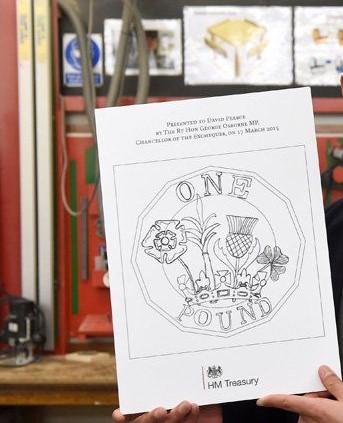
The original design entry: It was then refined by the coin artist David Lawrence.
-
Bronze? You meant copper plated steel 😀! I would be surprised if that's not the case since the farthing has been demonetised for nearly 60 years now. "The Royal Mint had revealed 60% of 1 pence and 2 pence coins are only used once, while 8% of pennies are thrown away." This is so wasteful and it is just tradition keeping these coins alive.
-
Contactless payment doesn't necessarily mean a surveillance society. For examples, there are cities which use contactless stored value smart card that are anonymous. These card were originally used for transport payment but has grown to be used in convenience stores and supermarkets.