Peckris
-
Posts
9,800 -
Joined
-
Last visited
-
Days Won
53
Content Type
Profiles
Forums
Events
Downloads
Store
Gallery
Articles
Everything posted by Peckris
-
Don't think you're missing anything - it looks like a bog-standard, perfectly ordinary, average, cleaned example of the Withdrawn Type 6d. Ah good. It's not just me then. I also notice he is trying to sell a much more common 4+D 1921 shilling as the scarce 3+D "nose to S". It's nose to VS that is the rarer one. I was simply using a mixture of Davies and Spink terminology. Given that in both varieties the nose points to S, it's a pretty useless discriminator. OI! Spink's terminology is actually MY terminology as I was the one who got the two types of pre-ME obverses into Spink in the first place, specifically so that the rare 1921 shilling got recognised. How was I to know that (1) of the four or five identifiers I gave them Spink would pick only that one to use in the Catalogue, and (2) they would actually use them the wrong way round. The nose does NOT point to S in both cases (see attached), but really the way to tell them apart is quite straightforward. The Type 1 obverse is the deep-cut high-relief obverse used for most large silver between 1911 and 1920 - and for rare 1921 shilings and 1923 florins; the Type 2 is the shallow obverse from 1920 to 1926. Another good way to tell them apart is the distance from the legend to the teeth - it's twice as much on the Type 2 obverse. (Why has this forum suddenly stopped allowing Adobe Photoshop JPEGs from being uploaded?)
-
Don't think you're missing anything - it looks like a bog-standard, perfectly ordinary, average, cleaned example of the Withdrawn Type 6d.
-
VF Double florin for £145!
Peckris replied to Oxford_Collector's topic in British Coin Related Discussions & Enquiries
Oh well, you can console yourself with the fact that "only" 125 members of the public will get ripped off. Or, if Coincraft buy them all and add their own versions to boost sales, it could be 5,000... -
I like this in the description : "the coin is better than what the pictures are showing, the quality of picture is not good" ...what, you mean there ISN'T a socking great hole in it, it's just the photo??
-
Golden Coin of George III
Peckris replied to HAXall's topic in British Coin Related Discussions & Enquiries
Or, it could have been gilded at some point - a lot of coins of that era were, especially farthings a few years after that shilling. -
how horrible is this?
Peckris replied to moneyer12's topic in British Coin Related Discussions & Enquiries
Yes - the antoninianus (as opposed to the denarius) was often - especially among the later Emperors - silver-washed copper or bronze. But those are like Geo III fakes in that rather than toning, they show a greater or lesser degree of silver wash present. But that's exactly what I was saying! It's the composition of the packing materials that cause the 'orrible toning, not atmospheric pollution. You should not believe every fairy tale. Usually I do not dip my coins. An even & natural toning is the best thing you can have on a coin. Especially in case you own a rare date/mint mark the toning can help to judge whether the particular date or mint mark is manipulated or not. For that purpose you must have enough experience to distinguish between natural and artificial toning. Agreed! -
how horrible is this?
Peckris replied to moneyer12's topic in British Coin Related Discussions & Enquiries
Isn't that due to chemicals in the packaging. Yes, most probably, especially with those 73 sets. Not with those modern proof sets - they're well sealed Well no one has yet in my opinion come up with a convincing counter argument to my previous state that the amount of toning and rate of toning is in direct relationship to the quantity of environmental damage. The heavier the toning the harsher the environment the coin has been keeps in. Just putting a coin away in an envelope although may be considered as protecting it could actually do more damage than leaving it in open air. I still maintain that although all coins will tone with age a lightly toned coin is better than a deeply tone coin, so we shouldn't be seeking out toning and equating it with quality. I think there's a difference between seeking out and accepting toning. If you try to avoid all toning then you get the situation I believe they have in Germany where coins are dipped and varnished to preserve their state. Whereas the Americans seem to have gone the other way completely. Some coins will tone and, certainly with hammered coins that are likely to have been cleaned at some time, I prefer a bit of toning than the bright shininess like this: And once a coin has toned then I think it does more harm to try to reverse it than let it be. But perhaps it's a personal thing? Shiny bright-as-the-day-they-were-struck Roman coins somehow don't seem so bad to me as the shilling above for some reason. Isn't that because that's more usual for Roman coins than hammered? I've seen lots of untoned denarii, but never an untoned hammered except the one in your picture. It may be several causes - (i) the thickness of the coin, (ii) the quality of the silver, (iii) the frequency of hoarded Roman coins especially in this country. -
It certainly is "Ultra Rare" - the only coin in existence that is Fine, Very Fine, and Extremely Fine, at one and the same time!!
-
You've lost me shamo! What do you mean by noted? In the 19th edition collectors coins for Ireland, example(noted at auction 1999)and just(noted 1999),does this mean you take them to auction.I'm not looking to sell not any time soon, because i know there's no value,I'm a collector and i know there's a lot of decimal coins out there,I have to wonder if it would be to soon, maybe keep them for the kids, but by doing that it is unfair to other collector's,and if i do it now it give ebayer's a chance to make a quick pound or try to. LOL. This just means the author of the book has looked at various auction 'realised prices' and "noted" (i.e. "noticed", "saw") that some were worth quoting in his book!
-
1905 Florin - advice please!
Peckris replied to Paulus's topic in British Coin Related Discussions & Enquiries
Yes, but this applies to virtually all coins. The bun Britannia looks er... less than attractive in close up. Better to concentrate on some of the more robust physical features, my favourite being the particularly buxom Britannia in the 1825-60 copper series. As the art historian Robert Hughes said (of Goya's La Maja) 'one could imagine climbing into the picture and having a really great afternoon'. Mind you, she could do some serious damage with that trident of hers... She'd beat me at arm wrestling every time -
Interesting, I didn't know that the die finished had changed, its a real shame about the effect this had had on the finish of the coins, really makes modern coinage minted in this way look unappealing! Yes, I've always thought the silk finish on 1969 50p pieces were far superior to - say a brightly mirrored 1980 specimen.
-
how horrible is this?
Peckris replied to moneyer12's topic in British Coin Related Discussions & Enquiries
How would you explain the fact that proof coins are usually more toned than non-proof? Surely proof coins would be better looked after than non-proofs, but tone more readily due to an interaction between the metal, the atmosphere and the material contained within the presentation case. Agreed. Proof coins that are in absolute mint state and have never left their sealed plastic tombs, can tone horribly as we all know from 1973 sets. -
1964 Six Pence & Half Crown decentration
Peckris replied to ChKy's topic in British Coin Related Discussions & Enquiries
Convex one side, and concave the other? -
1964 Six Pence & Half Crown decentration
Peckris replied to ChKy's topic in British Coin Related Discussions & Enquiries
The weird thing is, from the legend into the centre, it all looks perfect and undistorted - even though the whole design is off-centre. -
how horrible is this?
Peckris replied to moneyer12's topic in British Coin Related Discussions & Enquiries
(I had to see this via Tom's relinking...) I'm afraid I'm going to buck the trend here. From the description I expected to see yet another artificial 'rainbow' ugliness, but this wasn't. I agree that it may be artificial and the golden toning is a little too rich, but on the whole I love silver coins with a single colour toning - e.g. blue, or gold, or even grey-pewter. That's not nearly as ugly as I thought it was going to be. I'm with you Peck, I like toned silver. Although, in this case the obverse is not very attractive, but I could easily live with the reverse. Agreed -
1964 Six Pence & Half Crown decentration
Peckris replied to ChKy's topic in British Coin Related Discussions & Enquiries
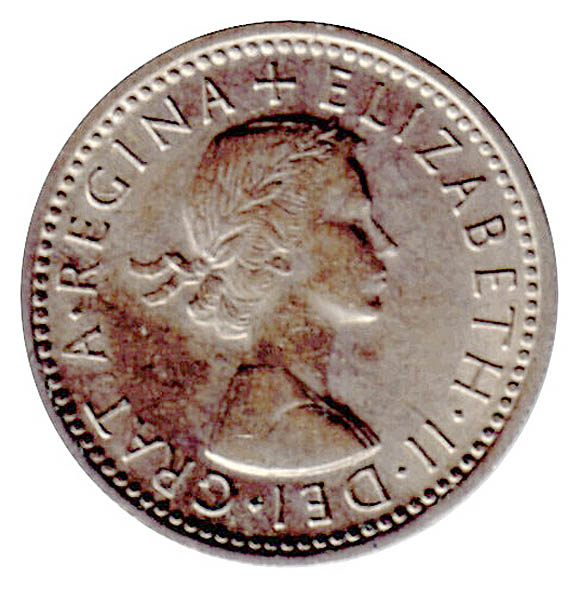
Agree,they moved in 67 I believe. There are collectors of errors (mainly in the US)where double dies even command high premiums.We have an error member on the forum(not a regular visitor but has some stunning early copper errors)Maybe someone can remember his name. No, they didn't move at all. The new Mint in Llantrisant only produced decimal coins. The London Mint produced all of the remaining predecimal coins dated 1967 (up to 1969? 1970?) at which point they began to turn their attention to proof sets I believe, and coins for other territories, until their disabanding in ?1975? In any case, these are 1964, two years even before the Chancellor's announcement to Parliament in 1966 that all predecimal coins would henceforth carry the date 1967 to 'prevent hoarding and speculation' (ha! may the sainted Jim rearrange the following to form a well-known phrase or saying "good bolted it's horse shutting after no door stable the the has"). The interesting part about all this is how on earth this happened. The halfcrown obverse not 'missing a crescent' is well explained by the rim which is completely missing and which is quite wide on Lizzie halfcrowns. However, the sixpence obverse is far more mysterious. The teeth (such as survive) are totally wrong, and so is the gap between the legend and where the teeth should be. For comparative purposes have a look at this 1964 sixpence obverse. The teeth should be almost beads very close to the legend, and the rim too is quite wide. Now check the original picture and note how very different that obverse appears to be. There's more going on here than meets the eye, but what?
-
how horrible is this?
Peckris replied to moneyer12's topic in British Coin Related Discussions & Enquiries
(I had to see this via Tom's relinking...) I'm afraid I'm going to buck the trend here. From the description I expected to see yet another artificial 'rainbow' ugliness, but this wasn't. I agree that it may be artificial and the golden toning is a little too rich, but on the whole I love silver coins with a single colour toning - e.g. blue, or gold, or even grey-pewter. That's not nearly as ugly as I thought it was going to be. -
Prominent ebayer at it
Peckris replied to azda's topic in British Coin Related Discussions & Enquiries
Peter, it was impossible for the coin to move anywhere. What he's trying to do is say that its got huge cabinet friction and then tell me he wants a price reduction, but then tell me we can take it off the Shilling. When i replied to him telling him he was bullshitting because of the way it was packed (no cardboard was involved in the making of that parcel) and would have been an improbability for it to have anymore wear than it showed in the pictures he then suddenly became very very quiet, especially when i told him what he was obviously trying to achieve by bullshiting. He was immidiately blocked. Right behind you Dave, eBay as a seller can be a right royal pain in the arse and for the buyer Paulus Slander !!! -
It's the same fake that was discussed here a little while ago. It's amazing that even when told it's fake, some people will bid believing otherwise. It's worth a couple of quid for the silver. Yes, I thought that darker patch around the 05 looked familiar.
-
Money matters and Chelteham
Peckris replied to Peter's topic in Nothing whatsoever to do with coins area!
Gah - as a double you would got - what? - 56-1? -
You would think the faker would have made at least SOME effort to line the 0 and the 5 up properly.
-
Just wait until I explain to you what that tiny room with the porcelain bowl is for! I think I've worked that one out - seems like a lot of machinery just to wash one coffee cup at a time though! No no, you're supposed to use it to FILL the coffee pot and kettle with...!
-
How embarrassing
Peckris replied to Boomstick's topic in British Coin Related Discussions & Enquiries
let me explain for those not familier with betting odds...... liverpool are quoted as 10-1 to win the premiership this season....what this means is, if you bet £1 on liverpool............................................................................................................................................youve wasted a quid Hm .. wonder what odds you would have got at half-time in the 2005 Champions League Final? i may be wrong but this may be dito for lizzie le deux, ascended to the throne in 52 but got the hat in 53. Correctamundo. Also true for George VI, his brother having abdickered in ?December 1936 (the year of three monarchs). And Edward of scarce silver fame, he deaded in 1910. As scott says, you'd be hard pressed to find someone whose accession, coronation, and first coins, all happened in the same year. George II was the last one where that occurred. Before that there was George I, Anne... They seemed to be much quicker with the coronations in those days. Probably due to a certain .. instability .. surrounding the monarchy in the previous few hundred years. -
UK Coins - bargains?
Peckris replied to thecoinstar's topic in British Coin Related Discussions & Enquiries
Those are fair prices IF (as Peter says) the grades are accurate. However, if you used to collect then you're presumably not a newbie at grading and can judge this for yourself. Grades are certainly no stricter - if anything, a bit less so - than they were some years ago. However, I'd take the BU George VI halfcrown prices with a pinch of salt. From 1944 - 1946 these are very common even in BU state, and I'd look to get them for less than £5 if possible; those would be good prices only for really superb BU specimens. In fact every denomination from halfcrown to sixpence is equally common in high grade for those dates. Probably due to hoarding when silver coins were replaced with CuNi in 1947. -
How embarrassing
Peckris replied to Boomstick's topic in British Coin Related Discussions & Enquiries
let me explain for those not familier with betting odds...... liverpool are quoted as 10-1 to win the premiership this season....what this means is, if you bet £1 on liverpool............................................................................................................................................youve wasted a quid Hm .. wonder what odds you would have got at half-time in the 2005 Champions League Final? i may be wrong but this may be dito for lizzie le deux, ascended to the throne in 52 but got the hat in 53. Correctamundo. Also true for George VI, his brother having abdickered in ?December 1936 (the year of three monarchs). And Edward of scarce silver fame, he deaded in 1910. As scott says, you'd be hard pressed to find someone whose accession, coronation, and first coins, all happened in the same year.