
Rob
-
Posts
12,800 -
Joined
-
Last visited
-
Days Won
347
Content Type
Profiles
Forums
Events
Downloads
Store
Gallery
Articles
Everything posted by Rob
-
Just a worn die? Wear is rarely completely even. Logically, I would expect the first point of contact to show the greatest die wear, but then that assumes the die is equally hard across the face - which isn't a given.
-
Weak patches can be due to various things. Wear is the most obvious, but also blocked dies or soft strikes. If it is an area of lower relief, then it is usually something filling the die. It may be metal dust or could also be grease. Unused dies are stored in grease to prevent rusting, and sometimes this is not fully removed prior to use. Because the grease will not compress under pressure, the flan is not struck up at this point.
-
Coin prices continue to rise
Rob replied to 1949threepence's topic in British Coin Related Discussions & Enquiries
My initial reaction looking at the lot details was 'why is the estimate so high?' £80 high estimate still leaves £50 for a proof 3d after slabbing costs - which is silly. I'd love to get even half of that. -
I doubt they would use a genuine name because it might confer 'official' status in the eyes of the public, consequently raising hackles at the mint/BoE leading to them having to publicly disown them as per Moore's Models
-
Not necessarily a worst offering, just mis-described by NGC and the vendor has followed suit. https://www.ebay.co.uk/itm/126326106682?itmmeta=01HPP1PAKM29E6B28M1EVHGG5E&hash=item1d699f6a3a:g:NV4AAOSw2tZlxS33&itmprp=enc%3AAQAIAAAAsLKd0l82XvnuaGrzJO%2FHcJBV3x52qzjv7EFUyGtuDfrY3BiF%2BgCLs%2F0oAPx%2Fn0SCC3RYgwRYFrRUDPMG%2FjfGZzu2ShMHdF58OPVYNlD%2BPndD4YGTqM7lC1YVglfmlKPDqzbdsYoAG6L1bd3CV68Ofczf280EJOyzDBDpNBXB5YeOESC2tfazyh2oR4M4VNnnR8bnBs8D5P1Ga873l60L2fb0i9cBE9XtVSCS1gVpihmJ|tkp%3ABk9SR_6p2cG1Yw I have messaged him might be worth others doing so too. Makes the blurb with the listing pretty redundant. I wonder what the real numbers are? Bet there are errors both ways with a few mules thrown in to cover bases. Full sharp UNC details and fully Satiny Lustrous. Very scarce "Beaded Border" variety and of the only 26 known by the major grading services only 1 graded higher!!!
-
Whatever, I wasn't really interested.
-
I think it could have been even later than Jan/Feb. Lingford lists 9 obverse dies for 1551 of which only obv. Z was tun and the other 8 were Yorke's. Furthermore, obv.Z was only known paired with Lingford reverses 12 & 13. One/Two dies would be a small number for 2-3 month's worth of coining, as given they didn't start until October 1551, it leaves less than 6 months for the 9 obverse dies in total. Speculatively, I assume that reverses 1-11 (mm.y) were the initial Yorke dies identified by Lingford when he did his study, and that 16, 17, 19 & 20 came as a result of later discoveries. Similarly, 14 & 15 were immediately identified for post 1551 coins, with rev. 18 (mm.Tun) again being a later find. That's 15 y reverse dies for 1551 compared to 2 tuns. If the evidence could be found, I wouldn't be surprised to learn that Throckmorton didn't start work until March. Lockdales 75 lot 290 was an obverse G paired with what appears to be an unrecorded die (it's a bit worn to be certain), so that would mean a 16th reverse - which pretty much backs up the rule of thumb that you had twice the number of reverse dies as obverses. 60% of all 1551 crowns use obv. A which presumably was a result of the urgency to get the fine coins into circulation asap.
-
The wiki page on Sir John Yorke might hint at why the mark changed from y to tun. 'In 1552 York was pardoned 'for all treasons and offences concerning making and issuing of the king's money', on the condition that he settle his mint accounts for over £9500 'due to the king'. So presumably 1551 was not such a good time for Yorke. Any such impropriety would surely result in loss of privileges, such as making the coinage.
-
The jury is out. It's possible that Southwark didn't fully close. Stewartby only covered the period up to the end of the base coinage, and so the July closure might refer only to the cessation of striking debased coins. I say this because Edward's Chronicle on the 24th September 1551 says amongst other things, 'Also that York's mint and Throckmorton's mint in the Tower, should go and work the fine standard'. To me that implies that Southwark was still considered operational - at least by Edward, but doesn't eliminate the possibility that Yorke moved across the river and set up shop alongside Throckmorton or in Tower mint 2, which we know existed from the debased coins. Given y coins are only for 1551 and subsequently superseded by Tun at the end of the year, it may be that Throckmorton was initially indisposed and Yorke operated at the Tower before Throckmorton took over, but the wording in the Chronicle suggests to me that both mints could have been involved. C can be eliminated because the dies for the fine were new. A y/Tun mule would more likely place things at the Tower, but I'm not aware of anything for any denomination. Further edited to say that stocks of fine silver were more likely to have been held at the Tower.
-
The font and layout is almost like it used to be when computers used DOS - say the early noughties, before windows appeared.
-
1966

-
If Peck knew that Bressett had written about it and reiterated this in a letter dated 1966, it only leaves 2 options. Either it is included in the 1966-7 edition of Bressett, or whenever the next edition was published depending on whether he knew before the 5th edition went to print. I'm assuming the advice was by letter or telephone given the letter is dated 1966. There is a fifth edition listed on ebay. https://www.ebay.co.uk/itm/325963803688?hash=item4be4f4ec28:g:3XsAAOSwelpgwTTb&amdata=enc%3AAQAIAAAA4CXC1kcT8Pgn1wofpXIBaezimKqcb6r7OGnowqU63xVmOPug4KwnR%2BB2ThsmfVuWW4c%2B%2FUKYvKV9MgUg8LLPt4su2pT8a7u%2Fvtj9FOHdW%2FkrbQNiZyTnz7Z15qR95dLHdyWtYkHlIipAtdgOmvmEG%2BOHQoyr1opQUqeT01UpEauZPvPTfETWUus5OK7oluY3Kbu2W4XFEdFGuigXLF%2BkS4AYhK7HGwVhoYnqWLM0oKKjPL8bHUf5Jo3iPmYMgJk4EUFSGzQ7uJtv1vftp68aRv2wLuMwm1%2FBOmqjLjbzNj6d|tkp%3ABFBMsobV-aFj
-
Elizabeth Bell Halfgroat with pellets over mark of value II
Rob replied to Coinery's topic in British Hammered
Different dies surely, the N is further away from the cross end on yours -
Elizabeth Bell Halfgroat with pellets over mark of value II
Rob replied to Coinery's topic in British Hammered
Here's another one I had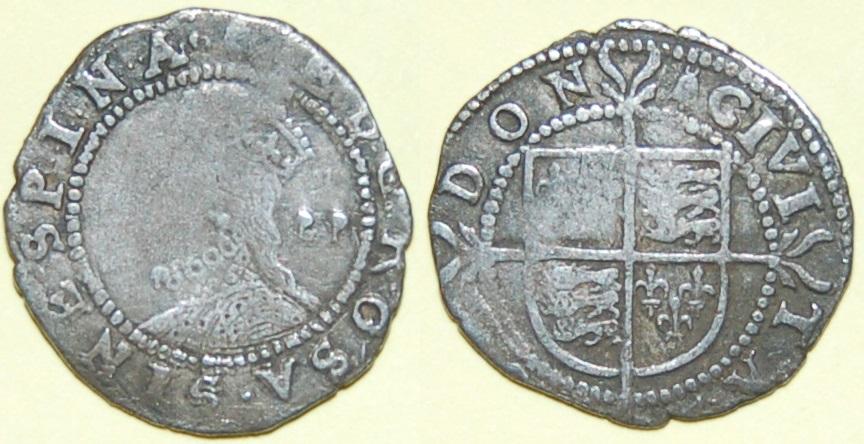
-
Bresset doesn't list it in the 1965 (4th ed.) book, so I suspect the following year is your best bet, unless conveyed verbally/letter.
-
'Meanwhile on planet Russia'
-
What auction houses and reputable shops should I be keeping my eye on?
Rob replied to Master Jmd's topic in Beginners area
Yes he is. He has the table across from me in the small room or 2 down in the big one. -
Why on earth would people do this? The melting point of copper is 20 degrees higher than gold, so there's a real danger of melting the gold. The copper salts will also have a higher melting point. The best you can hope for is to alloy the copper and gold, which are chemically miscible.
-
I had assumed they took the vendor's description verbatim, as they would never arrive at that by checking any reference book. It isn't as if Geo. V pennies are difficult to locate correctly described. Lavrillier patterns are another matter
-
Rob Page Henry3.com website???
Rob replied to Coinery's topic in British Coin Related Discussions & Enquiries
I've got the NC on a CD, but Sod's law saw my computer with a CD drive die soon after I got it. Now I need to find someone with a CD drive to get it onto a memo stick or something I can use to download and print things off before the drives no longer exist. -
Rob Page Henry3.com website???
Rob replied to Coinery's topic in British Coin Related Discussions & Enquiries
BNS blogs will be subject to the same issues. You can save it digitally, but also print it out at your convenience. There is no guaranteed permanent repository of research data, but you can scan in printed articles ad infinitum. -
Rob Page Henry3.com website???
Rob replied to Coinery's topic in British Coin Related Discussions & Enquiries
Build your own databases and get a proper library. Even just copying and pasting the info into your own reference file negates the inherent issues with sites dedicated to a narrow focus. All these nerd sites have one thing in common. When the person responsible loses interest in a field they have researched, so does their interest in keeping the site going. -
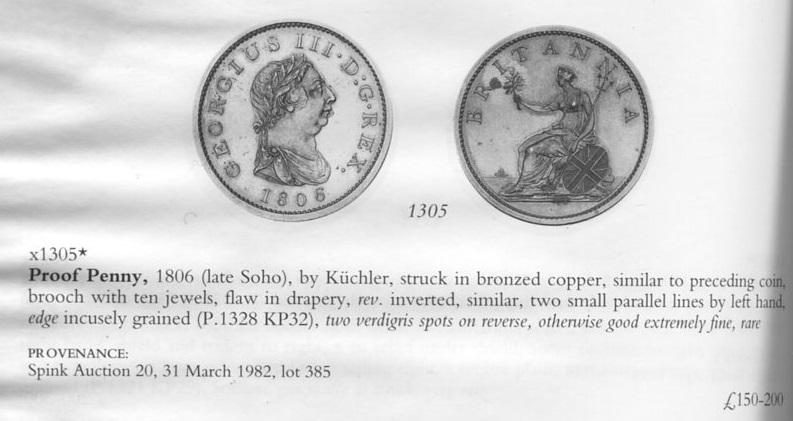
Selig collection of coins sold at Spink on 2nd March 1999. That coin was lot 1305 - see attached image from catalogue. And thanks for asking the question as I discovered my chimney has a leak, soaking the edge of the catalogues for sales 127 to 133. It's been wet recently.
-
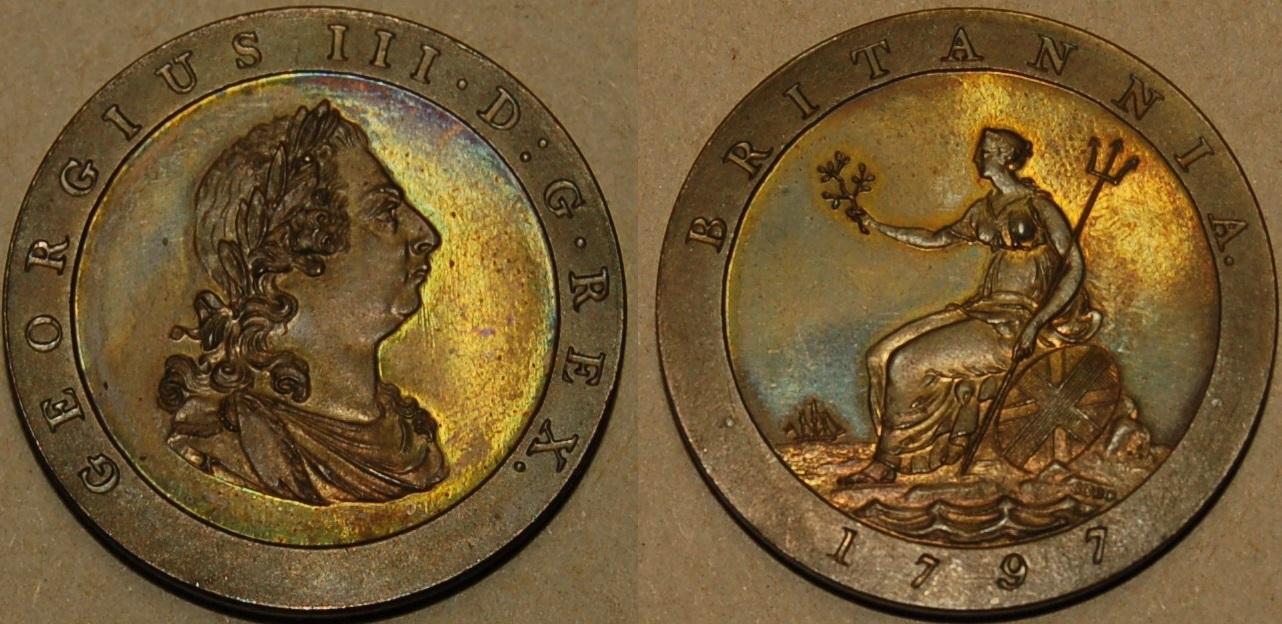
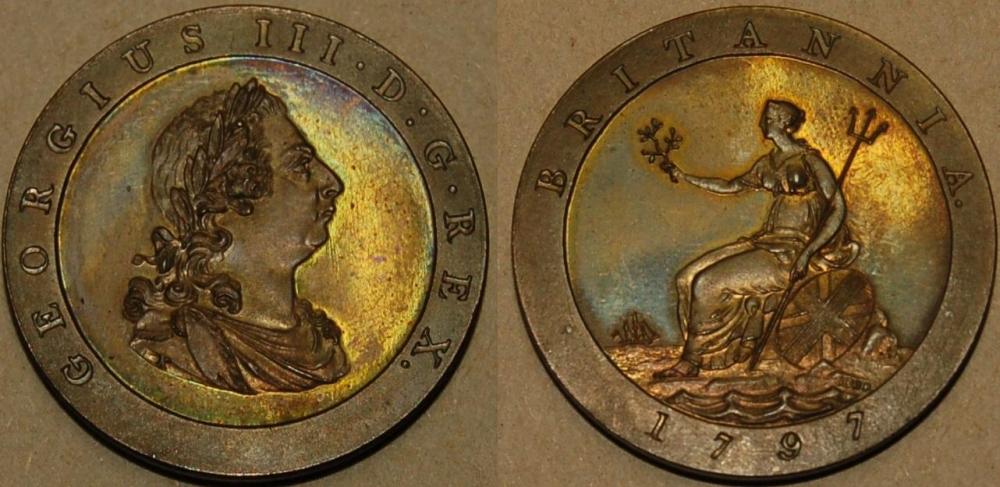
In the case of the two coins pictured above, the photo has been done so as to maximise the reflectivity of the field and produce as much of a cameo effect as possible. That doesn't help to show the colour as in hand. Lighting angle, picture angle, surface reflectivity all combine to give a multitude of options. This pattern halfpenny is really dark in hand, but lit from a certain angle is like an oil painting.
-
There is quite a lot of variation in the colour of bronzed proofs. Soho and Royal Mint bronzing is normally darker than Taylor's restrikes, which can be a bit blotchy in nature.