absence of uniformity
-
Posts
358 -
Joined
-
Last visited
-
Days Won
7
Content Type
Profiles
Forums
Events
Downloads
Store
Gallery
Articles
Everything posted by absence of uniformity
-
Thick flan?
absence of uniformity replied to absence of uniformity's topic in British Coin Related Discussions & Enquiries
Why should I constantly have to prove myself. You bought no value to this discussion instead you suggest im being dishonest. Im really starting to find it rude. What is so hard to understand about asking a valid question? You have been quite supportive to my journey so far then suddenly you getting all weird. -
Thick flan?
absence of uniformity replied to absence of uniformity's topic in British Coin Related Discussions & Enquiries
What are you talking about ? I found a coin online for sale that is a 1874 H which I have identified as 10+J ( I could be wrong) And it would appear it has has a thick rim. I'm simply asking the forum for advice.............. I dont understand these assumptions/accusations what's it all about? what is the problem. I'm asking a genuine question to the forum looking for advice and thoughts on my theory I have put forward. What is so mind boggling to you about this? The questions is really simple. Yes I have used my brain in producing this question why is that so alarming? Tell me what is weird? What's not elementary? pitch me? explain to me what you are getting at -
Thick flan?
absence of uniformity replied to absence of uniformity's topic in British Coin Related Discussions & Enquiries
Just from this image alone would you not agree the flan thickness appears a similar width to the height to the C in Victoria?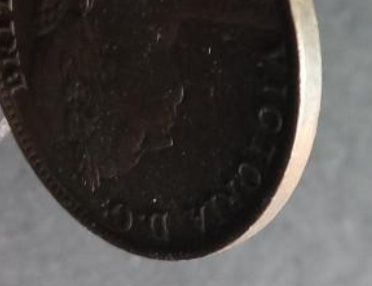
-
Thick flan?
absence of uniformity replied to absence of uniformity's topic in British Coin Related Discussions & Enquiries
I just seen on LCA website there is a 1874 H Thick flan coin rated R20 listed as 2mm thick... When comparing the imaged coin to the LCA example I cant see any differences in the die pairing. The imaged coins is in alot better condition than the LCA coin which sold for £600. They state a EF example sold for £3042. -
Thick flan?
absence of uniformity replied to absence of uniformity's topic in British Coin Related Discussions & Enquiries
The coin is 1874 H 10+J and I noticed this listed for 10+J : 1874H 10+J Thick flan R20 -
I know its insignificant and probably common on early halfpenny coins. Out of interest what is the reason one letter would be tilted back like this. Is it simply repunched in which case where is the trace of the original letter? Thanks.
.thumb.png.f0e2f9fa8316152ad420f1070ae230ee.png)
-
Thick flan?
absence of uniformity replied to absence of uniformity's topic in British Coin Related Discussions & Enquiries
By measuring the top crossbar of the T on a coin I have to have it roughly 1.28-1.30mm if I measure the crossbar on the T on the above image then apply that measurement to the rim it suggest the Rim of the imaged coin is wider than 1.3mm. -
Thick flan?
absence of uniformity replied to absence of uniformity's topic in British Coin Related Discussions & Enquiries
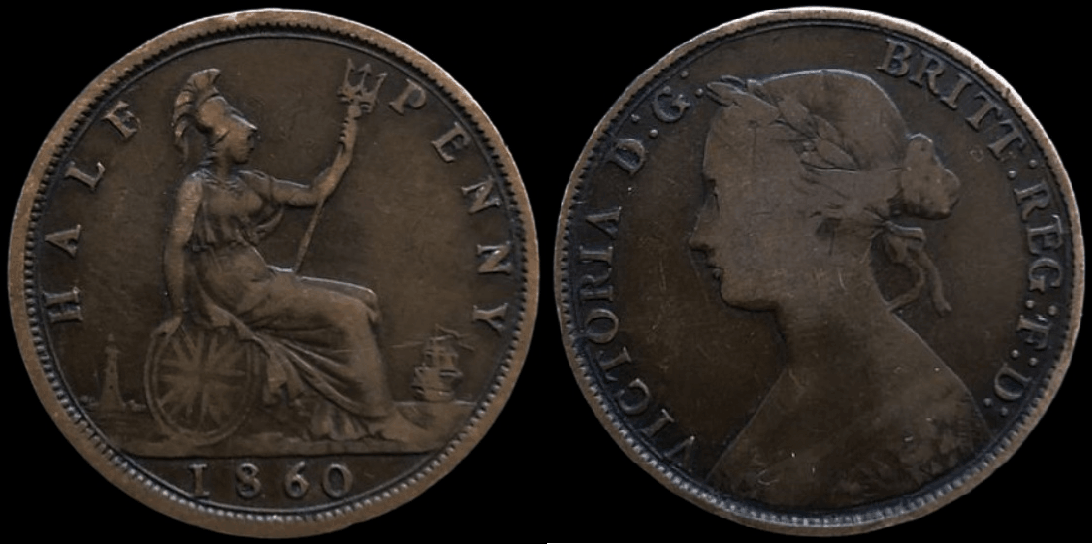
A worn penny is measuring 1mm thick, proportionally this halfpenny looks thick to me. I have measured the C in Victoria on a Halfpenny I have to hand using a vernier caliper the C seem's close to 2mm in height. Using the above image if I measure the C in Victoria then apply that to rim of the coin it appears similar thickness of roughly 2mm I know the image is on an angle which may change the accuracy of those measurments. It just looks thick to me. The halfpenny coins I have measure around 1.2- 1.3mm thick. The imaged coin is clearly thicker than that. What do you think? Thanks -
I dont have this Halfpenny coin to hand but noticed what looks to be possibly a thick flan would you agree or not? I appreciate its not so easy to be sure from the image provided.
-
https://www.essex.police.uk/news/essex/news/news/2026/may/wickford-counterfeit-currency-sentenced/ RM pulled 30,000 notes out of circulation supposedly from these two.
-
T Over E in REG
absence of uniformity replied to absence of uniformity's topic in Confirmed unlisted Varieties.
-
T Over E in REG
absence of uniformity replied to absence of uniformity's topic in Confirmed unlisted Varieties.
Im not sure if I sized the E correctly in this image but by overlaying the E over a T from a different coin this is the result..jpg.53618e93fafdaf8dc61d252550e2130f.jpg)
-
T Over E in REG
absence of uniformity replied to absence of uniformity's topic in Confirmed unlisted Varieties.
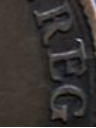
Once I can I will photograph the coin properly. When I first noticed this I saw what I thought to be a faint outline marked in red shown on my drawing. If that faint line is the missing right arm then it would more or less proportionally correct. The base of the T in BRITT appears wider though. Could well be a die flaw like as you say. It just looked rather defined. Unfortunately I wont be able to make it to this one, hopefully the next..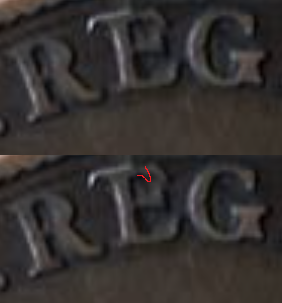
-
T Over E in REG
absence of uniformity replied to absence of uniformity's topic in Confirmed unlisted Varieties.
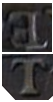
-
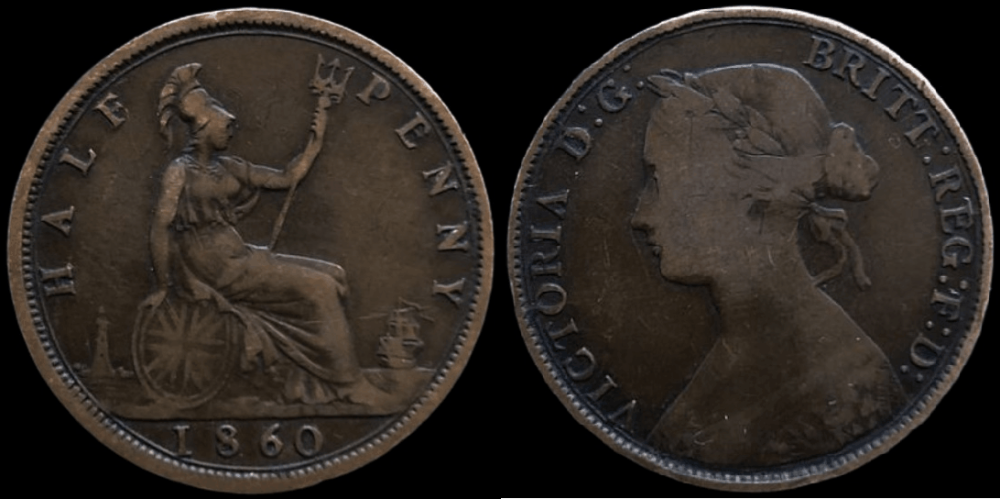
Am I seeing thing's or is that a T over E in REG. I posted this in Unlisted varities because I cant find any reference to this. Thanks
-
1873 One Schilling die 91
absence of uniformity replied to jdtann's topic in Confirmed unlisted Varieties.
1873: 1 to 6, 10 to 14, 16, 17, 19, 21 to 24, 26, 27, 30, 31, 34, 35, 37, 39 to 48, 50, 53 to 65, 67, 69 to 71, 73, 75, 76, 79, 83 to 89, 92 to 94, 96, 100, 101, 103, 105 to 107, 109 to 111, 113 to 115, 117 to 123, 125, 127 to 129, 131, 132, 135 to 137, 141 -
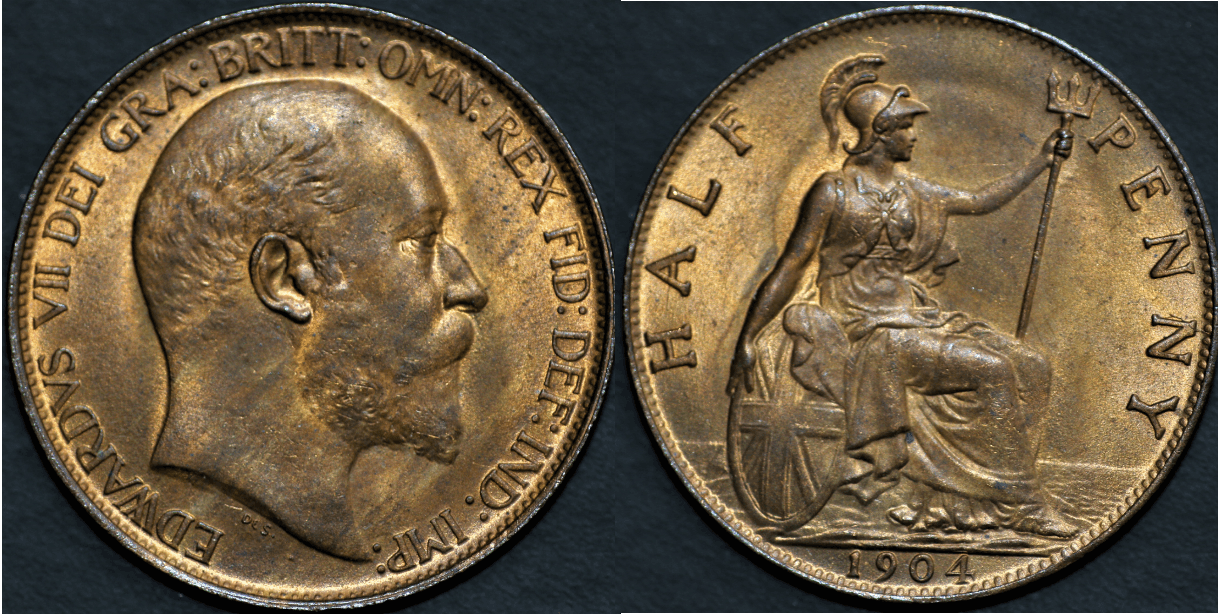
Thanks the image is not a good representation of remaining luster and the colour, I was playing with the ISO setting on the camera while the image shows nicely the depth of the strike the remaining luster is a higher percentage than the image shows and the colour is better aswell. I need to learn about lighting and practice more with the camera. Looking at sold examples of the 1904 this coin I think is roughly around the £60 price point. Similar coins have sold for quite a bit more and quite a bit less.
-
More Pennies
absence of uniformity replied to Prax's topic in British Coin Related Discussions & Enquiries
The challenge is to find a uncirculated 1915 with the thin defined ear, regret to say I have not found one yet. -
More Pennies
absence of uniformity replied to Prax's topic in British Coin Related Discussions & Enquiries
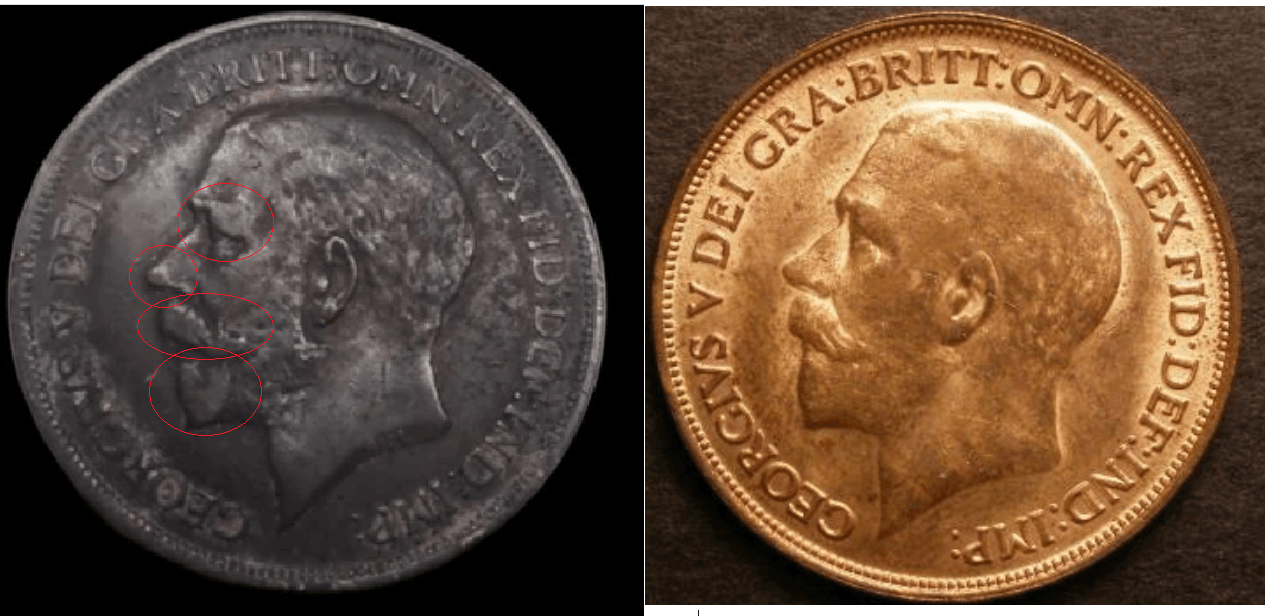
Here it's clear cut, the "uncirculated" coin does not show the flat/worn areas on the face highlighted by red cicles on the worn coin yet the the top curved part of the ear on the uncirculated coin is not a thin defined line. I know strike and die wear are factors on this year. But how can a worn coin have a more defined ear if the ear is not recessed? Given its hard to find a sharp struck 1915 with or without a broken tooth if the ear is finely defined IMO its a recessed ear. It really stands out to me.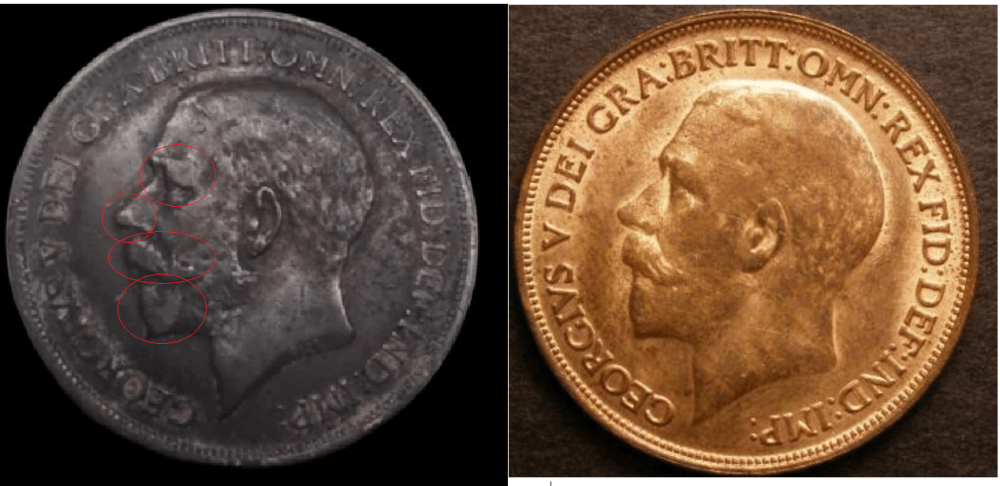
-
More Pennies
absence of uniformity replied to Prax's topic in British Coin Related Discussions & Enquiries
For me its all about the top curve of the ear, a thin defined line broken tooth or not, with overall wear to coin or not. The top curved part of the ear looks rounded without any flat spot. You can clearly see flat worn areas on this coin but the the top curved part of the ear remains thin and defined. Coins listed as uncirculated which are not recessed ear types dont have the definition to the top part of ear. For me thats the easiest way to know with or without a broken tooth.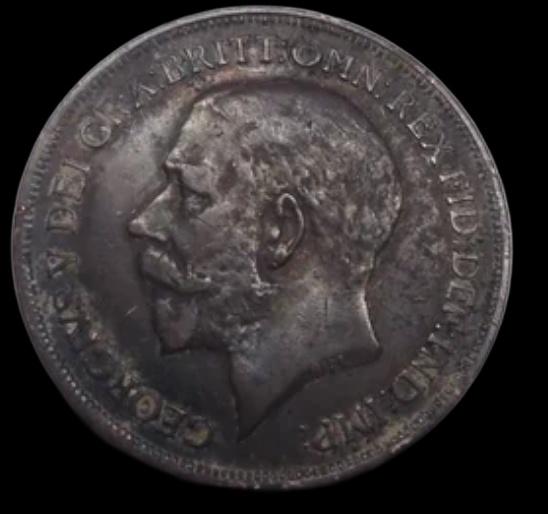
-
Thank you
-
D of DEI?
absence of uniformity replied to absence of uniformity's topic in British Coin Related Discussions & Enquiries
Thanks Rob, I managed to get a new set of images of the coin and infact the apparent difference in the 8 were because of the poor images and way the coin was photographed. In the new images the 8 looks normal. I did go on to look at the the silver Florins and become quite interested in the series. Interestingly over 50% of the Florins I have looked at for sale were listed incorrectly which leaves hope to find something rare misidentified. I found a 1879 42 Arcs no die number/WW listed as a different year. -
Looks to be a decent sharp strike when looking at other sold examples on LCA. I can see what roughly these grade coins have sold for but Im interested to hear opinions. Thanks
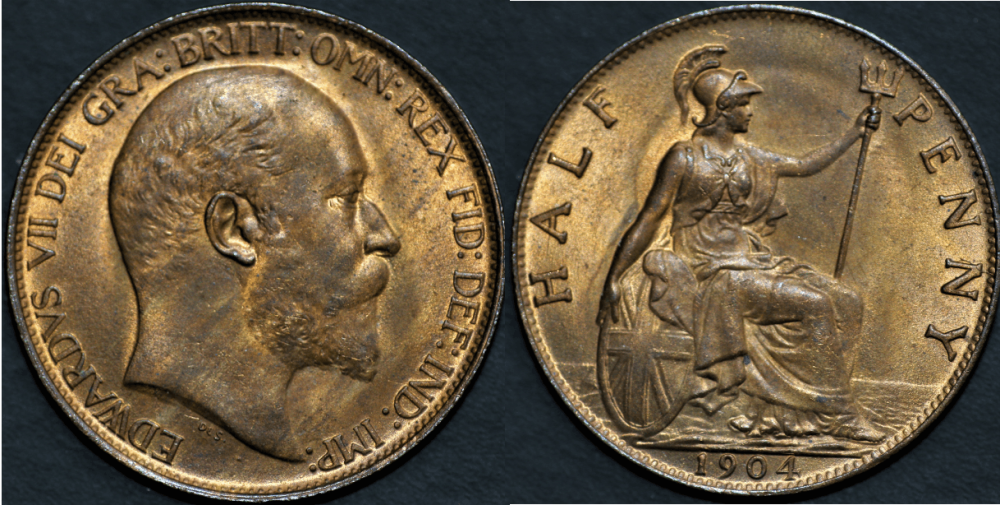
-
What is your thoughts EF or better? I think it probably is slightly better. The coin is not needed for my collection, it was purchased as part of a lot to obtain another coin in the lot. Im looking to sell this one to purchase other coins I need. What would be a fair price please to list this coin to sell. Thanks
-
More Pennies
absence of uniformity replied to Prax's topic in British Coin Related Discussions & Enquiries
How do you think the edge of the die clashed almost central? Are the two dies not on a fixed axis?
.png.b8d5d892c0585e7171c66a7406a129bd.png)