absence of uniformity
-
Posts
358 -
Joined
-
Last visited
-
Days Won
7
Content Type
Profiles
Forums
Events
Downloads
Store
Gallery
Articles
Everything posted by absence of uniformity
-
 Thanks alot ! I have asked if they will sell upon approval, also asked for extra images. Not sure if you remember the coin in the attached imaged but when it arrived the apparent crossbar of the T was nowhere to be seen?? Reminds me of that...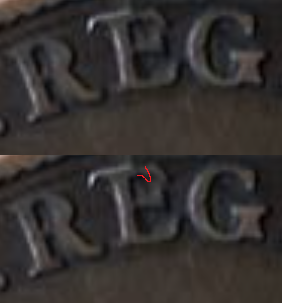
-
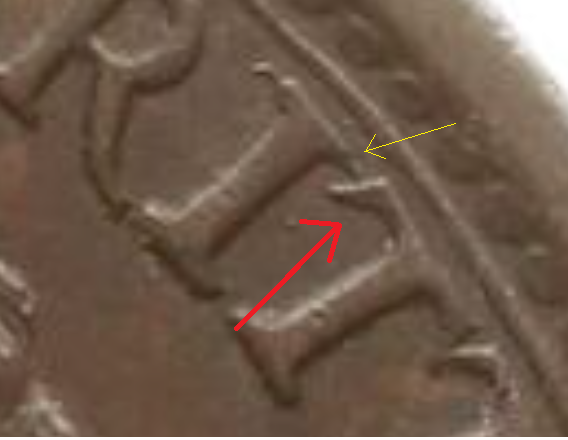
One last detail, at the very tip of the red arrow there is a possible faint outline that could represent the right serif of the T. The tip of the yellow arrow marks where the I serif should stop and there also appears to be a faint line.
-
The imagination is running wild now I know; if a mint worker went to repunch the T using a T punch and suddenly realised at the last moment the punch wash infact over the I and the punch was struck partially could this little visible flaw be the result of that? I know all too well using a metal punch when marking base metal objects with my makers mark if the force is not right and the punch is not perfectly square to the object half of the imprinted mark is often missing.
-
Its quite expensive, the coin is for sale so I dont have it in hand and the images are all thats availible. The penny is from the 1870s, not a rare pairing. For the price of over 100 there is no luster and the coin is not anything special in my opinion. Concerning location of the serif I made a layered image Jerry to show the serif is actually quite close in terms of location. If I had the coin to hand I could look closely and take macro images. Thanks for the input so far.
-
Thank you for the response it's frustrating this type of enquiry ofcourse I have a hopeful imagination but also have learnt things are more often than not what they seem.
-
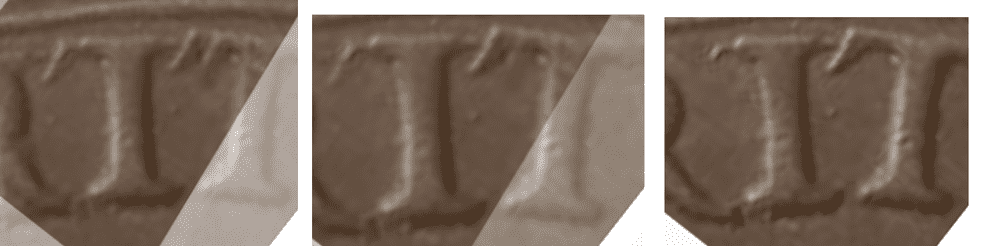
In the attached image I have rotated the image and layered the T over the I from left to right I have faded out the top layer with T becoming more transparent from left to right.
-
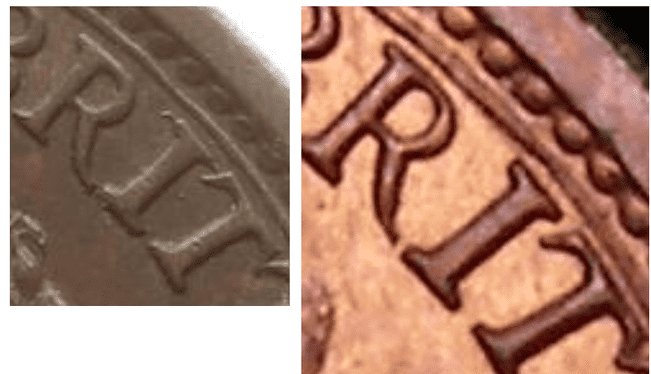
Here I attached an image of coin with what I think is the same pairing note the top right serif of the letter I does not extend far also shown in image is the coin in question for comparison. None of the coins I have looked at for the same pairing show the top right serif of the letter I extending and almost touching the T.
-
The coin is a Penny, and for the year there is no listed I/T listed from what I can see.
-
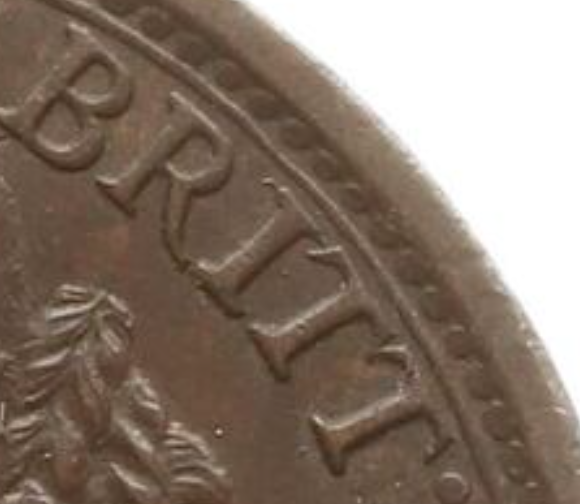
Please dont feel I'm relying on the opinions shared here to make a decision to buy, I'm not. I'm simply asking what others think; I dont think it is I over T but the truth is I dont know ! What do you think? In the image attached there appears to be a what looks like a crossbar extending left of the I. I would appreciate hearing what you think. The only reason I'm not sure the tip of the crossbar shows a similar angle of the serif of the T also the crossbar possibly appears to extend to the right of the I. Thanks
-
Its a shame I didnt copy the initial interaction because I called it out, AI was claiming the die flaw to the forehead was not uniqe to Obv 5, then I said The flaw is unique to 5 and AI bactracked and said yes you are correct I made a mistake lol. I realise I am feeding into to algorithm I'm pretty anti AI but over the last few weeks I have tested it on a few different subjects and mostly the information is incorrect in real world facts. It will hash together what it thinks you want to hear. Rather than stating I dont know.
-
I put the question to AI, why only a few hundred 5+G are estimated to remain and pressed AI for the reason. the text above is what was regurgitated. Use it at your peril, very often the information is incorrect. Hence me asking how likely that information is accurate.
-
How accurate is the following likely to be ? The exact reason so few 1861 5+G halfpennies were struck comes down to a strict "mismatch timeline" in the Royal Mint's production logs. To understand why this specific pairing is an anomaly, you have to look at the overlap—or lack thereof—between the active lifespans of Obverse 5 and Reverse G in 1861. The Royal Mint did not deliberately manufacture a single "5+G" layout. Instead, they were rapidly testing minor design variations to see which steel dies could withstand the brutal physical pressure required to stamp hard bronze. Obverse 5 was an extremely brief experimental design featuring 15 leaves in Queen Victoria's wreath. It was phased out almost immediately in early 1861 in favor of the much more durable, standardized Obverse 6 (which features 16 leaves). Reverse G was an intermediate, short-lived design choice where the mint engraver, Leonard Charles Wyon, experimented with completely omitting his "LCW" initials from the base of the rock. Because the Mint was facing a massive backlog to replace millions of old copper coins, press operators on the factory floor did not stop production to wait for matching dies when a fracture occurred. They paired whatever functional dies were sitting in the spare inventory racks. [1] The 5+G pairing was a complete accident. It happened during a tiny micro-window of time when an obsolete, left-over Obverse 5 die was pulled from a bin and matched with a newly prepared, short-lived Reverse G die. The definitive reason the numbers are so low is catastrophic die failure. When these two specific pieces of steel met on the factory line, one or both of them cracked or shattered almost immediately under the pressure of the coining press. [] Rather than a sustained minting run, the 5+G is essentially a record of a production run that lasted mere minutes before the machinery was halted to replace the broken components. The technical crisis regarding "die shattering" is well-documented in Royal Mint archives from the Great Bronze Recoinage of 1860. [] Mint Master records from the time note that switching from soft, pure copper to the harder, durable French bronze alloy (95% copper, 4% tin, 1% zinc) caused an unprecedented spike in broken equipment. [] The steel dies of the era frequently developed catastrophic stress fractures. This confirms why the Mint was constantly tweaking the thickness, borders, and leaf counts (like the move from Obverse 5 to Obverse 6) to find a design that wouldn't shatter the steel. [1] During the Victorian era, coining presses were entirely mechanical. Operating logs indicate that when a die fractured, the priority was minimizing down-time to meet massive production quotas. [] Because the obverse and reverse dies are entirely separate pieces of steel fitted into a mechanical press, operators regularly substituted any working spare die that would physically fit the machine to keep it running. The absolute lack of a uniform "5+G production log" coupled with the tiny handful of surviving physical examples proves that this pairing was an unintended transition—an emergency factory-floor substitution rather than an intentional batch design
-
Interesting information thank you. Other than tonnes of coins being lost at sea what other possible explantion could explain very little remaining examples left today?
-
Thanks for this info. Is there images online of the F over P in F.D do you know? The F over P in HALF looks like a die flaw to me just a blob/apostrophe of metal making the F look like a P. I was wondering if 1861 5+G F2755+G F over P in F:D: ?R20 Is a clearly defined P? Thanks
-
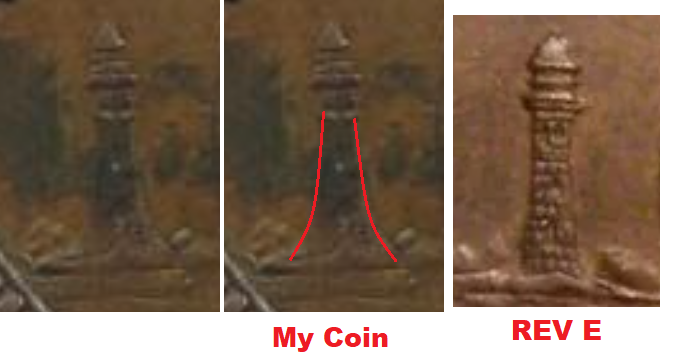
Without knowing for sure if the coin has the flaw on the obverse but the lighthouse doesn't match that of G I'm thinking its probably E?
-
Do you think this to do with the change over from copper to bronze? And the difference hardness in the metal? Thanks
-
That a nice really nice example, its interesting mine doesnt show any of the die cracks and the flaw on the forehead less pronounced on yours? If its R16 does that mean all the obverse 5 coins come from the same single die? Surely if multiple dies were in use more coins would of been struck? Its also surprising a die would deteriorate after only strikng a 100-200 coins.
-
Ok thanks, according the Richards site there is also 1861 6+E F2766+E 1st 1 over 1 I dont think you are seeing things, the date alignment is what caught my attention initially. There appears to be some doubling on E and Y of penny aswell.
-
I'm not sure I think it is G the coin I have by the difference in the shape of the lighthouse, also reverse E has L.C.W above the 8 & 6 in the date. From what I can see the ace of clubs to the left of lighthouse is on G and not E. The rock to the right of the lighthouse on my coin is different and appears to match better with G.
-
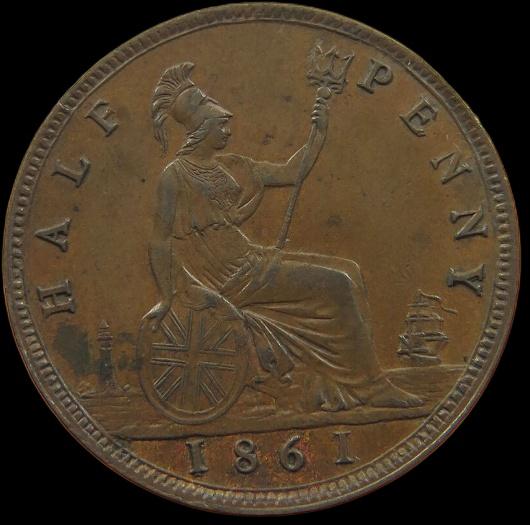
On the LCA website I just found an example of 5+G that appears to show the 1st 1 over 1, but the coin was not listed as such. Of the 51 to 100 known surviving specimens that is potentialy two of this minor die variety that exist.
-
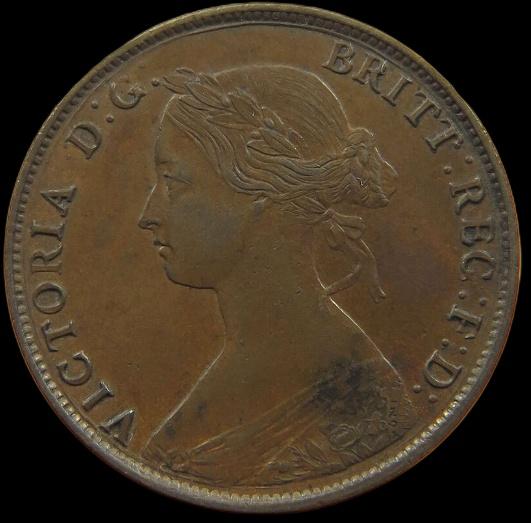
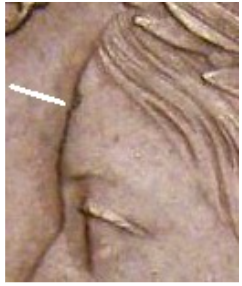
Here is the coin in question; The die flaw leads me to beleive its Obverse 5. The only two reverse options for a obv5 coin is E or G and the lighthouse does not match that of a Reverse E. The images show the flaw on the forehead and the lighthouse of Reverse G and the 1st 1 over 1.
-
Hi, Can I ask please; (I have tried myself to find the awnser without success) Can anyone please confirm whether any other obverses show the die flaw shown in the attached image in the halfpenny series? I have taken the image from @secret santa website, thanks again for this great source of info. I found a halfpenny which I think is 5+G die paring the coin also appears to show 1st 1 over 1. 5+G is listed as R16 but I cant find reference to this pairing showing the 1st 1 over 1. The coin looks to be in ok condition, slightly rarer pairing with the added bonus of the 1st 1 over 1. Thanks.
-
Its come a long way already, I have been leaving the coin in direct sunlight with fresh air flow sat on a manilla envelope. In less than 6 months it has already taken on alot of toning.
-
Thanks ! In the hammered coinage there must be some varieties that command the higher premiums? For this coin I think it was mostly right place right time with alot of luck. It kind of fell into my possesion. Initially I did not find the variety, I found the coin then researched the varieties for the type. This was my first find and possibly the best to date.. You can see why and how I become totally consumed by penny varieties. Then shortly after the 1877 F90. Since then I have found many decent coins but not quite of the same calibre of those two. It was enough to be hooked for life and invest more time to learn all I can. I feel now I have run out of avenues for prospection, I find myself looking over the same coins for sale.