
Coys55
-
Posts
170 -
Joined
-
Last visited
-
Days Won
11
Content Type
Profiles
Forums
Events
Downloads
Store
Gallery
Articles
Everything posted by Coys55
-

A Dodgey 1927 Florin.
Coys55 replied to ozjohn's topic in British Coin Related Discussions & Enquiries
It does look a bit odd now you mention it. The lines under the eyes and BM don't look quite right either. Here's the link: https://www.ebay.co.uk/itm/267686864594?_trksid=p4375194.c102726.m162918 Does seem a strange one to copy though. -
A Dodgey 1927 Florin.
Coys55 replied to ozjohn's topic in British Coin Related Discussions & Enquiries
Isn't it a case of "that's neither superb nor a proof" rather than a repro? -
Post-1752 Maundy coins were never intended for circulation so they are usually in good condition.
-
Can you crop the original photo to the area of interest and then compress the smaller area to 500kb if necessary? The freeware irfanview will do the job very well.
-
Ah, sorry. I don't think it's a 5 either TBH.
-
I'm not entirely sure what you are seeing, but it's not an H if that's what think it is. Or the face of Jesus either.
-
Isn't it a brockage?
-
Comparing it to my pair of 1844 crowns I'd say that's the top part of a cinqfoil. The star is larger and goes almost to trhe top of the N and I whereas the cinqfoil is smaller and goes about halfway up the letters.
-
Is the stop after TUTAMEN any clearer?
-
Charles II (1st bust) 1 Crown How would you grade this?
Coys55 replied to Citizen H's topic in Free for all
It was probably part of an early attempt at decimalisation, with the florin (1/10 of a pound) being introduced in 1849. The intention may have been to replace the crown with the DF, but it didn’t quite work out. -
D of DEI?
Coys55 replied to absence of uniformity's topic in British Coin Related Discussions & Enquiries
If that was my question I would have given that answer a haha, but I guess not everyone shares my sense of humour. -
Congratulations on finding a good one! Even if it was accidental.
-
I’m afraid not, but I’m really not an expert on these penny varieties. I am interested though and will go through my own old collection of bun head pennies at some time just in case.
-
Thanks for posting the image. I agree that there’s nothing there, but see where you thought it a was.
-
If you wanted to be really fussy a full set would include the 1887 Arabic 1 and Roman 1 variants and the 1888 and 1889 Inverted 1 (or is it a die-filled normal I serif or broken punch?) for second I in Victoria variants. All three variants are listed in Spink so I think it's reasonable to include those in the set. I did anyway...
-
There are a lot of fakes around so I wouldn't touch a wreath crown on eBay these days. Prices at auction are generally lower anyway, even allowing for the add-ons and postage. The last two I bought were a 1928 and a 1931 from lockdales in 2021.
-
Several of the his claimed discoveries (e.g. the 1875H and VIGTORIA pennies) have turned out to be not what he thought, so maybe it's just newbie enthusiasm.
-
1862 VIGTORIA??
Coys55 replied to absence of uniformity's topic in British Coin Related Discussions & Enquiries
Yes it is. A search threw up three others sold by London Coins in 2019/2019 (both auction #167) and 2017 (aution #156), all in significantly worse condition but with clear G. -
1862 VIGTORIA??
Coys55 replied to absence of uniformity's topic in British Coin Related Discussions & Enquiries
Here's a definite Vigtoria. I don't think your G looks the same, even allowing for the condition. Compare it to the two Gs in D.G. and REG on "your" coin and I think it's pretty clear. Personally I think the seller saved you £6.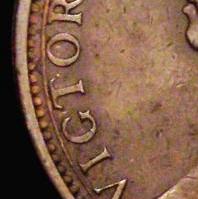
-
Looks more like a 10cf to me. Definitely London.
-
Looking forward to seeing this.
-
I find it interesting that we'll argue for days whether a letter is pointing at a tooth or gap or if a tide is high or low on a penny, but no one is interested in Victorian die numbers, which are as clear as day and surely worth studying and would throw up new and possibly unique dies. Some of the money paid for what seems like tiny and obscure penny varieties really astounds me. We're a strange bunch, and I include myself in that statement; I'll spend ages identifying the die pairing on a Rhuddlan cut half, or even a quarter, and could easily get interested in said penny varietes, but I have no plans to do so. Yet. I think I'll steer clear of the die numbers too TBH. Hmm, there's a lot of die number shillings on ebay... 🐰
-
Oh yeah. I missed that.
-
Is it just me or would the "low tide" P point more at gap than a bead if the arrow was drawn as close to the edge of the P and as straight (rather than at a slight angle) as on the "high tide"?
-
I'll go with class 9b too; the unbarred Ns (I don't think they are pothook) are disinctive. Also not my main field of interest or expertise, although I did somehow end up with 35 or so of the things and a copy of the Galata Guide. Post as many short cross (including cuts) as you like and I'll have a go though.