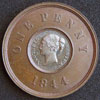
King Kenny Posted Saturday at 04:12 PM Posted Saturday at 04:12 PM My Grandad had this penny in his draw since the 1960's. Because of the date, 1945, he thought it was an attempted German forgery. We always know it as Fred's tin penny. 1 Quote
Rob Posted 4 hours ago Posted 4 hours ago On 9/19/2026 at 4:28 PM, absence of uniformity said: If the above is correct and the surface of the coin did dissolve at an equal rate the stress lines? would not become visible, because the metal above the stress lines is flat and the erosion would simply eat through the thickness and the lines around the rim would not appear, I cant see a reason why acid would treat metal differently. Who knows about chemistry and can explain why acid would dissolve metal faster with different characteristics in the underlying metal? If you consider what a flan is, there is an underlying crystalline structure based on the metal in question. At the atomic level, the atoms are connected by well defined structural links via shared outer electron pairs. In a perfect piece of metal with no inclusions, this would be consistent across the entire surface. However, at the next level up, the surface is disrupted by metal flow when struck leaving small sub-micron cracks. A crack is a crack and therefore will allow a greater surface area to be exposed to any reactant. One thing I have noticed with seriously corroded coins at the date for example is a 'moat' around the digit where the metal has been more rapidly removed than one might otherwise expect. I acquired and sold one 20 years ago, but can't find the image. This I would explain by the cracks allowing the reactant to penetrate the metal and so lead to increased metal loss at these points. To compare with toning, which is only another form of altered metal surface, not involving metal loss, you regularly see more toning around the relief detail. Again, I would put this down to the stress cracks allowing greater reactivity with the atmosphere. eg. see below. It is posted elsewhere, so apologies, but does demonstrate my theory very well. If metal is going to react, it doesn't matter much whether the fluid is a liquid or a gas, as both will cause some effect if chemically possible, just the rate and effect will vary. 1 Quote
Coinery Posted 14 minutes ago Posted 14 minutes ago My thoughts on the German forgery is that I reckon they had bigger fish to fry in 1945, than to bother themselves with bronze pennies Quote
Recommended Posts
Join the conversation
You can post now and register later. If you have an account, sign in now to post with your account.