
Martinminerva
-
Posts
549 -
Joined
-
Last visited
-
Days Won
32
Content Type
Profiles
Forums
Events
Downloads
Store
Gallery
Articles
Everything posted by Martinminerva
-

1863 One Penny Help?
Martinminerva replied to DaveyJones's topic in British Coin Related Discussions & Enquiries
It is most definitely a die number 4, and therefore one heck of a find. Michael Gouby in his latest penny book reports that 15 of this die number are known (so now 16, I guess!), which is the most "common" of all the die numbered 1863 pennies , but nevertheless there'll be a lot of people on this forum well impressed - me included. He values them at £600 in fair and £1250 in fine, so I would think this one out of the ground and in about fair condition might be worth £500 or so. But if you put it into auction, you never know what might happen if two ardent penny collectors battle over it - and there's every chance of that given some previous auction results. Well done!! -
1881 Penny 9+M?
Martinminerva replied to bronze mad's topic in British Coin Related Discussions & Enquiries
Looks very much a 9+M to me. Diagnostics are the CONVEX - actually - shield (yes, Freeman has got it wrong here) and the seven border beads inclusive between the 2 colons in D : G : - Obverse 11 which is the usual one paired with the mint mark has 8 border teeth here. The H mint mark only occurs for 1881 on reverse M, so unless it has been doctored ( just occasionally H 's can be cut off other coins and stuck on new ones - London Coins sold an "1875H" narrow date penny last sale where that was exactly what had been done, as genuine 1875 H pennies always have a wide date), you have made a very rare find indeed. Gouby (yes, a brilliant book and well worth getting, even if I say so myself (I get a quick credit in his acknowledgements!)) records it as number BP 1881 Ga and his die pair is M + p, and states that only 5 are known, so yours will be a sixth - well done indeed! He gives a value of £120 in fair, which actually seems a little low to me given its rarity. Just check out the H with a good eye glass first!! -
Can anyone paste in what it says, out of interest? I don't have that Feb issue...
-
I'm now attaching a bigger and better resolution image of 1853 groat a from my previous list (attachments were in reverse alphabetical order for some reason!). Do people really think it is a proof? The border beads are significantly doubled in many places and some of the legend letters are doubled/ghosted too. I would have said this was the best bet for a currency specimen due to the dodgy standard of strike. It is milled edge, upright axis like currency specimens (though some proofs have this too of course).

-
Here are the four 1853's that I have culled pictures of from ebay over the last 10 years or so (reverses only, I'm afraid). 1853 groat a displays that same "bulbous" 5 and damaged/repaired 3 as I mentioned above, yet would appear to be a currency specimen: some of the beads are heavily doubled - and indeed so are some of the letters. I suppose a proof die could then be put into service afterwards for currency strikes? 1853 groat b certainly looks currency! But I guess both of these first two could be heavily circulated proofs? c and d would seem to be proof, albeit c rather toned. Does this help, or confuse the issue?! (by the way, they seem to have been attached in reverse order d, c, b, a. !!)


-
Very interestingly, the last one of the three examples has a markedly diiferent font for the digit 5 from the other two (with an 'indented' top bar, squatter shape and more bulbous loop, exactly like the 5 in the rare 1852 groats), and also the 3 seems to have been repaired/repunched extensively, especially in the top loop. Would a proof display such a poor repair?
-
And for that matter, has anyone ever seen / got a picture of a definite 1843 over 53 (or 4 over 5) groat?? Catalogues suggest not much premium over the standard date, but I've been looking out for this overdate for ages and am yet to see a convincing specimen!
-
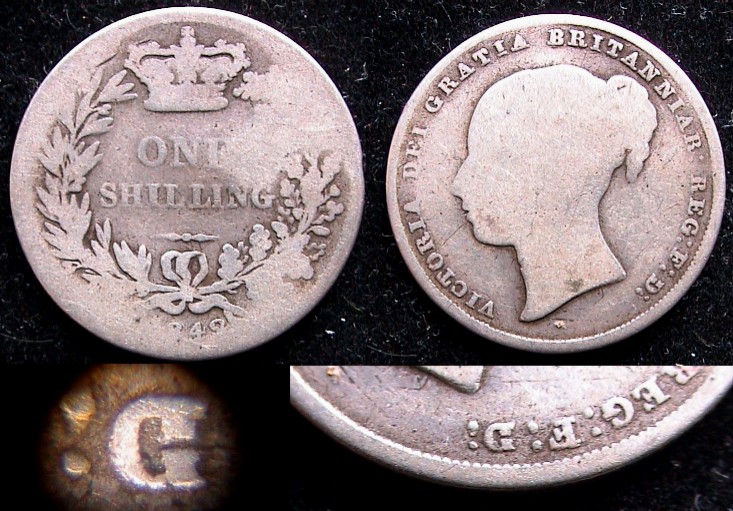
1842 Shilling with Inverted G over D in FD
Martinminerva replied to Martinminerva's topic in Confirmed unlisted Varieties.
Here's another angle which I think shows the D and G curvatures better; there is a distinct change in the width of the curvature about two-thirds of the way down the "G", perhaps a sign of where the repair punch was located? Additionally, I have just noticed that the lower colon (or "top" one, the way the picture is orientated) has clearly been re-entered. This is clear on all the pictures, so would suggest to me indeed is is a blundered repair. If it's not a G, what is it?!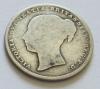
-
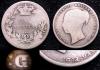
Here's a new one to me: an 1842 shilling with the D of FD repaired with an inverted G punch. I know of the rare 1857 inverted G variety with a similar repair, but have never seen it on another date. It seems to be a repair, rather than an error: it is not very clear from the pictures, but the underlying curve of the D can be detected beneath the new curve of the G, and the "top" serif of the G (ie. the original bottom serif of the D) is much thicker than the original. Anyone seen one, or got a picture of one in better condition? Shame this one is so worn, esp. on the reverse!
-
London Coins Auction 128 (Jul 2010) Lot 1738. Thanks for that info, Nick! £140 hammer price for the Unc specimen there sounds like quite a bargain someone got! Anyone got another??
-
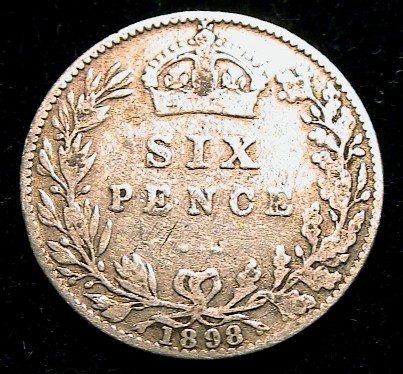
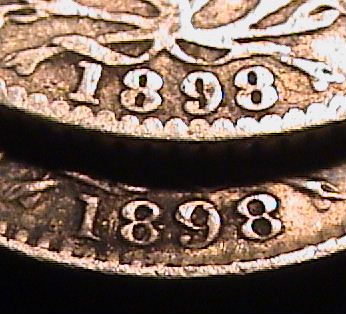
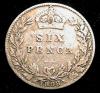
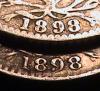
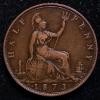
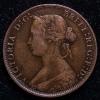
In Peter Davies' British Silver Coins book, he declares that all 1898 Victorian sixpences have the date in larger figures than all the other veiled head years. Indeed, until now all those I had ever come across had the larger figures, though I do vaguely remember reading somewhere that at long last a specimen with small figures had turned up (anyone remember where that was?) Well, another one has turned up - please see the images. Interestingly, as well as the smaller digits, the 1 of the date is over a bead, rather than a space as is usual on the larger figured specimens. Worth recording?
-
Getting quite common now lol.....Your example has some old cleaning MartinP, or do we call you Mr Platt? Not convinced it does, actually - in the hand it seems more like just genuine circulation wear and thus rubbing to the high spots. I don't understand the Platt reference at all, I'm afraid... Who's that?? Ain't me!
-
?? Dracott, not heard of this reference before David Coin News, April, May and July 2004. Quite interesting and detailed study! Cheers.
-
I have since tracked down and obtained the Dracott articles and can now spot reverse C# with ease! (narrower lighthouse, P and E of PENNY in particular closer to the linear circle etc.) I have also recently obtained a specimen of the pairing 7+C#, which makes two of them known now, and it is in pretty decent condition - pictures attached. I also know of 4 more examples of the 8+C# pairing, which brings their total to at least 9. Do both pairings now warrant some sort of official recording somewhere? I wonder how many more specimens of either pairing are out and about, but as yet unidentfied?
-
I am afraid I am showing my ignorance here, but how does your Reverse C# differ from Freeman's Reverse G? Can you give me any specific pointers for me to be able to use your two detailed scans to differentiate them from what I believe I have in my collection which is the common Reverse G? Thanks.
-
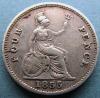
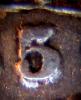
I have recently come across this 1855 groat on which the final 5 seems quite clearly to be over a 3. As far as I can tell, it is unrecorded. I am aware of specimens on which the final 5 is double entered over a lower 5 (indeed I have one of those too), but this specimen seems unequivocally to be over a 3 as the diagonal down-bar is very evident. The lower "bulb" of the 3 is clear too, and different in shape and position from the double entered 5 that seems more common. Do you think this IS a 5 over 3?? Does anyone else have one in better, clearer condition? Does it merit being recorded as a hitherto unknown variety?
-
1819 George III sixpence T of BRIT over B
Martinminerva replied to Martinminerva's topic in Confirmed unlisted Varieties.
Indeed it is, most pronounced on the 9 which is over another 9. The same is true of my specimen. Also there is a die crack running up through the 9 to the head on both specimens. Perhaps the combination of these flaws means that the die was discarded before many specimens were struck? -
1819 George III sixpence T of BRIT over B
Martinminerva replied to Martinminerva's topic in Confirmed unlisted Varieties.
I've seen another. Alex Anderson had one slabbed by CGS in UNC at the Harrogate Coin Fair recently, but I don't know what grade number it was given. That was obvious too from a distance. I've tracked this one down - It is currently for sale by Certified Coins Investments Ltd (www.cci-uk.biz), slabbed by CGS as Unc 80, on sale for £625. Their website doesn't currently have an image of it available, unfortunately. So how many do exist, and what might my one be worth in its rather sorry condition, albeit as only currently the second recorded? The image is now available on their website. Obviously much better than mine, but are these the only two known so far?


-
1819 George III sixpence T of BRIT over B
Martinminerva replied to Martinminerva's topic in Confirmed unlisted Varieties.
I've seen another. Alex Anderson had one slabbed by CGS in UNC at the Harrogate Coin Fair recently, but I don't know what grade number it was given. That was obvious too from a distance. I've tracked this one down - It is currently for sale by Certified Coins Investments Ltd (www.cci-uk.biz), slabbed by CGS as Unc 80, on sale for £625. Their website doesn't currently have an image of it available, unfortunately. So how many do exist, and what might my one be worth in its rather sorry condition, albeit as only currently the second recorded? -
Mentioned in just about all the reference books and CCGB is the 1843 britannia groat with the 4 over a 5. I've been looking out for one for ages to no avail, yet catalogue values give it little or no premium over the plain 1843 groat. Does it actually exist? Has anyone got one? Can anyone post a picture of one? Replies awaited with interest.
-
Here's a new overstrike that I've not come across before: The coin is a George III sixpence of 1819, but with the first T of BRIT clearly struck over a B. The coin is only in fair condition, but the overstrike is very visible. Has anyone come across this before, or maybe check your sixpences to see if another specimen is out there! Does it merit being recorded as a hitherto unknown variety?
-
1693 shilling 3 (not 9) over 0 or 6. Unknown?
Martinminerva replied to Martinminerva's topic in Confirmed unlisted Varieties.
On further research, I see in the Coincraft Catalogue of 1995 that there is reference number "WMSH-025 1693 shilling with 3 over inverted 2". Is this it, then? That might well answer why there is no extension of the underdate to the right of the 3, as the inverted 2 (picture attached for comparison) would not have one! So how rare are these? My one and those two on ebay, but I expect there will be many more? Can anyone provide a picture of a high grade one to answer things conclusively?
-
1693 shilling 3 (not 9) over 0 or 6. Unknown?
Martinminerva replied to Martinminerva's topic in Confirmed unlisted Varieties.
Would you believe it - there's 2 of them currently on ebay, both in better nick, and both looking very much like the 3 is over a 6!!! Paste these into the web browser: http://cgi.ebay.co.uk/ws/eBayISAPI.dll?Vie...=ADME:B:SS:UK:1 http://cgi.ebay.co.uk/ws/eBayISAPI.dll?Vie...=ADME:B:SS:UK:1 Perhaps it is not so rare a variety, and perhaps it deserves recording?! I'll try and paste pictures in too...

-
1693 shilling 3 (not 9) over 0 or 6. Unknown?
Martinminerva replied to Martinminerva's topic in Confirmed unlisted Varieties.
It is hard to be certain about the scale of the under-strike, if any, due to the poor condition of the coin, but it appears to be of the right proportions to be a 6 or a 0. I attach a larger photo of the figure and a scale drawing of what I believe is visible. The outlined part is the actual 3, and the solid black is what may be the underdate. Like you say, this is very clear to the left, where a curved (and raised – so incuse on the die) limb peters away to little or nothing, but to the right it is much less obvious. I honestly can’t tell if my solid black part to the right is just part of the curve of the 3 and so purely conjecture and imagination on my part, or part of the curve of a 0 or a 6, mostly erased from the die. The little indent is interesting, though. How wide is your 3 at this point, compared to mine if you enlarge it to the same scale? That might help ascertain if there is anything there. Like you, I would plump for a 6 rather than a 0 from the fact that that digit occurs in the date already, and the fact that the 6 is pretty much the same as a 0 in size and shape but for its little tail. We really need to find a much better condition one, if possible! Is there anyone out there with one?

-
1693 shilling 3 (not 9) over 0 or 6. Unknown?
Martinminerva replied to Martinminerva's topic in Confirmed unlisted Varieties.
Here's another picture of the 3 on mine, which might just hint at something on the RIGHT hand side of the 3 - there appears to be a little gap halfway up the bottom curve where the original 0 or 6 might leave the course of the 3 over it, but has been almost entirely erased from the die before the correct digit was puched or cut in, but that may well just be imagination or a nick on such a worn coin. It would be very interesting to see if someone has another specimen similar, but in much better condition...