
jelida
-
Posts
1,898 -
Joined
-
Last visited
-
Days Won
115
Content Type
Profiles
Forums
Events
Downloads
Store
Gallery
Articles
Everything posted by jelida
-
Interesting metal detecting finds
jelida replied to George111's topic in Nothing whatsoever to do with coins area!
Nice to see with the retaining wires and leather. Sometimes leather and even cloth survives when intimate with copper alloy, protected from bacterial or fungal action by the leaching copper salts, I have several mediaeval examples. Jerry -
Sadly probably true. ? Jerry
-
1909 2 + E penny now there are 16 !
jelida replied to chrismalvern's topic in British Coin Related Discussions & Enquiries
Very nice, better condition than many too, well done! Jerry -
Well done Prax, I see the coin sat long enough on Ebay USA to be re-listed, and none of us spotted it! Well spotted Richard, you are right . Exciting! Jerry
-
The images for 2354 and 2360 have been transposed. Jerry
-
I think this guy is using stolen images. This one is from Accumulators website. http://www.ebay.co.uk/itm/1895-penny-/172111348079?hash=item2812a2c16f:g:GCYAAOSwDuJWy5hr Jerry
-
Sorry Rob, I did realise what you meant, just surprised he didn't think it was Richard III. Jerry
-
Likewise?
-
I'm sure he's breaking all sorts of Ebay rules for doing the right thing! Good for him. Jerry
-
Interesting metal detecting finds
jelida replied to George111's topic in Nothing whatsoever to do with coins area!
do this in the animal doctoring book that belonged to my great-great-grandfather! I had always been curious about how the balls were screwed onto the horns, and it sounded like this method would really work. The book (printed in the 1880's) says to bake two large round potatoes, until they are not quite as done as you would like them to eat. Stick a hot potato on each horn, and leave them there until the potato cools down some. (10 minutes?) The hot moist potato sort of steams the horn, to soften it. Then you take the hot potato off the horn, and screw the threaded brass ball on as tight as you can with pliers. According to the book, it will never come off. If you try this, I want to know if it works as neatly as they say it will. Here is a description from the 1880's of how to fit them. Jerry -
Interesting metal detecting finds
jelida replied to George111's topic in Nothing whatsoever to do with coins area!
http://oxhilldevons.com/2012/05/03/tutorial-fitting-horn-knobs/ Here is a tutorial on fitting the modern equivalent, and there is so much more on the net including old catalogues. It seems so appropriate that I should be debating knobs with you, Flash.? Jerry -
Interesting metal detecting finds
jelida replied to George111's topic in Nothing whatsoever to do with coins area!
https://finds.org.uk/database/artefacts/record/id/194362 They are actually fairly frequent and well known finds Flash, have you never found one? Totally unlike any knob or draw pull, with the coarse large diameter internal thread designed to be screwed onto a cow horns to protect man and beast alike. Plenty shown on the net. The general design is very consistent, though as George says there are some stylistic variations. Jerry -
Interesting metal detecting finds
jelida replied to George111's topic in Nothing whatsoever to do with coins area!
No, its not a livery button; doesn't display a livery for a start. But its not a sword pommel, their form has been well studied . I agree the taper does suggest something slotted into it; I have seen these in the past but I cant remember where at the moment. That's a nice horn guard its resting against. Jerry -
Interesting metal detecting finds
jelida replied to George111's topic in Nothing whatsoever to do with coins area!
Why do you think that, George? I note that it was fixed at the periphery by two iron screws or rivets, leaving a rectangular recess under. It has a Rococo style foliage design once silvered, both features suggesting an 18th century date. I wonder whether a strap guide is more likely. Jerry -
Interesting metal detecting finds
jelida replied to George111's topic in Nothing whatsoever to do with coins area!
http://www.surpluswarrior.com/military-gas-can-cap/#PhotoSwipe1455554394325 -
Interesting metal detecting finds
jelida replied to George111's topic in Nothing whatsoever to do with coins area!
You are being fanciful again, George, there is nothing to suggest that this is any kind of brooch or clothing fastener, and everything to suggest a utilitarian function and age of less than 150 years, the patina suggests brass and the manufacture appears modern. The only 'wear' I can see in the photo is to the patina, and has nothing to do with pre loss useage. I have not found an exact parallel but you can see a jerry can lid of similar form below. Jerry -
Interesting metal detecting finds
jelida replied to George111's topic in Nothing whatsoever to do with coins area!
Looks far too heavy for jewelry or clothing fitment. I think the indents may be to allow the fingers to get a grip on the ridge, and that it is some sort of locking cap. There are similar but not identical images on the net with radial arms. Could prove quite collectible if off a vehicle. Jerry -
Interesting metal detecting finds
jelida replied to George111's topic in Nothing whatsoever to do with coins area!
Nice early weight, not a coin weight but a trade weight, cant find the book at the mo but I think the shield dates from the Commonwealth period. Jerry -
Interesting metal detecting finds
jelida replied to George111's topic in Nothing whatsoever to do with coins area!
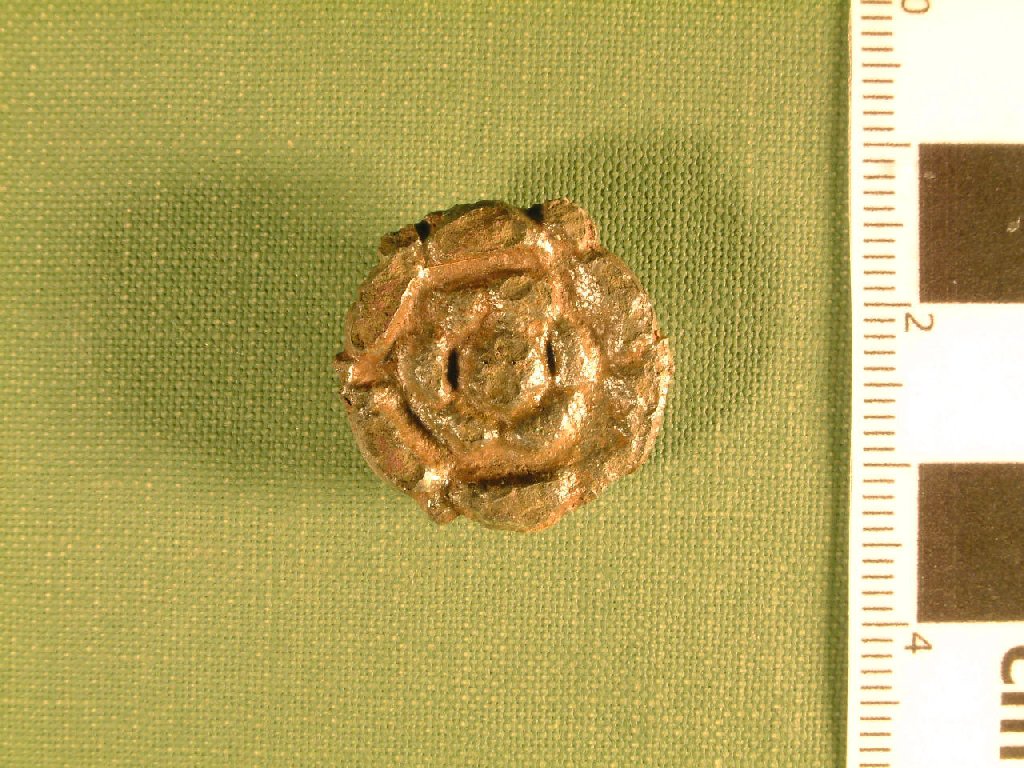
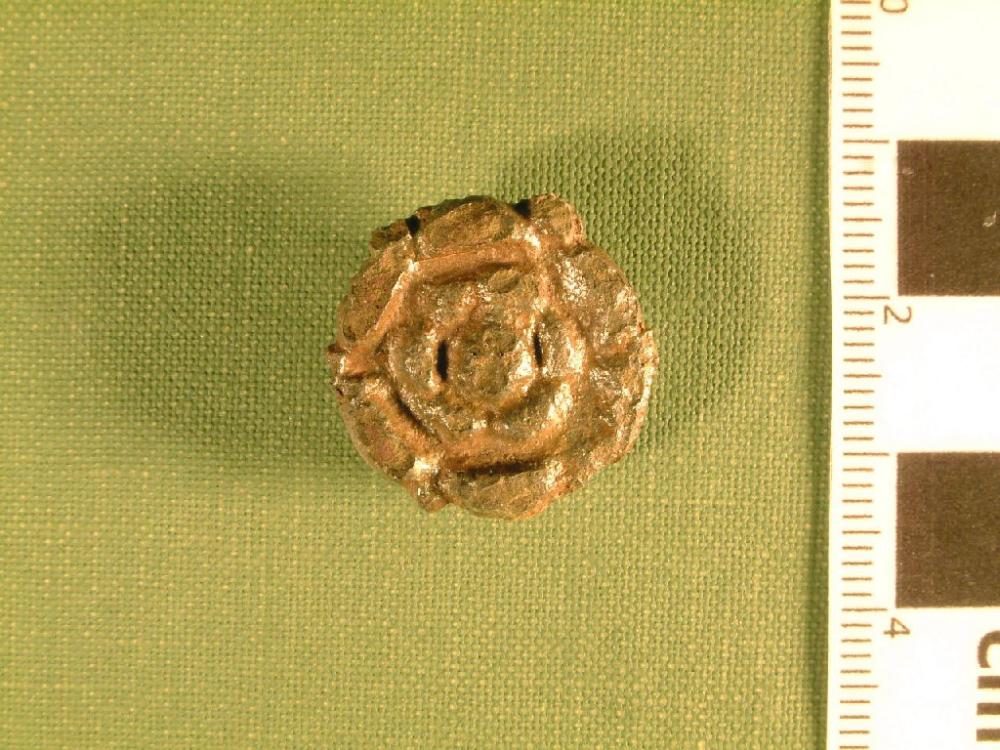
I really cant give an id on the pin, though it looks too thick to be from a brooch (though again a scale would help). Here are a couple of harness decorations..thumb.jpg.628d8c09f09fe914a214f9cca5053e9c.jpg)
-
Interesting metal detecting finds
jelida replied to George111's topic in Nothing whatsoever to do with coins area!
Agreed. I rather like the early post mediaeval harness decorations, frequently gilded, they are a reminder of the brighter, showy side of our existence in the fifteenth , sixteenth and seventeenth centuries that we tend not to be aware of now, with history taught with reference to war, conflict, politics and pestilence, wheras life went on 'behind the scenes' with rather greater humour and gaity as circumstances allowed. For all their faults, humans tend to the positive. I will hunt out some of mine. Jerry -
Fair enough Pete, we have to disagree on this issue. But for general information, I have seen nail varnish remover equated with acetone; numismatically, they are not the same, nail varnish remover contains additives, wheras pure acetone is 100% volatile. If anybody does decide to experiment, and by all means choose low value coins first, only use pure acetone. Jerry
-
Acetone is a solvent as is water, but safer for the coin as it does not leave residue, unlike water which, unless distilled, contains dissolved salts and added chlorine (which is the main culprit as regards verdigris) Previous acetone application does not show, nor affect lustre, and has no effect on the coin; nor in fact do most of the organic solvents including petrol which is a very effective de-waxer, though I would have some concerns about additives (and would probably use acetone after!) . The overall effect if used correctly and appropriately is to return the coin as much as possible to its 'natural state', which should not include a layer of harmful gunge from previous mis-handling. This is only my opinion too, Pete , though it does have some scientific basis in the chemistry of corrosion (refer Plenderleith, and Jenny Cronin for texts that I have found very useful when undertaking archaeological conservation work in the past) I would certainly agree in being selective though, most coins don't need treating and if not confident in what you are doing, dont do it! Jerry
-
In this discussion, Pete, I would refer back to a post I made on the previous page, and comment that acetone is purely a solvent, a decontaminant, in this instance. Unless applied with undue abrasion, neither the coin nor its patina or lustre is affected, merely surface contaminants removed, reducing the liklihood of future corrosion. The term 'cleaned' should not be equated with 'damaged' in this context, it is simply that a 'dirty' coin is no longer 'dirty'. Jerry
-
Another optimist! The typo at the beginning of his second sentence seems singularly appropriate. http://www.ebay.co.uk/itm/One-Penny-Coin-1861-Toothed-Border-/301868882224?hash=item4648c99930:g:VCYAAOSwUuFWugtc Jerry
-
Interesting metal detecting finds
jelida replied to George111's topic in Nothing whatsoever to do with coins area!
This article deals quite comprehensively with the possible issues arising from putative identification of detector found objects, and I urge you all to read it. https://thedailydetectorist.com/2016/01/21/hoard-of-celtic-ring-money-turned-out-to-be-remains-of-victorian-curtain-factory/ Jerry

.jpg.c3975159f8e54d9816f520366fc8265a.jpg)