
Varietalis
-
Posts
67 -
Joined
-
Last visited
-
Days Won
1
Content Type
Profiles
Forums
Events
Downloads
Store
Gallery
Articles
Everything posted by Varietalis
-
1953 2+A Farthing
Varietalis replied to Pete McClelland's topic in British Coin Related Discussions & Enquiries
I did manage to obtain one of these in the end (in a toned VF) through a tip off from a forum member, but if yours is a decent example then I'd be willing to go up to £50 for it. Pictures please, or PM me. -
Scarce Liz II Silver
Varietalis replied to sound's topic in British Coin Related Discussions & Enquiries
Even though I was born in 1969 I do seem to recall that shillings and two shillings were still to be found in change in the 1970s and even into the '80s. They were accepted as being 5 and 10 pence pieces. I dare say the banks weeded them out over time but to the general public I think that they were seen as legitimate tender. My point is that shillings and florins were often spent in shops and handed out as change long, long after decimalisation. This maybe a factor as to why there are fewer BU specimens than may otherwise be expected. -
I meant to say Mr Muscle Window and Glass cleaner. It's good at removing adhered debris and recently occurring verdigris. Moreover, it doesn't leave the tell tale purple discoloration you quite often get after using acetone.
-
Mr Sheen window and glass cleaner on a cotton bud will lift recently occurring and superficial verdigris off a toned bronze coin without changing the patina. However, if you don't know how long the verdigris has been there then it's best to assume that it is too established to be safely removed.
-
1870 Penny.
Varietalis replied to Michael-Roo's topic in British Coin Related Discussions & Enquiries
Try an inter-library loan from the British Library to your local library. A tad old school perhaps but you'll be able to get hold of the reference books for sure. Having said that Gouby might be tricky. Wasn't it privately published and sold by Michael from his shop? Still, if it has an ISBN then you should be able to get it. -
Putter-togetherers
Varietalis replied to damian1986's topic in Nothing whatsoever to do with coins area!
I was remarking on the quality of the hand-made ones compared to the mass-produced plastic-handled stuff you'd normally find down the local shops... the attention to detail, craftsmanship; by all accounts these guys were close to going out of business but the media coverage they've had lately has seen a big bump in sales which is good to see. This reminds me of a Fred Dibnah anecdote about a pair of Sheffield made scissors he lost by leaving them on top of an outside wall. Twenty years later he came across them again and found that, in spite of having been out in the Bolton climate for two decades, they cut through paper first time. Its a shame we couldn't apply the same corrosion resistance in other areas of industry such as British cars and motorbikes! -
I didn't go there often but the shop will be greatly missed. I enjoyed the experience of going to a real shop and ALWAYS finding Michael was there ready to buzz you in. Because you didn't have to make an appointment you didn't feel obliged to spend big money. You could just pitch up with £20-30 and end up buying something without having to do lots of researching, Googling, exchanging emails, fannying about with PayPal, going to the post office depot to collect, etc.
-
I wonder if the new £1 will lead to a growing interest in the brass threepence and perhaps even push up prices in this particular series. Talking about brass threepence, does anyone know where I can lay my hands on a BU 1956? This is a surprisingly difficult year to find in BU. If anyone has a BU specimen for sale please PM me.
-
Anyone At Londoncoins Sale Today?
Varietalis replied to azda's topic in British Coin Related Discussions & Enquiries
Someone with the CGS username of Johnboy now seems to own the £7K 1953 mule penny. Hats off to him for landing it. I'm told the '53 VIP proofs were pre-production sets hence the penny is, I suppose, a pattern proof. I wonder if they were minted prior to the commencement of the standard proof sets' production run... we'll probably never know unless there is something in the RM archives to explain it all. -
Anyone At Londoncoins Sale Today?
Varietalis replied to azda's topic in British Coin Related Discussions & Enquiries
I noticed that the 1953 VIP proof set with the mule beaded/toothed penny went for £10K (£2.5K over estimate). Obviously you've got to add 17% buyer's premium to that as well. Has to be some kind of record. -
1937 Edward Viii Threepence
Varietalis replied to Coppers's topic in British Coin Related Discussions & Enquiries
The tone spot wouldn't bother me too much. Arguably the coin looks almost too pristine. That letter dated 1997 is crucial, without it I wouldn't bid even if I could afford it. Surely though there must be more provenance than just the letter? And why leave it 60 years to get someone to authenticate it? -
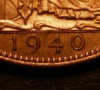
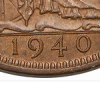
In short, these are the two different double exergue line '4' pointings...
-
Forget the pointings - what I can see there is two distinctly aligned 4's: the first is rotated slightly counter clockwise, the second is rotated slightly clockwise, in relation to a hypothetical vertical line. That alone is enough to account for the pointing difference. Good spot. In my haste I didn't make it clear that I'd attached four different thumbnails. The second posting looks like a duplicate of the first but the thumbnails were showing two additional coins. In the first posting the two coins are: (a) double ex line 4 to left of (but overlapping) a tooth; (b double ex line with a wonky 4. In the second posting the two coins are: © single ex line 4 to a gap (4 is not wonky i.e. a 'classic' 4 to a gap); (d) double ex line 4 to a gap. As to scarcity, my gut feeling is that both pointings for the double ex line are equally common. All credit to numidan, I agree that there is a real varietal difference.
-
P.S. the bottom serif of the 4 can play tricks on the eye, you have to look along the full length of the back of the 4 to see if it point to the gap.
-


-
Just reading this old thread and thought I'd like to put in my two penneth.. or indeed three penneth worth. There are, in my opinion, three varieties of the 1940 penny: 1) single exergue line which (as a general rule) has the 4 in the date pointing to a gap 2) double exergue line which has the 4 in the date pointing to a gap 3) double exergue line which has the 4 in the date pointing to the left of but also crucially overlapping a tooth


-
Opr... Omg!
Varietalis replied to Varietalis's topic in British Coin Related Discussions & Enquiries
Okay, so I've now had email replies from both Kruggerland Ltd and NGC. Kruggerland can indeed act as an agent for sending coins to NGC but their handling fees would, in my opinion, only make it worth while if you were looking to send bullion or similar very high value coins. NGC basically said they dispatch the coins with very low-key descriptions and values so as not to attract took much attention from the tax man. In short then I won't bother with the OPR paperwork as the relatively low value bronze coins I'll be sending won't warrant the hassle. I'll also keep each consignment quite small. However, if anyone out there is looking for an insomnia cure, or indeed wants to send a high value consignment to NGC, then it might be worth having a read through this: http://customs.hmrc.gov.uk/channelsPortalWebApp/channelsPortalWebApp.portal?_nfpb=true&_pageLabel=pageImport_InfoGuides&propertyType=document&id=HMCE_CL_000225 -
Opr... Omg!
Varietalis replied to Varietalis's topic in British Coin Related Discussions & Enquiries
Wow, thanks for the tip. I'll email them this week. -
Opr... Omg!
Varietalis replied to Varietalis's topic in British Coin Related Discussions & Enquiries
as in, 'better the devil you know' -
Does anyone have much experience of sending coins to the US for grading by NGC? I was thinking of sending off a few coins but then started to look into the customs and exercise regulations and OMG does it look complicated! It seems to revolve around OPR (outward processing relief) which is a convoluted method for avoiding paying import duty on your items once they're returned to you in the UK (after all they originated from the UK in the first place). If anyone does have experience of using NGC then I'd love to know if it is really necessary, or at least advisable, to actually do all the OPR paperwork.
-
Spot The Mistake...
Varietalis replied to RChris's topic in British Coin Related Discussions & Enquiries
The current London Coins catalogue has just under 3500 lots. I estimate that CGS slab around 1000 coins a month. So in any 3 month period they are processing 3500 auction lots and around 3000 coins for grading. Added to that there's all the coin fairs they attend. Does anyone know how many people actually work at London Coins/CGS on a day to day basis? I think it is 4 but I could very well be mistaken. I've had one or two issues with them myself and know how frustrating it can be when things don't go entirely smoothly, but it's not hard to see why these blips occur. There's an obvious flip-side to this argument however which is that a business as obviously successful as London Coins/CGS should have the money to invest in the necessary systems, training, staff, infra-structure etc. that would make these occasional issues a thing of the past. -
Spot The Mistake...
Varietalis replied to RChris's topic in British Coin Related Discussions & Enquiries
I've always found her very helpful. Like most middle-aged men I have a very large grumpy streak running through me so I sympathise with her having to deal with people like me day in day out. -
Coincraft - Phoenix Newspaper....
Varietalis replied to Colin88's topic in British Coin Related Discussions & Enquiries
I was up at the British Museum just yesterday to see to the Pompeii exhibition they've got on. Even though I arrived there massively early and had nothing to do I couldn't be bothered to go into the shop even for a quick look around. I had a lager in the pub two doors down instead. -
1940 penny with unusual feature
Varietalis replied to Varietalis's topic in Confirmed unlisted Varieties.
Thanks for your insights. I agree that a die flaw seems the most likely cause as a raised area on the coin would tend to suggest metal missing from the die. This only makes me wonder why I've not seen or heard about any other examples. One possibility is that the die flaw occurred, presumably due to metal fatigue, at the end of the die's life. Therefore there may only have been a very limited number of coins minted with this flaw before the die was then retired. Even so, varieties are recorded that only have a couple or three specimens known so you'd think that, if it were a die flaw, there ought to be at least one or two others out there. -
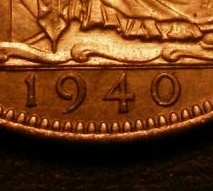
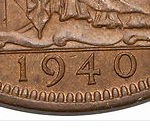
Hi all, please have a look at the photobucket link (assuming it works!). The coin, which is obviously a 1940 double exergue line penny, has an unusual raised feature that tracks along the underside of the third wave (above the 4 in the date) before bridging down to the top of the exergue line. Broken die? grease on flan? I've not come across anything like it before, has anyone else? http://i1364.photobucket.com/albums/r731/George_VI_and_Elizabeth_II_coins/1940pennywithunusualfeatureonexergue_zpsba85d9a2.jpg