Peckris
-
Posts
9,800 -
Joined
-
Last visited
-
Days Won
53
Content Type
Profiles
Forums
Events
Downloads
Store
Gallery
Articles
Everything posted by Peckris
-
1918KN & 1919KN in EF
Peckris replied to 1949threepence's topic in British Coin Related Discussions & Enquiries
My daughter's just cancelled her blind date with you -
1918KN & 1919KN in EF
Peckris replied to 1949threepence's topic in British Coin Related Discussions & Enquiries
I have an Unc 1934 (Mint toned variety) that I got in a Colin Cooke postal auction some years back. Nice. As for those KNs, the 1919 in that grade is pretty truly rare, so I wouldn't be at all surprised to see it fetch the asking price. I'm not sure I'd want the (inferior) 1918 as part of the deal though. -
Warwick and Warwick April sale
Peckris replied to Mat's topic in British Coin Related Discussions & Enquiries
Sic transit gloria mundi. Oh for the days when W&W were conservative in their grading! I'd grade that 1841 as barely Fair, not a hint of Fine anywhere near it As for the prices - truly shocking. Even a deliberately low estimate (which is normal for auction houses) shouldn't be any less than 1/3 to 1/2 of a confident upper bid. -
And how much? Ooooops, it has been answered already :-) Far be it from me to introduce a cynical note (quoth he, introducing a cynical note), but if London Coins are a major advertiser with Coin News, or there is a strong personal connection with the editorial there, then how free from bias would we say that article actually was? I'm sure it is true that the CGS grading standards are high, but are we saying that only a slabbed coin can be accurately graded? That would be a sorry day, if true! There would have to be a whole lot of other advantages to make me give houseroom to ugly slabs.
-
I think if you go to the very top - Christies, Baldwins, Spink - there is far less likely to be a problem at auction: those places have good experts. But even respectable middle-ranking auction houses simply don't have the professional expertise. I'm speaking after attending many auctions at Warwick&Warwick : the local dealer, Peter Viola, always scrutinised the lots, and he was the one to go to on the morning of the sale and ask "Any problems?" Usually there were. So any provincial auction without a Peter Viola on hand, could contain some (I can't say how many, but I'm prepared to guess it's got worse the last few years) problem lots to snag the unwary. The auction houses act in good faith, but they often fail to spot expert forgeries from China.
-
It's your decision - you might indeed be taking a wise course of action. The only way to detect good forgeries is to find another collector with an identical coin - it's the reproduction of the minute imperfections of one original coin used as a 'master copy' that is the tell-tale. In which case, eBay might be the best place to sell on. As to the future, avoid eBay, avoid China, avoid auctions - find yourself one trustworthy dealer and rely on him/her as a source of supply.
-
King GV KN Penny 1918 error ?
Peckris replied to Russ777's topic in British Coin Related Discussions & Enquiries
I agree about the difficulty striking pennies properly : the halfcrown was also a large coin with the same deep portrait, but the reverse design was far deeper and more "raised" than the penny, and the rim higher, so therefore the design was more balanced both sides. It's interesting to note that shillings (which in my experience have well-struck up obverses) often have ghosting on the reverse; the lion on crown design being quite shallow. I'm unsure about the embargo on steel for dies? For two reasons : 1) the amount of steel required for the entire Mint output would have amounted to a couple of capstans on the average battle-cruiser! and 2) the importance of the economy to the war effort would have meant that the Mint would have had quite a high priority in the 'pecking order' of things ... the total circulating coinage forming a large % of the money supply compared to now. I doubt the striking force of the machinery would have altered? It's the unbalanced nature of the first series designs I'd think - particularly pennies, halfpennies, shillings, and sixpences, where the worst ghosting occurred. (The depth of the portrait is less pronounced on farthings and threepences, and the rims are comparatively bigger in relation to the overall coin size). On all these designs, the depth and size of the obverse design compared to the shallowness and thin rims of the reverses, caused this 'metal displacement' that led to ghosting. The Mint's interventions prior to 1927 are to do with reducing the obverse in some way or another. There were no crowns until 1927, so no ghosting. I imagine that the strike for each blank size was calibrated separately? In any case, the shallower obverse design of every bronze penny prior to 1911 resulted in little or no ghosting, thus putting even more of a finger of suspicion on the design, rather than the strike or machinery. -
Did you buy from private sellers, or from dealers / auction houses covered by trade associations (e.g. BNTA in UK)? If the latter, and you kept the receipts, then you have - if not provenance exactly - then a certain level of bona fides which would cover you when or if you decided to sell. If the former, then you can console yourself that the chances of every private seller you dealt with was offloading fakes, is somewhat remote, to say the least. Maybe the odd forgery got through, that fooled the whole trade in the UK and USA - and if everyone was fooled, that's also a kind of reassurance, in a way.
-
The reverse... but believe me, this just does NOT do the coin justice :
-
Ok, I will. But - sigh - we have the usual problem with scans ABSOLUTELY FAILING to capture the beauteous lustre, at all. And, I've just bought a decent digital camera, but have no idea how to take pictures of coins with it. So this is something of an anti-climax, I'm afraid.
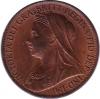
-
Oops, I'd never spotted the legend misspelling before! BRITANIARVM instead of BRITANNIARVM. No wonder it wasn't adopted!
-
King GV KN Penny 1918 error ?
Peckris replied to Russ777's topic in British Coin Related Discussions & Enquiries
Which perhaps makes one wonder, if the machinery used in the strike is the cause, not the dies and certainly not the planchet. Particularly wondering about the ferocity of the strike ? I'd say most of those - the one thing the Mint did know, apart from how to cure it - was that the main cause of the problem was both the depth and overall size of the portrait. I don't know the actual physics, but apparently it was to do with the displacement of metal caused by the strike, and therefore you can blame the design AND the strikings. The dies can only be blamed in so far as they carried the unbalanced design; the planchet was standard for pennies and therefore cannot be blamed. Another contributory factor is the shallowness of the rim on the reverse, compared to the Vic OH for example. In my experience (ok, not comprehensive, but I've seen plenty of coins from the period) this isn't evident - or it would show up on the larger silver coins in particular,but it doesn't (see my reply above). -
King GV KN Penny 1918 error ?
Peckris replied to Russ777's topic in British Coin Related Discussions & Enquiries
It is strange though that despite using the original portrait, the years 1911-13 (but not the 1912H) and 1921-6 rarely show symptoms of ghosting (although 1926 MEs do have other problems). However, between those dates pennies more often than not have the tell-tale halo round Britannia. I would slightly take issue with £400 (puts on crash helmet and hides under table!) in that it did seem to get solved - I have seldom seen anything from 1921 to 1926 with much in the way of ghosting. Most designs seem to suffer from it to some extent and in some examples, but I would suggest that by that stage pennies were no worse than any other contemporary design. The worst years were probably 1915-19 which, allowing for a slight time lag coincided with the First World War and its attendant shortages of materials and skilled manpower. In fact, the pennies produced during this period were amongst the worst-made coins of the modern era. An interesting topic Mr Russ, which us old stagers will be quite familiar with but collectors of more tender years will probably know little about. I have mixed responses to this (based purely on observation, not any academic research) : • I have certainly seen plenty of 1911 - 13 pennies with ghosted reverses (a 1911 was one of the worst I've seen). • I do agree however, that the ghosting - while not cured - seems greatly reduced after the 1921 Type 2 obverse (1921-26). • I'm also unsure about the 'World War I' thesis : the 'faded look' of the penny obverse from 1913 is almost entirely due to the reduction in the very deep portrait of 1911. Where this did not happen (halfpennies & farthings) the quality of the striking holds up, except where worn dies were persisted with, for example some 1919 farthings. Also, that thesis would have to apply to ALL coins minted surely? Yet I have found that many shillings / florins / halfcrowns of the WWI period are particularly strong (we know that they deteriorated badly after 1920 with the 'shallow cut portrait' introduced along with the alloy change). My own observation about pennies is that worst offenders seem to be the Heaton and Kings Norton strikes 1918-19, possibly due to striking with dies that had already borne heavy wear. After those I would say that 1918 - 1921 pennies from the Mint are often poor obverses too, improving considerably - both sides - with the 1921 Type 2 obverse. But it's a hazy area, and would repay research I'm sure. I'm NOT volunteering. -
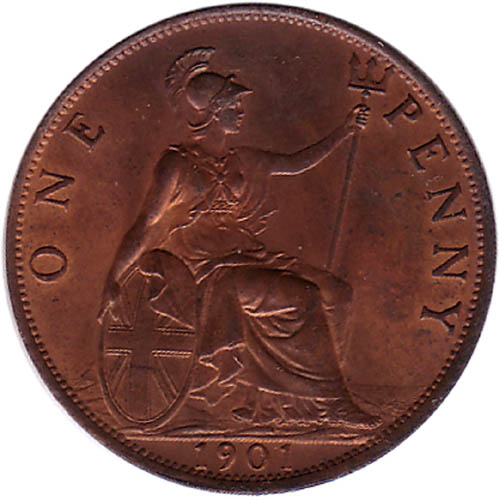
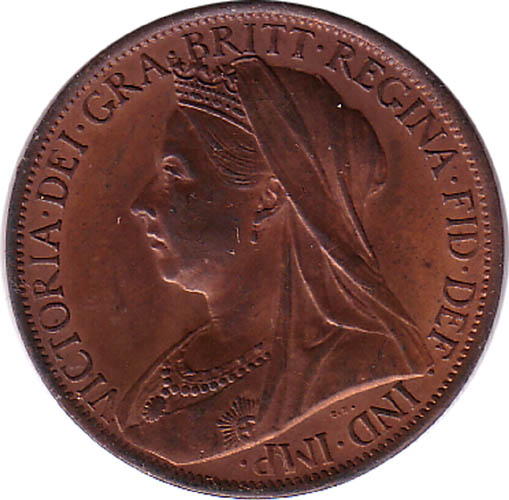
Yes, despite the small images, that's a good point well made. I have two 1901 Unc pennies - one almost BU with that pale straw toning to the lustre, and a fingerprint on the reverse. The other is also technically Unc, but has an overall rich dark tone with some lingering lustre that is such a deep red colour, it's utterly gorgeous. When I get a chance I will try to post scans. Here's a slightly larger image of the nicely toned 1900:- Yes, very nice. My 1901 is similar, but imagine the lustre slightly redder and deeper in colour.
-
1993 Revised Series E £20 note
Peckris replied to a topic in British Coin Related Discussions & Enquiries
That's because the example on eBay has the A01 prefix, making it part of the earliest run of notes. Those early prefixes (or late) fetch a strong premium over ordinary numbers. And the one on eBay looks in Mint condition, to my eyes. Unless your notes have anything significant about the serial number (& I don't know enough to judge), you'd be better off sending them off for face value. -
1833 Sovereign with errors, possibly unique
Peckris replied to azda's topic in British Coin Related Discussions & Enquiries
Have to say I was thinking GVF, although the second lot of photos look better than the first, but grading is meaningless if you paid the right money. It ran into 4 figures Red ;-) Wow, more than £9.99 you mean? -
Victorian half crown - grade?
Peckris replied to Voynov_BG's topic in British Coin Related Discussions & Enquiries
Yes, I would partly agree. There are many hairline scuffs on the obverse, though the tone is quite good (i.e. you can't tell it's been cleaned from the tone). Also there is a little too much wear on the hair and tie bands to be EF. The reverse is clearly EF IMO, and attractive. I'd personally grade the coin GVF/EF with lustre and attractive tone. But you'd have to mention the scuffs if you were selling. -
My thoughts too, all the wide date seem pretty scarce, I have a 96 and a 99 both fair, couldn't resist this one whether they will attract a premium in future who knows David Yes I bought a Fair '99 from the 'Bay, only to find, when I stating trawling through a heap of Veil Head pennies taken from circulation late-60s, that I already had one, and had had it for around 40 years
-
Yes - that whole series of pennies (1895 - 1901) is prone to some quite dramatic variations in the spacing of the last two digits. It's a little odd, considering that by the early 1880s they'd introduced electrical minting equipment that reduced the previous variations to almost nothing. In fact, you just don't see date width bun penny variations after 1883, so why it suddenly reappears after 1895, is puzzling.
-
Heads Up
Peckris replied to £400 for a Penny ?'s topic in British Coin Related Discussions & Enquiries
I'm sorry to see Dave Craddock's name in that list. I have bought / sold with him in the past - a good dealer to do business with. Hope he gets his stuff back. -
That's good idea, then can we have the next peak in 2019 around april - may time. Noooo! Not yet, I'm not quite ready! Hahaha - did you mistake that 9 in the date, for a 0 Declan? I still maintain that mere 'supply and demand' is an unsustainable mantra. It would be true of petrol, wheat, potatoes, and things like that, but too many other things - housing included - are at the whims of fashion every bit as much. If it were not so, then perpetually restricted supply of, for example, Wreath Crowns would have ensured peak catalogue values over the decades. But even those have been subject to the ins and outs of fashion. S&D on their own are misleading. no I mean I'm not quite ready for a price crash yet...! Ah, I get it - you need to sell before you buy!
-
Yes, despite the small images, that's a good point well made. I have two 1901 Unc pennies - one almost BU with that pale straw toning to the lustre, and a fingerprint on the reverse. The other is also technically Unc, but has an overall rich dark tone with some lingering lustre that is such a deep red colour, it's utterly gorgeous. When I get a chance I will try to post scans.
-
The sharp corner 1949 3d is scarce? The example I bought from Colin Cooke (GVF/AEF w lustre) some years back, is that variety. I'm pretty sure Colin didn't know it was scarce, and I certainly didn't. I thought we discussed this sometime last year ? I'd never seen a sharp edge 1949 threepence, before I saw the image supplied by Gary. It's entirely possible. My memory is notoriously goldfishy. But my 1949 is indisputably the sharp corner variety.
-
That's good idea, then can we have the next peak in 2019 around april - may time. Noooo! Not yet, I'm not quite ready! Hahaha - did you mistake that 9 in the date, for a 0 Declan? I still maintain that mere 'supply and demand' is an unsustainable mantra. It would be true of petrol, wheat, potatoes, and things like that, but too many other things - housing included - are at the whims of fashion every bit as much. If it were not so, then perpetually restricted supply of, for example, Wreath Crowns would have ensured peak catalogue values over the decades. But even those have been subject to the ins and outs of fashion. S&D on their own are misleading.
-
Request for values from 2010 catalogue
Peckris replied to Mat's topic in British Coin Related Discussions & Enquiries
Yes, although the milled coins were clearly superior, apparently the Mint workers whose jobs were threatened staged a 'rigged' trial to 'demonstrate' that milling was much slower than hammering. It probably WAS slower, but not by that much.