1949threepence
-
Posts
8,081 -
Joined
-
Last visited
-
Days Won
262
Content Type
Profiles
Forums
Events
Downloads
Store
Gallery
Articles
Everything posted by 1949threepence
-
Obverse 3 - in my opinion, one of the most difficult obverses to identify. Had we all seen this, it would have had many more bidders than 2.
-
By the way, this was the original:-


-
What?? I don't believe it!!
1949threepence replied to Peckris 2's topic in Nothing whatsoever to do with coins area!
I'm not, Chris. Nor a Man City one - but I do have Aguero, Sterling and David Silva in my work Fantasy football team (league of 23 members of staff), as well as Callum Wilson from Bournemouth. So it was an important match in that sense. -
See if it works:- Well I'll need to perfect my technique, but so far so good - from photoscape. Thanks @Paddy
-
What?? I don't believe it!!
1949threepence replied to Peckris 2's topic in Nothing whatsoever to do with coins area!
Well done Ben Stokes. I must admit I watched the Bournemouth - Man City match. -
Somebody's 'avin a larf.......
-
Penny Acquisition of the week
1949threepence replied to Paulus's topic in British Coin Related Discussions & Enquiries
It hurts your eyes anyway, to keep staring at gaps/teeth, and depending on the angle you are looking at the coin picture from, you can very easily be wrong, unless the coin is in hand. So to find a very obvious and easy way of recognition, such as a thin rim, combined with the much clearer GRA:BRITT differential, is brilliant. -
I know some people like them, and I concede they very much have certain positive attributes, but they're not for me. I like the feel of the actual coin itself.
-
Penny Acquisition of the week
1949threepence replied to Paulus's topic in British Coin Related Discussions & Enquiries
A new (for me anyway) and convincing way of recognition. Well done Jon, that's a real bargain. -
The $64,000 question, Terry.
-
Penny Acquisition of the week
1949threepence replied to Paulus's topic in British Coin Related Discussions & Enquiries
Yep, you're right. The one is definitely over a tooth. It just looked at first glance as though the P of Penny was to a gap not a tooth. I need to get me teeth and gaps sorted. -
Penny Acquisition of the week
1949threepence replied to Paulus's topic in British Coin Related Discussions & Enquiries
Jon, I know these are a sod to tell apart, but I think that may be a 177 - P of Penny to a gap and colon between GRA and BRITT to a tooth. I hope one of the experts corrects me, I'm wrong, and it's a 175 or 176. -
14 years later I know, but I use the same method as the guy in this video
-
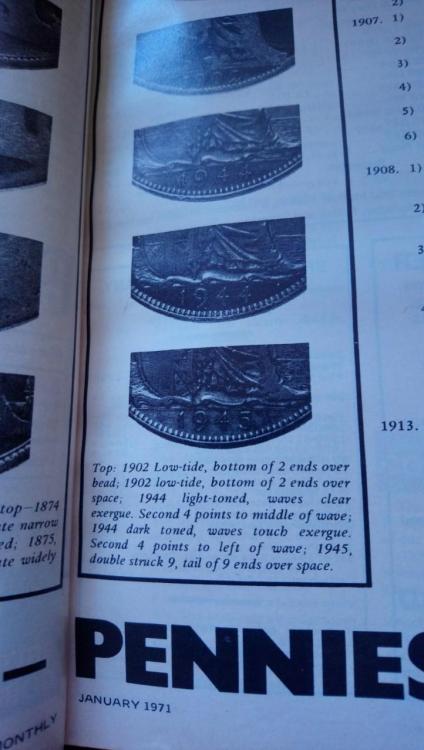
Very interesting. This particular variation is noted in the January 1971 edition of Coin Monthly. It's in an article entitled "Coin Varieties - pennies", by A,J.Braybrook, on pages 50 to 53. "1944 light toned, waves clear of exergue, Second 4 points to middle of waves" Here's a photo of the relevant bit:-
-
F164a?
1949threepence replied to mrbadexample's topic in British Coin Related Discussions & Enquiries
No problem - this is one difference I recognise immediately. -
F164a?
1949threepence replied to mrbadexample's topic in British Coin Related Discussions & Enquiries
By the way, that's a cracking specimen, Pete. -
F164a?
1949threepence replied to mrbadexample's topic in British Coin Related Discussions & Enquiries
Sounds a plausible explanation, Terry. -
F164a?
1949threepence replied to mrbadexample's topic in British Coin Related Discussions & Enquiries
Definitely a 160, Chris. Here's a 161 - you can see immediately that the E of penny is tilted slightly clockwise and therefore out of alignment with the P. Yours is not:-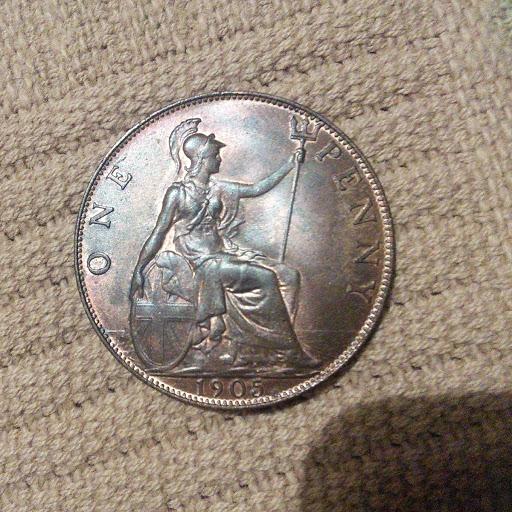
-
F164a?
1949threepence replied to mrbadexample's topic in British Coin Related Discussions & Enquiries
Sorry, that should of course be upright E of PENNY. -
F164a?
1949threepence replied to mrbadexample's topic in British Coin Related Discussions & Enquiries
With the 160 it's PE - the upright P of penny points to a gap. The 161 is the EN. It has the E turned slightly clockwise, is now over a border tooth, and looks out of alignment with the P. The difference is clearly visible to the naked eye even when the two are not side by side. The scarcity of the 164A in high grade is relatively easily explainable. But with the rest, it's more complex. It may be something to do with the comparative scarcity of two or more year varieties in relation to each other. It might be connected to how many of the year itself have been collected in high grade, in the absence of collector knowledge at the time. If many, then inevitably, by random chance, there will be a few of the scarcer varieties amongst them. But I can't explain the 160 being difficult to find in high grade - it's got a C rating, so it hsouldn't have been as difficult as it was. Maybe it was just my personal experience which was out of kilter. -
F164a?
1949threepence replied to mrbadexample's topic in British Coin Related Discussions & Enquiries
At the end of the day, Blake, it's up to each collector to decide and set their own personal parameters, which may, in each individual case, increase or decrease over time. When I first started collecting pennies seriously, nearly 10 years ago now, I never imagined I would develop such a completist mindset during the intervening period. At that point, I would have said that one decent 1908 (for example) would have been enough. But as my interest deepened, so did the completist side. I suppose if something is worth doing, then it's worth doing well - and you only succeed by relentless pursuit of your ultimate objective. With regard to the different types and their popularity/notoriety, the clincher is what has charisma, and what doesn't. As you say, the 1890 dropped 90, is arguably a type in and of itself. Certainly recognised by Gouby, as we know. But not one which attracts a lot of attention. Conversely the 1934 missing waves, creates a bit more fuss. Moreover, you only have to look at what brings in the big money. Compare and contrast the F90, 1877 narrow date penny with an 1881H Freeman 103. The 103 is probably rarer than the F90, but head to head at auction, we both know the F90 is going to draw in the greater number of punters and get the most money. Probably because it's instantly recognisable. If a die No 1 under date ever does appear, it'll no doubt fetch in excess of £20k. Although maybe there isn't a Die No 1. Perhaps they considered the normal dies to be "No 1" and started at No 2. All very interesting and worthy of discussion. -
F164a?
1949threepence replied to mrbadexample's topic in British Coin Related Discussions & Enquiries
Again, found the 160 surprisingly difficult to get in high grade. 161 very easy. -
F164a?
1949threepence replied to mrbadexample's topic in British Coin Related Discussions & Enquiries
Maybe not, but perhaps the mindset was different then. Besides which, I'd say that if it's an obviously intentional difference, or differences, such the the progression through four types, of the F164, 164A, 165 and 166, then they are distinct types, albeit the differences are slight, but nonetheless recognisable. This surely lends importance. If Peck had discovered and published details of the 164A in 1958, I'd lay odds there's be a lot more around than there currently are. Same with mules where there are obviously incompatible reverse/obverse pairings. There have been enough minted for us to know that the minting was intentional, whether due to a broken obverse/reverse die necessitating the temporary substitution of an out of date die, or other reason. Same again with overstrikes whether intentional as a result of "good housekeeping", or arising from operator error. They are all distinct types which have gained popularity over the decades. Where it starts to get flaky is with tiny unintended differences such as sloping final ones on the 1861 or the far 4 on an 1864 crosslet. Quite a lot of these minor variations around - of interest, but not so much as to warrant separately trying to categorise them. -
F164a?
1949threepence replied to mrbadexample's topic in British Coin Related Discussions & Enquiries
Maybe he did, Richard, but wasn't too enthusiastic about including it as a distinct variety. I've just found this post made by Chris Perkins in August 2015, and quoting Michael Freeman's letter to him. In it, Mr Freeman states (extract):- So we nearly didn't get Reverse I by the sounds, which might have meant F69's and 76's being discovered by someone else - Gouby assigning a different number, perhaps. -
F164a?
1949threepence replied to mrbadexample's topic in British Coin Related Discussions & Enquiries
Thanks, that's really interesting. Court's estimate of circa 55,500 examples minted, may not be too far off the mark. Clearly the overwhelming majority of these will have gone in the melt as I imagine not too many specimens would have been collected between February 1969 and demonitisation. Does anybody know of any evidence of them being sold by dealers, as a separate entity, at any point between 1969 and the 1971 demonetisation?