
Rob
-
Posts
12,957 -
Joined
-
Last visited
-
Days Won
377
Content Type
Profiles
Forums
Events
Downloads
Store
Gallery
Articles
Everything posted by Rob
-
You mean any government from 200 out of the last 250 years? Pretty much so. But as always, SIZE MATTERS
-
Found it hiding in the for sale trays. 8 over 7 on the left clearly seen as a straight line above the top of the 8. Not over 7 obviously just an 8.

-
Nice spoof - get it in the Sun. The smaller the number involved, the easier it is for the readers to get their heads around it. I'll keep quiet about the 50000 presentation packs, 20000 Ag proofs, 3500 Ag piedforts, the gold pieces....
-
Calling the pharmacist!
Rob replied to Colin G.'s topic in British Coin Related Discussions & Enquiries
What you say makes sense. I was just struggling to see the first letter as a G. It's late. That should have said I was struggling to see the first letter as a G without the second letter being an L. The second letter can only be an L if the first letter is a C, but the style of the C after Dot on the first ticket is not the same. The initial loop starts on the curve of the C in this instance and on the ticket below. The first letter on the other sides all start with the initial loop consistently to the left of the curve which would suggest a different letter. Taking the left curve down and through to the top of the upstroke and back to the base again as a letter would be a good fit for a G in my opinion. -
Scan below. The one on the left is the first type with the deeper hollow behind the beard (much more obvious in the hand). The right hand one is the later shallow type. The first was found with both I of GEORGIVS to bead and space, so any 1911 1/- with the I to space is the deeper cut (Davis obv.1). Davies obv. 2 is the same effigy with the I to bead. The shallow neck was introduced in 1911 (Davies obv. 3) and adopted as standard from 1912 onwards, so any coin from 1912 until the end of 925 silver is this type.

-
Calling the pharmacist!
Rob replied to Colin G.'s topic in British Coin Related Discussions & Enquiries
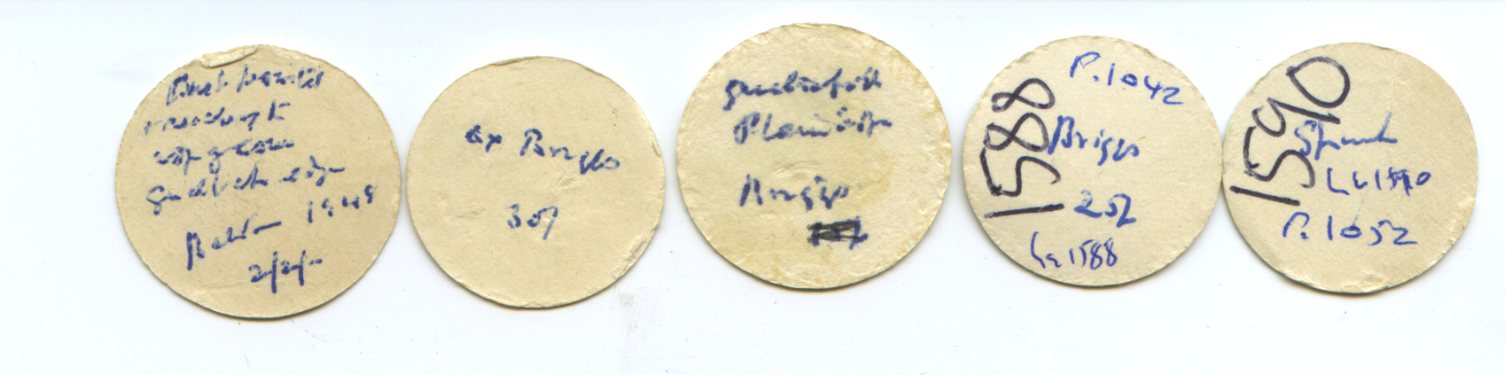
Any use? The left says Baldwin 1948. The next three Briggs(sic) - M A Brigg sold his gold & silver in May 1939 and the coppers 4 years later. A really nice collection. The last says Spink. All three were popular sources for Rogers.
-
Calling the pharmacist!
Rob replied to Colin G.'s topic in British Coin Related Discussions & Enquiries
Glens were an auction house and not a dealer, so you wouldn't expect to get tickets from them for individual coins. The other sides of the tickets show the letters B, C, D & F. Ignore VICTORIA which is printed capitals, the joined up writing is the relevant bit. On the top left ticket, the first letter after the capital looks to be an a. The last letter has to be something with a tail i.e. g, q, y, z. Seaby ends in y, but I'm struggling to make the first letter an S. The last two letters fit tz well with the cross of the t starting the top of the z. That is my reasoning. -
Calling the pharmacist!
Rob replied to Colin G.'s topic in British Coin Related Discussions & Enquiries
I agree with the translation so far offered. I think you've done a bit better than you realise. It looks to me like the reverse says Gantz and the price. A quick check of the Gantz catalogue for 23-7/6/1941 shows that the Rev. W L Gantz of Stanstead Abbots, Herts (d.1940) had only a handful of coppers in the Glens sale, but Manville and Robertson say that a portion of the collection was purchased by Seaby in 1926 and other coins sold privately in addition to the two sales in 1941 (the first sale was Ancients). If I am correct in deciphering the scribble, the price of 6d each suggests a private transaction with Gantz, though it could equally have come from Seaby. Rogers was quite heavily into small coppers in the 1920s as he wrote an article on the Chas.1 rose farthings in the BNJ vol.18 (1925-6), though the base coinage in general was his main sphere. I note that lot 1481 had a 1799 farthing, though at this time I doubt if anyone worried about the number of berries in the wreath when cataloguing as it is part of a lot of 14. The difference in style compared to my ticket could be accounted for by 20-30 years between the two styles which as a gift from Peck in 1957 was obviously written near the end of his life. -
I think the only area in which you need play the waiting game is bullion value or close to items. Top grade pieces will always command a premium to bullion and rightly so with the exception of modern isues which are rarely encountered in worn condition and generally found only as collectables of bullion value in the secondary market. The intrinsic value of silver coins is not a primary consideration for anything vaguely collectable. The current fashion for snapping up the low grade silver is entirely driven by bullion values which attracts far more people than there are collectors. From the collecting point of view, individual denominations are varyingly popular at any point in time. Historically, the most popular pieces were the largest - probably driven by the ability of people to easily identify what they were holding. Conversely smaller coins suffer a greater likelihood of being passed over as a casual glance will probably not lead to the mental recognition of the item. So hammered farthings will not be as popular as milled ones for example which retain a sentimental attraction. However, outside of bullion, the majority of prices are driven by collector pressure being as they are well in excess of the scrap price. Whilst I haven't plotted out a value/time graph for individual denominations, their values relative to each other have broadly stayed in the same ratios over quite a long period of time. Any divergence from this relationship tends to be the result of collector pressure to acquire what is perceived to be a real rarity, be it the huge prices currently seen for minor varieties or the premiums paid for specific types in the inter war years. In the case of the former they are probably rare because nobody apart from a few individuals really cares about the actual variety detail, but greed dictates that everybody wants to find one to sell and so they will be found in the fullness of time. In the case of the latter, communications were considerably more difficult and so the awareness of relative numbers was the driving force. A crown with only 3 or 4 known examples might have sold for £20-30 in the inter-war years relative to a common issue selling for £2-3 each. Now however that price differential has been largely eradicated because we now know there are several times the number of pieces extant than was thought at the time. You do get fluctuations between denominations which I would suggest are driven by new collectors entering the market and looking for something cheap to collect at the bottom end value-wise whilst being aesthetically attractive enough for the collector to want to look at them. The top end is driven as always by a relatively few individuals with deep pockets. Most of these are successful in business being driven by personal ambition - a trait which in all probability will carry over into their collecting habits with the desire to acquire a better collection than the competition. With the accumulation of large amounts of data over time, there is also a better appreciation of what is genuinely rare and what is not. This is a moving attribute and always open to the possibility of having to be revised as a result of hoard finds. Today we have information that our predecessors could only have dreamed of, but we all have to bear in mind that we too do not have the definitive answers to the various factors that shape demand and hence prices. As with any asset category, bubbles will always exist at some point in time. Prices fell off a cliff in the early '80s for example following what was probably the biggest bull run in numismatic history in the 1970's when the government was failing to balance its books, giving in to inflationary wage demands, living beyond their means...... Sounds familiar?
-
Third farthing 1866 with some old image?
Rob replied to Voynov_BG's topic in British Coin Related Discussions & Enquiries
It looks like clashed dies to me which happens when the two dies come together without a blank between them, so leaving an impression of either the obverse on the reverse die or vice-versa depending on which die was the harder of the two. -
The 8 is cut over a 7 either because the 7 is a mistake, or in the case of successive years as here, usually because the die was not worn out at the date changeover and so used on the grounds of economics. Additionally, sometimes the underlying year had dies produced but not used. Rather than throw the dies away they were cut with the new date or initial mark to ensure they were compliant with other dies and put to use. Hi so are there two of that type (1888 1888/7) ? and if so how do i tell the difference . thanks You've chosen a funny one there, because all 1888 shillings are actually 1888/7. If you have an 1888 shilling, get yourself a cheap 30x jewellers loupe, and have a close look under good light. That'll show you what you're looking for - a clear overdate, if the grade is high enough. Not all 1888s are over 7. The straight 1888 is considerably scarcer, but does exist and is not rare as such. If I can dig both of them out I'll post a comparison as the 8/7 is quite obvious, consequently the straight 8 is equally obvious in the hand.
-
The 8 is cut over a 7 either because the 7 is a mistake, or in the case of successive years as here, usually because the die was not worn out at the date changeover and so used on the grounds of economics. Additionally, sometimes the underlying year had dies produced but not used. Rather than throw the dies away they were cut with the new date or initial mark to ensure they were compliant with other dies and put to use.
-
Davies is British Silver Coins since 1816 by P J Davies. It goes into more detail on die differences than ESC (English Silver Coinage since 1649) which only has the most obvious varieties, but covers a shorter period. Your interests are labelled as shillings, pennies and halfpennies, but the books most suited to you will depend on the dates covered and so only some of the books mentioned will be of use. For pennies and halfpennies then the bible is Peck which covers 1558-1963 in the second edition (1964). Slightly more specialisation is found in Freeman's The Bronze Coinage of Great Britain (2nd.ed 1985 or 2006 reprint). Pennies are studied in depth in Michael Gouby's The British Bronze Penny 1860-1970. Hammered halfpennies are covered by Paul & Bente Withers excellent 5 volumes of Small Change covering Edward I-Commonwealth. Dave Groom has produced a book on the "Identification of English 20th century Silver Coin varieties" and another on the bronze, but this covers only post 1900. Generally speaking, the greater the detail, the shorter the period covered. This list is not exhaustive. All of these books have something to offer, and so it really depends on your chosen area. This was recently discussed in the Oooh err, hmmm section link
-
The date spacing on any coin prior to 1879 is due to the fact that the dies were finished with the addition of the last two digits by hand. The footnote on p.135 of ESC refers. If you look through past sales you will find that pennies and other denominations exist with only partial dates such as a copper 18 penny, or the 181 half crown. True wide or narrow dates are uniformly spaced so. Thanks Rob so its just a normal.Sorry new to all this some members seem a bit sharp Thanks again In my opinion, undue attention is paid to the position of the last digit or two of the date given we know they were hand made. It's ok as part of a die study for a series as it is one of the few ways to readily identify different dies, but for the average or new collector this is not really relevant. To go back to the previous point, here are a couple of images from another thread. 1862 halfpennies with different end spacing and Wide and narrow date 1876H halfpennies. The first is a random result and although technically a variety, it arose by pure chance. The second is a design feature as the dates on both are equally but differently spaced, and most importantly of all consistently so between nominally identical dies.
-
The date spacing on any coin prior to 1879 is due to the fact that the dies were finished with the addition of the last two digits by hand. The footnote on p.135 of ESC refers. If you look through past sales you will find that pennies and other denominations exist with only partial dates such as a copper 18 penny, or the 181 half crown. True wide or narrow dates are uniformly spaced so.
-
ESC 1338E yes that is right not no line .shorter or longer line thanks .going down right track now No problem, my thought processes were malfunctioning too - I hadn't considered faulty question as an option.
-
1819 George III sixpence T of BRIT over B
Rob replied to Martinminerva's topic in Confirmed unlisted Varieties.
Well done. Living proof that if you want to obtain a rarity, best is to publicise an example of something unrecorded in any literature and suddenly the whole world has one too. 2 dies as a minimum means there will be more out there somewhere. -
What is the reference for the no line shilling? Spink doesn't list one. Davies lists 3 varieties - cross to bead, cross to space and SHILLING more spaced. No mention of what would be a blindingly obvious missing line below SHILLING though. ESC lists a shorter line which is the same visual effect as a more spaced SHILLING. Coincraft hedges its bets and in footnote 10 says lettering and line length varies. I've never seen or heard of one. The immediate reaction would be that no line below shilling is most likely due to a blocked die or it has been physically removed.
-
The US reference Krause states that up to 1981 all coins were struck with an inverted die axis, which is presumably what you mean with your question. The 1943 1SFr is therefore correct. In 1982 there was a changeover to medal alignment and so the 2SFr coin may or may not be anomalous depending on the date - which you haven't provided.
-
He certainly doesn't like full stops, does he. It's the "sorry for the grammer it should read a little batterd" that gets me. It's always funny to see anything corrected with yet another misprunt (sic).
-
It's the bit at the end I find funny. link That's an apology for an apology
-
why is the 1992 small head 20p not a mule?
Rob replied to scott's topic in British Coin Related Discussions & Enquiries
Master broke? Punch used on the earlier coins unserviceable? Who knows? You could ask the RM why the change was made as if anyone is going to answer the question it has to be the people who made it. -
You might have to wait a bit more than 5 years for a Cromwell if it means you aren't going to buy your regulation 2 coins a year. It books in this year's Spink at £3750 EF. Mint state you would be looking to pay at least £6-7K with stiff competition for it to that level. It could even go higher with the right eye appeal.
-
Well, presumably he was responsible for the condition of the coin as his id proudly states. What is more worrying is that it has 4 bids already. Still under melt price though Rob (which is where I suspect it is heading). Hopefully that will be its final destination - for the benefit of all.
-
Well, presumably he was responsible for the condition of the coin as his id proudly states. What is more worrying is that it has 4 bids already.