
david.bordeaux
-
Posts
89 -
Joined
-
Last visited
-
Days Won
14
Content Type
Profiles
Forums
Events
Downloads
Store
Gallery
Articles
Everything posted by david.bordeaux
-
 Susan Hicks Beach was also the model for the Britannia on the trade dollar. There was an article in Coin News in July 2024. Pages from CN JULY 2024_opt.pdf
 -
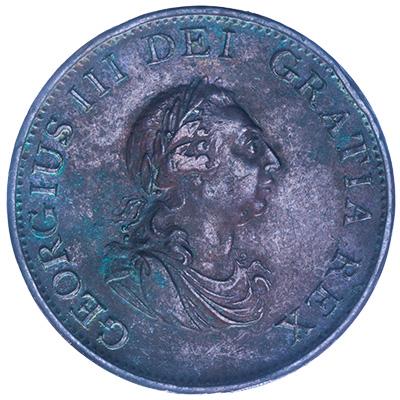
The verdigris may not show very well in the photo. Below is another "before" photo under different light. Work is in progress on coins with more obvious/stubborn verdigris. I will report back!
-
1. I bought mine on Amazon. It is also available on eBay and from pet shops (for use as a buffer in fish tanks). It is sometimes branded as "Borax substitute" or "Crex" but read the label carefully - it must be sesquicarbonate. 2. Yes, Brita filters remove chlorine. 3. Yes, but not so effective as a quick dip in acetone.
-
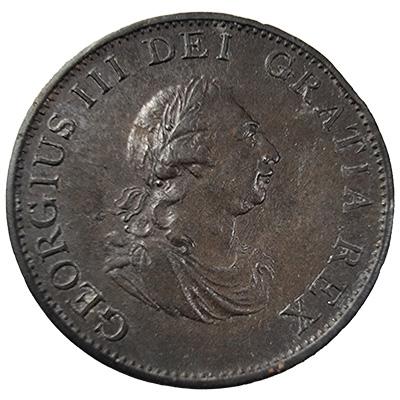
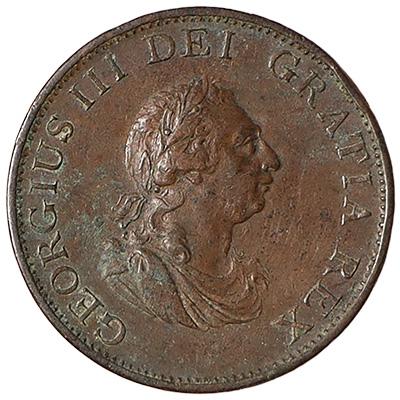
I don’t like using proprietary products because I don’t know what’s in them, and I believe VerdiCare is difficult to obtain in the UK anyway. After some research on what the British Museum used to use to treat bronze disease and verdigris on large objects, like cannon, I tried the technique for myself on this battered 1799 half-penny. For anyone interested, the treatment was 100 minutes at 90°C in a 2% w/w solution of sodium sesquicarbonate in chlorine-free water. Followed by a rinse in chlorine-free water to remove the chemical and then a rinse in acetone to remove the water. The heat is needed as the reaction is impossibly slow at room temperature.
-
Long cross penny identification
david.bordeaux replied to david.bordeaux's topic in British Hammered
For anyone using the Google Drive workaround, don't forget to set the permissions: right click > Share > Share, then change from "Restricted access" to "Anyone with the link" (Viewer). -
Long cross penny identification
david.bordeaux replied to david.bordeaux's topic in British Hammered
Also trying a link to Google Drive to see if that works: Obverse link Reverse link -
Could anyone kindly help with identifying this penny? HENRICUS [III] on the obverse and I think I can make out a sceptre. With a bit of imagination, the reverse legend might be NICOLE ON LVND. Possibly Class 5, but I can't narrow it down any further. Any help would be much appreciated. Penny_B_O@0.1x.pdf Penny_B_R@0.1x.pdf (Posting PDFs due to the recurring 403 problem.)
-
If a silver proof does exist, and assuming it is the same thickness as the cupro-nickel crown, it would be more easily identifiable by weight than by the unreliable "ring" test: Cu-Ni: 28.27590 g (the standard weight given in the Coinage Act 1946) .925 silver: 32.82 g .999 silver: 33.16 g Otherwise, a silver coin of the same weight as the cupro-nickel crown would be noticeably thinner (about 2.47 mm compared with 2.91 mm, so easily visible to the naked eye when placed side by side). This is due to the differing densities of the metals/alloys: Ag 10.49 g/cm3, sterling silver 10.3845, cupro-nickel 8.9455.
-
I spoke to Graham Dyer two weeks ago at the Michael Dolley symposium in London and can confirm that he is still an encyclopaedic source of information on the Mint. Best to contact him via the Mint Museum, as Rob suggests.
-
The entry for 4337 in the 7th edition of Bull has been corrected to read "Struck in cupro-nickel".
-
Here is the relevant page from Linecar and Stone, in case this is of help. Linecar.pdf
-
Thorburn Collection of 1887 coins
david.bordeaux replied to Mr T's topic in British Coin Related Discussions & Enquiries
I wonder if the sale will include the "proof florin with a wide gap below the truncation"? Bull and other cataloguers imply wrongly that this is the "normal" proof, but in fact nearly all the 1887 proof florins have the later obverse with a narrow gap. -
The 1862 plain-edge proof Gothic florin (2849 in Bull, who records it as "not traced") sold for $21,600 (including buyer's premium) at Heritage yesterday. At least we know that it exists now.


-
TICKET CENTRAL
david.bordeaux replied to Rob's topic in British Coin Related Discussions & Enquiries
Jameson 1004 to 1008 are all Poseidon, so maybe a misreading or misattribution? -
TICKET CENTRAL
david.bordeaux replied to Rob's topic in British Coin Related Discussions & Enquiries
Not Jourdan but Jameson? - Collection R. Jameson Tome 1
-
Does this exist? Anybody got one or seen one? It has been listed since The Milled SIlver Coinage of England (Spink, 1925) and appears in "old" ESC as 807B and the current edition of Bull as 2825 (with rarity R3). Davies lists it as 723 but with an asterisk to indicate "to be confirmed". I suspect it is one of those errors that have been copied and pasted from the 1925 book (like the 1887 florin with 34 arcs). Dickinson wrote in 1978 and 1980 (Seaby Coin and Medal Bulletin) that the 1853 florin with a stop after the date was "unlikely to exist" and I am inclined to agree.
-
You can consult them at the National Archives in Kew. Apart from that, you might find something useful in the online papers (up to 1992) of the Royal Mint Advisory Committee - they discussed a new coinage for the Solomon Islands in 1975.
-
London Coins Catalogues
david.bordeaux replied to Rob's topic in British Coin Related Discussions & Enquiries
On the subject of London Coins, I see from my invoice for the June sale that their buyer's commission is soon to go up to 18.5% -
Florin diameters
david.bordeaux replied to david.bordeaux's topic in British Coin Related Discussions & Enquiries
The Royal Mint Museum has confirmed that 28.30 mm is incorrect and according to "the data used in the Museum, sourced from the production records held in our archive" the diameter for all florins from 1893-1970 should be 28.50 mm. -
There seems to be great confusion about the diameter of the UK silver florin between 1893 and 1970. Some sources, including the Royal Mint shop and the Numista website, indicate a change of diameter in 1937, giving 28.30 mm for 1893-1936 and 28.50 mm for 1937-1970. Other sources give a single (but different!) diameter for all florins between 1893 and 1970: Krause (28.3 mm), Wikipedia (28.5 mm), Peter Davies (28 mm) and Matthew Dickinson (28.5 mm). Analysis of the coins in my collection refutes the idea of a small increase in diameter in 1937. On the contrary, there is a statistically significant decrease in diameter. I find no evidence for the existence of a florin measuring 28.30 mm of any date. For 1893 to 1936, the diameters measured range from 28.44 to 28.74 mm. From 1937 to 1970, from 28.36 to 28.57 mm. Assuming that the Mint measured in inches, my conclusion is that the correct (nominal) diameters for florins are as listed below: Godless 1849: nominal diameter 1.10 in = 27.94 mm (rounded to 28 mm) Gothic 1852-1887: 1.18 in = 29.972 mm (30 mm) Jubilee 1887-1892: 1.16 in = 29.464 mm (29.5 mm) 1893-1936: 1.125 in = 28.575 mm (28.6 mm) 1937-1970: 1.12 in* = 28.448 mm (28.4 mm) *Another possibility is that the diameter was “metricated” in 1937 to 28.50 mm Unfortunately the Coinage Acts give only the weight and fineness of each denomination, and not the diameter. Any thoughts on this would be gratefully received.
-
I have since discovered that George de Saulles died of peritonitis after surgery for appendicitis.
-
In fact he was only 41. So far I have only found that he died after a "very short illness". In his obituary in the Numismatic Chronicle, his former employer John Pinches suggests that overwork contributed to his death: "It is to be feared that his devotion to his art, which kept him working early and late, weakened a constitution never very robust and helped on the end so much to be deplored."
-
I recently bought this 1895 penny, completely outside my usual area of interest, as I'm doing some research into George de Saulles. I know next to nothing about pennies, but assume from the price I paid that this is the more common variety of high/low tide on the reverse?

-
TICKET CENTRAL
david.bordeaux replied to Rob's topic in British Coin Related Discussions & Enquiries
Possibly Raymond Carlyon-Britton (died April 1960), son of P.W.P.? -
Newly listed, a 1951 crown (complete with a shabby ink-stained cardboard case) for just 250 pounds plus postage. Rush before someone snaps it up!